






Cancer researchers have identified a key signaling pathway in B-cell lymphoma, a malignant type of blood cancer. They demonstrate that the signaling pathway can be blocked using compounds that are already in clinical development.

For being a fellow of above average height (<6'2" now - age will do that) traveling to Holland can be a strange experience. It seems like everyone is around my height. The men are tall, the women are tall. 

Netherlands has the tallest people in the world. Yet they used to be the shortest.  While everyone got taller during that time, Dutch average height went up 8 inches in two centuries.

Take this quick medical pop quiz: which of the following conditions would you prefer to have during your next stay in hospital? A. Staphylococcus aureus (golden staph) bloodstream infection; or B. a heart attack?

I am guessing most non-medical readers voted for the Staph option and, if my experience is anything to go by, the majority of medical readers will have also made a microbial choice.

The shorter you are, the more your risk of coronary heart disease, according to a new study. Every 2.5 inches change in height affected your risk of coronary heart disease by 13.5 percent - so a 5 foot 6 inch tall person has a 32% lower risk of coronary heart disease  than a 5 foot tall person because of the latter's shorter stature.

Coronary heart disease is the commonest cause of premature death worldwide. It is the condition where the arteries that supply blood to the heart muscle (coronary arteries) become narrowed due to a deposition of fatty material (plaque) in the walls of the arteries. If a blood clot forms over the plaque then the artery can become completely blocked suddenly giving rise to a heart attack.

Scientists have identified a small RNA molecule named miR-182 that can suppress cancer-causing genes in mice with glioblastoma mulitforme (GBM), a deadly and incurable type of brain tumor. 
There are 16,000 new cases of the deadly brain tumor reported in the U.S. every year. Patients have a very poor prognosis, with median survival of just 14 to 16 months.

Standard chemotherapy drugs stop cancer cells from reproducing by damaging DNA but the new method instead stops the source that creates those cancer cells: genes that are overexpressing certain proteins.

Carbon capture could play a central role in keeping greenhouse gas emissions out of the atmosphere so many materials are being tested for the purpose of capturing CO2
New results show that ordinary clay can work just as effectively as more advanced materials. Clay offers many benefits compared to other materials, particularly because other potential materials can be expensive, difficult to produce, toxic and not particularly environmentally friendly. A possible practical future use of this discovery could be to include clays in CO2 filters for industrial-scale CO2 emissions reduction.

Thermochromic nano-coatings can help reduce energy usage and generate savings by absorbing heat or permitting its reflection, depending on temperature.
 
The reasn is because minute dimensions can still have major effects - nanoparticles have an especially large surface-area-to-volume ratio, making them them extremely efficient and reactive. Researchers of the Fraunhofer Institute for Chemical Technology ICT in Pfinztal near Karlsruhe are utilizing this characteristic to create novel coatings and incorporating active nano-materials into polymer systems. These coatings can be applied easily like paint or varnish.


In the developed world, we are aging rapidly. People age 85 and older make up the fastest growing age group in the United States and in other countries that trend will also increase.

Aging and aging well are not always the same thing, though, and issues like Alzheimer's are a concern. A new study of 256 people with an average age of 87 who were free of memory and thinking problems at the start of the study concluded that who participate in arts and craft activities and who socialize may delay the development in very old age of the thinking and memory problems that often lead to dementia.
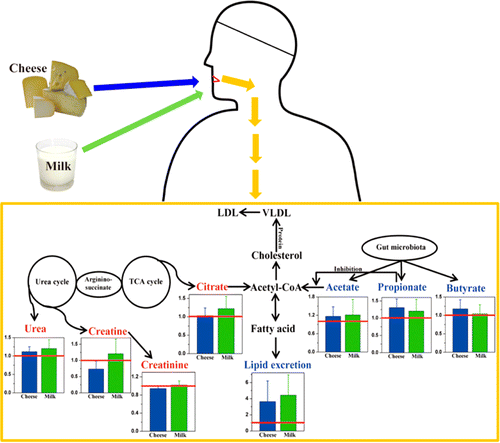
Though they are catching up nicely in obesity and heart disease rates now, historically the French have been something of a paradox; they drink a lot of booze, they eat a lot of cheese and they don't exercise, but they had lower cardiovascular disease rates than other countries despite all that. 

While nutritionists claimed dairy was making American people fat - it must be bad for our hearts because epidemiological papers put a curve of saturated fats next to a curve of heart disease - the French Paradox was quietly studied with much less mainstream media attention. Like with BPA, GMOs, vaccines, nuclear power, and human embryonic stem cells, the debate over saturated fats was more cultural than evidence-based, all the more reason for science to get involved.
Children who play a game together have a stronger connection than kids who play the same game but not in a synchronous way, according to a new paper. 

The authors assert that a physical activity performed in unison helps children feel more positively toward each other and could perhaps increase their empathy. 

"Synchrony is like a glue that brings people together -- it's a magical connector for people," said lead author Tal-Chen Rabinowitch, a postdoctoral fellow at the Institute for Learning&Brain Sciences at the University of Washington.


