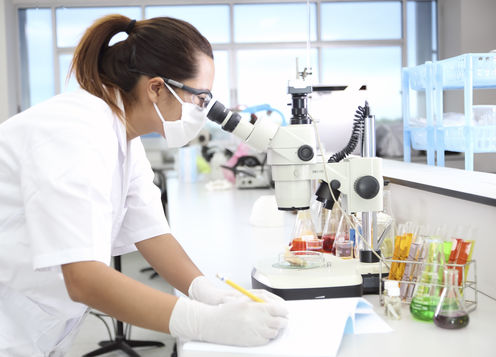







Science is considered a source of truth and the importance of its role in shaping modern society cannot be overstated. But in recent years science has entered a crisis of trust.

The results of many scientific experiments appear to be surprisingly hard to reproduce, while mistakes have highlighted flaws in the peer review system. This has hit scientific credibility and prompted researchers to create new measures in order to maintain the quality of academic research and its findings.

Particle physics is so cool - you get to build huge detectors with a specific goal clearly stated in your letter of intents and technical proposals, but are then allowed to use them to study many other things.

Clearing grasslands to make way for biofuels may seem counterproductive, but University of Wisconsin-Madison researchers show in a study today (April 2, 2015) that crops, including the corn and soy commonly used for biofuels, expanded onto 7 million acres of new land in the U.S. over a recent four-year period, replacing millions of acres of grasslands.

Is there any point to the World Health Organization (WHO) making a recommendation that 3 people out of 1,000 can achieve? If not, Americans won't take WHO seriously, and the British respect those guidelines even less. Only 1 in 1,000 in the UK can meet WHO's targets for potassium and sodium.

The World Health Organization recommends we consume no more than 2,000 mg of sodium a day - less than a teaspoon of salt - supposedly because of studies showing it impacts heart disease and stroke. And they recommend at least 3,510 mg of potassium daily, again to lower our odds of heart disease and stroke.

A new study of 311 childless Danish women initiating assisted reproduction using donor semen finds that single women seeking treatment are no different than cohabiting women seeking treatment when it comes to sociodemographic characteristics or attitudes toward motherhood

The authors used baseline data collection in a multicenter cohort study from alll nine public fertility clinics in Denmark to examine sociodemographic characteristics, family backgrounds, reproductive histories, and attitudes towards motherhood in single vs. cohabiting women seeking treatment with donor semen. 

If you ever thought your spouse makes your blood pressure go up, you now have a study to show it.

Sociological and epidemiological papers have long linked stress and negative marital quality to changes in mortality and blood pressure but there has not been much to show how those correlate to married couples over time. Using systolic blood pressure as a gauge, researchers assessed whether an individual’s blood pressure is influenced by their own as well as their partner’s reports of chronic stress and whether there are gender differences in these patterns.

Japan is famous for committing suicide - as many people kill themselves using rope as Americans, with a much larger population, do with guns - but they may have more accurate numbers than western countries, according to a new paper. 

In western countries, suicide or accident is determined by a coroner. When it's a drug overdose versus a suicide is subjective, only guns are sure to be consistently implicated in a suicide, because gun control is part of a control war, where no one is quite sure what to make of drugs.
A new paper links eating disorders in adolescent females with lower levels of educational attainment and personal income in early adulthood. They were also less likely to own a home.
Osteoporosis is a medical condition characterized by bones becoming brittle and fragile. Age-related loss in muscle mass and strength is considered analogous to osteoporosis but this “sarcopenia” is not recognized as a clinical condition even though it is linked to impaired physical function and contribute to disability, falls, and hospitalizations. Lower muscle mass and strength are also associated with lower bone mineral density and greater risk for osteoporotic fractures.

Why isn't sarcopenia more accepted? No valid diagnostic criteria whereas osteoporosis can be diagnosed based on widely accepted clinical standards.

An Australian Government report into the state of the Great Barrier Reef found that its condition in 2014 was "poor and expected to further deteriorate in the future". In the past 40 years, the Reef has lost more than half of its coral cover and there is growing concern about the future impacts of ocean acidification and climate change.

But science could restore the Great Barrier Reef to its former glory through better policies that focus on evidence-based policies, according to paper in Nature Climate Change. But all the stressors on the Reef need to be reduced for it to recover, so nothing is off the hook.


