



America has the luxury of being able to dash from one culture war to another, primarily because we are a wealthy country with plenty of food and medicine and energy, providing ample opportunity for people who have never lacked for any of those to be opposed to science related to food, medicine and energy, while others can claim pollution is our friend or worry about abstract ideas like the conflict between science and religion.
The annual Rethink Media conference was held yesterday at Birmingham City University to address the future of the digital landscape and the challenges facing the sector and, predictably, there was plenty of blame to go around, and assurances that the answers were simple - but as usual when panels get together to lament the future, no one was doing anything.

Schools got the brunt of the cultural shame and blame.

“Schools need to fix the fact that technology is not being made aspirational for females”, urged Talk Talk’s Head of Digital, Rahul Chakkara. “Half of the talent is being lost at school level.”

Whether you're baking bread or building an organism, the key to success is consistently adding ingredients in the correct order and in the right amounts, according to a new genetic study by University of Michigan researchers.

Using the baker's yeast Saccharomyces cerevisiae, Patricia Wittkopp and her colleagues developed a novel way to disentangle the effects of random genetic mutations and natural selection on the evolution of gene expression. Their findings are scheduled for online publication in the journal Nature on March 16.

When patients develop acute liver failure, severe complications arise rapidly after the first signs of liver disease, and patients' health can deteriorate rapidly. New research published in the American Journal of Transplantation indicates that emergency evaluations of living liver donors can be conducted safely to allow acute liver failure patients to undergo transplantation before their condition worsens.

Tumors acquiring resistance is one of the major barriers to successful cancer therapy. Feng Fu, Sebastian Bonhoeffer (ETH Zurich) and their collaborator Martin Nowak (Harvard) use mathematical models to characterize how important aspects of tumor microenvironment can impair the efficacy of targeted cancer therapies.

Failure of cancer therapy is commonly attributed to pre-existing resistant mutants already present prior to treatment. However, the research publishing this week in PLOS Computational Biology highlights the important role of tumor sanctuaries in the rapid acquisition of resistance.

Scientists at Albert Einstein College of Medicine of Yeshiva University and their international collaborators have developed a novel fluorescence microscopy technique that for the first time shows where and when proteins are produced. The technique allows researchers to directly observe individual messenger RNA molecules (mRNAs) as they are translated into proteins in living cells.

The technique, carried out in living human cells and fruit flies, should help reveal how irregularities in protein synthesis contribute to developmental abnormalities and human disease processes including those involved in Alzheimer's disease and other memory-related disorders.

ESA’s Rosetta spacecraft has made the first measurement of molecular nitrogen at a comet,  Comet 67P/Churyumov–Gerasimenko,  providing clues about the temperature environment in which it formed. 


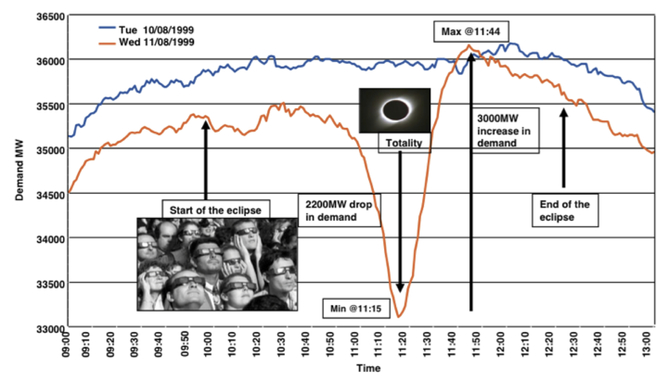
The solar eclipse due to cover much of Europe on March 20 will be the continent’s first for 16 years.

Back in 1999, as people stopped staring at the sun and got back on with their day they caused a power surge which still stands as a UK record – greater than anything after a football match or royal wedding.

A means by which the removal of carbon dioxide (CO2) from coal-fired power plants might one day be done far more efficiently and at far lower costs than today has been discovered by a team of researchers with the U.S. Department of Energy (DOE)'s Lawrence Berkeley National Laboratory (Berkeley Lab). By appending a diamine molecule to the sponge-like solid materials known as metal-organic-frameworks (MOFs), the researchers were able to more than triple the CO2-scrubbing capacity of the MOFs, while significantly reducing parasitic energy.

Among approximately 19,000 individuals, the use of aspirin and nonsteroidal anti-inflammatory drugs (NSAIDs) was associated with an overall lower risk of colorectal cancer, although this association differed according to certain genetic variations, according to a study in the March 17 issue of JAMA.

