



ARTICLE #1
New super-bouyant material: Life preserver might float a horse
ACS Applied Materials & Interfaces
Here's a story that might float your boat: Researchers in China are reporting the development of miniature super-bouyant boats that float so well that an ordinary life preserver made from the same material might support a horse without sinking. The advance, they say, might be difficult to apply to full-size craft. However, it could lead to a new generation of aquatic robots for spy missions and other futuristic devices, the scientists add. Their study is reported in ACS Applied Materials & Interfaces, a monthly journal.
In the new study, Qinmin Pan and Min Wang note that researchers have studied the chemistry of surfaces for years in an effort to design novel drag-reducing and fast-moving aquatic and air devices, such as boats and planes. Scientists have often turned to nature for inspiration. One source: The water strider, whose highly water-repellant (superhydrophobic) legs allow this insect to literally scoot across water surfaces at high speeds. But researchers still have not found a practical way to apply this phenomenon to technology.
Pan and Wang made several miniature boats about the size of a postage stamp. They used copper mesh treated with silver nitrate and other substances to make the boats' surfaces superhydrophobic. When compared to similar copper boats made without the novel surfaces, the water repellant boats floated more smoothly and also showed a surprisingly large loading capacity. The best performing mini-boat floated with up to two times its maximum projected loading-capacity, the scientists say. "Interestingly, the boat is able to keep floating even if its upper edges are below the water surface," the scientists note. - MTS
ARTICLE #1 FOR IMMEDIATE RELEASE
"Miniature Boats with Striking Loading Capacity Fabricated from Superhydrophobic Copper Meshes"
DOWNLOAD FULL TEXT ARTICLE: http://pubs.acs.org/stoken/presspac/presspac/full/10.1021/am800116d
CONTACT:
Qinmin Pan, Ph.D.
Harbin Institute of Technology
Harbin, People's Republic of China
Phone: 86-451-86413721
Fax: 86-451-86414661
Email: panqm@hit.edu.cn
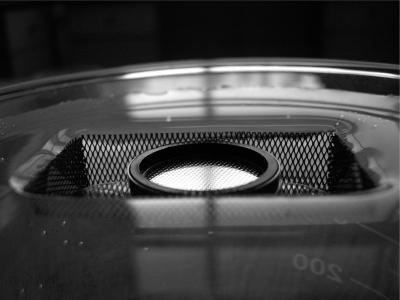
Scientists have developed miniature super-bouyant boats that could lead to aquatic robots and other futuristic devices.
(Photo Credit: The American Chemical Society)
ARTICLE #2 FOR IMMEDIATE RELEASE
First discovery of "animals-only" pigment bilirubin in plants
Journal of the American Chemical Society
In a first-of-its-kind discovery that overturns conventional wisdom, scientists in Florida are reporting that certain plants — including the exotic "White Bird of Paradise Tree" — make bilirubin. Until now, scientists thought that pigment existed only in animals. The finding may change scientific understanding of how the ability to make bilirubin evolved, they say in a report in the Journal of the American Chemical Society, a weekly publication.
In the new study, Cary Pirone and colleagues note that bilirubin is a brownish yellow substance resulting from the liver's breakdown of hemoglobin, the red pigment that carries oxygen in the blood. Parents know bilirubin as the stuff that discolors the skin of newborns with neonatal jaundice, sometimes requiring phototherapy, treatment with light. Bilirubin also gives a yellowish tinge to the skin of patients with jaundice resulting from liver disease. Until now, scientists never dreamed that plants, as well as animals, produce bilirubin.
The researchers used two powerful laboratory techniques, liquid chromatography and nuclear magnetic resonance, to detect bilirubin in fruit of the white bird of paradise tree. The fruits contain unusual, orange-colored, furry seeds, and bilirubin turns out to be the coloring agent. They also found the pigment in two closely related plant species. The discovery may stir evolutionary research to understand why and how plants make what everyone regarded as an animals-only pigment, they suggest. - MTS
ARTICLE #2 FOR IMMEDIATE RELEASE
"Animal Pigment Bilirubin Discovered in Plants"
DOWNLOAD FULL TEXT ARTICLE: http://pubs.acs.org/stoken/presspac/presspac/full/10.1021/ja809065g
CONTACT:
Cary Pirone, Ph.D.
Florida International University
Miami, Fla. 33199
Phone: 305-348-1453 or 305-348-3419
Fax: 305-348-1061
Email: cary.pirone@fiu.edu
ARTICLE #3
New technology for dating ancient rock paintings
Analytical Chemistry
A new dating method finally is allowing archaeologists to incorporate rock paintings — some of the most mysterious and personalized remnants of ancient cultures — into the tapestry of evidence used to study life in prehistoric times. That's the conclusion of a new report in ACS' Analytical Chemistry, a semi-monthly journal.
In the study, Marvin W. Rowe points out that rock paintings, or pictographs, are among the most difficult archaeological artifacts to date. They lack the high levels of organic material needed to assess a pictograph's age using radiocarbon dating, the standard archaeological technique for more than a half-century. Rowe describes a new, highly sensitive dating method, called accelerator mass spectrometry, that requires only 0.05 milligrams of carbon (the weight of 50 specks of dust). That's much less than the several grams of carbon needed with radiocarbon dating.
The research included analyzing pictographs from numerous countries over a span of 15 years. It validates the method and allows rock painting to join bones, pottery and other artifacts that tell secrets of ancient societies, Rowe said. "Because of the prior lack of methods for dating rock art, archaeologists had almost completely ignored it before the 1990s," he explained. "But with the ability to obtain reliable radiocarbon dates on pictographs, archaeologists have now begun to incorporate rock art into a broader study that includes other cultural remains." - JS
ARTICLE #3 FOR IMMEDIATE RELEASE
"Radiocarbon Dating of Ancient Rock Paintings"
DOWNLOAD FULL TEXT ARTICLE: http://pubs.acs.org/stoken/presspac/presspac/full/10.1021/ac802555g
CONTACT:
Marvin W. Rowe, Ph.D.
Texas A&M University
College Station, Tex.
Phone: 974-423-0018
Fax: 974-423-0060
Email: marvin.rowe@qatar.tamu.edu
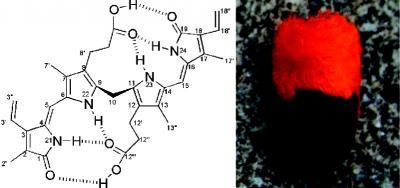
Scientists are reporting discovery of bilirubin in the white bird of paradise tree, the first example of this pigment in plants. Shown is the plant's furry seed which contains bilirubin.
(Photo Credit: The American Chemical Society)
ARTICLE #4
Record long platinum nanowires: An advance toward better fuel cells
Nano Letters
Researchers from New York are reporting production of the longest platinum nanowires ever made — an advance that they say could speed development of fuel cells for cars, trucks, and other everyday uses. The wires, 1/50,000 the width of a human hair, are thousands of times longer than any previously made, according to a report scheduled for the March 11 issue of ACS' monthly journal, Nano Letters.
In the article, James C. M. Li and colleagues point out that short platinum nanowires already have been used in sub-microscopic sensors and other applications. With platinum the primary material used in fuel cells (which generate electricity cleanly from hydrogen and oxygen), scientists have sought to produce long wires from this precious metal. Those wires could be woven into the first self-supporting webs of pure platinum for fuel cell electrodes.
By a process known as electrospinning, the team made platinum nanowires long enough to construct that web. "Our ultimate purpose is to make free-standing fuel cell catalysts from these nanowires. This technology is a key step toward better solutions," says Li. - AD
ARTICLE #4 FOR IMMEDIATE RELEASE
"Platinum Nanowires Produced by Electrospinning"
DOWNLOAD FULL TEXT ARTICLE: http://pubs.acs.org/stoken/presspac/presspac/full/10.1021/nl802910h
CONTACT:
James C. M. Li, Ph.D.
Department of Mechanical Engineering
University of Rochester
Rochester, N.Y. 14627
Phone: (585) 275-4038
Fax: (585) 256-2509
Email: li@me.rochester.edu
ARTICLE #5 EMBARGOED FOR 9 A.M., EASTERN TIME, March 16, 2009
Affordable medical tests for the developing world
Chemical & Engineering News
A new generation of simple, affordable medical diagnostic tests is heading toward the developing world where they may protect impoverished people from AIDS, tuberculosis, malaria and other infectious diseases. That's the message from an article on these simple medical diagnostics scheduled for the March 16 issue of Chemical & Engineering News, ACS' weekly newsmagazine.
C&EN senior editor Celia Henry Arnaud explains that scientists have designed the tests for the harsh realities that exist in much of the developing world. Those include lack of modern laboratory equipment, lack of refrigeration and unreliable sources of pure water. Many of the new tests require no instruments and can be read and interpreted by workers with minimal training. Some are multi-purpose, capable of diagnosing several infections simultaneously from a few drops of blood or urine, the article notes.
One new test, for example, can monitor levels of key immune system cells in patients infected with HIV, the cause of AIDS, and help determine when costly anti-viral therapy is needed. The tests may also be a boon for the developed world, making health care more affordable, the article suggests.
ARTICLE #5 EMBARGOED FOR 9 A.M., EASTERN TIME, March 16, 2009
"Making diagnostics affordable"
This story will be available on March 16 at
http://pubs.acs.org/cen/science/87/8711sci1.html
FOR ADVANCE INFORMATION, CONTACT:
Michael Bernstein
ACS News Service
Phone: 202-872-6042
Fax: 202-872-4370
Email: m_bernstein@acs.org
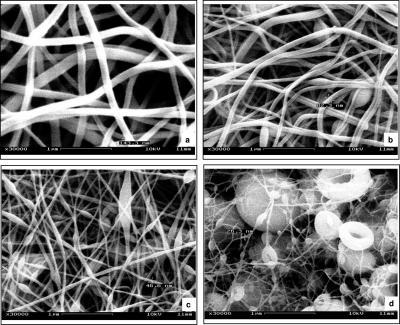
In an advance that could aid development of fuel cells, researchers are reporting the longest platinum nanowires ever made.
(Photo Credit: The American Chemical Society)


