
Banner
Object-Based Processing: Numbers Confuse How We Perceive Spaces

Researchers recently studied the relationship between numerical information in our vision, and...
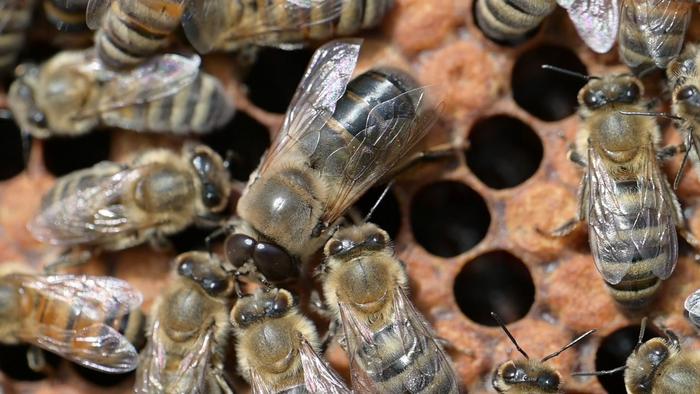
Males Are Genetically Wired To Beg Females For Food

Bees have the reputation of being incredibly organized and spending their days making sure our...

The Scorched Cherry Twig And Other Christmas Miracles Get A Science Look

Bleeding hosts and stigmatizations are the best-known medieval miracles but less known ones, like ...

$0.50 Pantoprazole For Stomach Bleeding In ICU Patients Could Save Families Thousands Of Dollars

The inexpensive medication pantoprazole prevents potentially serious stomach bleeding in critically...

User picture.
News StaffRSS Feed of this column.

News Releases From All Over The World, Right To You... Read More »

Blogroll

Scientists studying one of nature’s simplest organisms have helped to unravel the structure of a key molecule that controls pain in humans.

Chronic pain, unlike the acute pain associated with trauma, has no apparent physiological benefit, often being referred to as the ‘disease of pain’. Complete and lasting relief of chronic pain is rare and often the clinical goal is pain management through one or more medications.

But now researchers at The University of Manchester have examined microscopic amoeboid organisms commonly called slime moulds in a bid to gain greater insight into these pain molecules, known as ‘P2X receptors’.

Dr. Giovanna Tinetti ( read her interview with Scientific Blogging's Douglas Blane here ) of the European Space Agency and UCL’s Department of Physics & Astronomy has discovered that a planet passing in front of its ‘sun’ absorbs starlight in a way that can only be explained by the presence of water vapour in its atmosphere. This is the first time that astronomers have been able to confirm that water is present on an extra-solar planet.

‘Extra-solar’ planets are those outside our Solar System and more than 200 have been discovered orbiting stars close to our own Sun.

Indonesia’s Mount Gamkonora volcano is spewing hot ash and smoke into the air, as seen in this image taken by the MERIS instrument aboard ESA’s satellite Envisat, causing more than 8000 people to be evacuated amid fears of an imminent eruption, according to officials.

Officials raised the alert to the highest level on Tuesday after the volcano, located in the eastern province of North Maluku, started spitting out flaming material, indicating magma was approaching the crater’s surface making an eruption more likely, Saut Simatupang of Indonesia's Vulcanological Survey told Reuters news agency.

The 1635m volcano, located about 2400 km northeast of Jakarta, began releasing smoke and ash on Saturday and spewed it as high as 4000m on Monday.

A startling discovery on the development of human embryonic stem cells by scientists at McMaster University will change how future research in the area is done.

A study this week reports on a new understanding of the growth of human stem cells. It had been thought previously that stem cells are directly influenced by cells in the local environment or ‘niche’, but the situation may be more complex. Human embryonic stem cells are perpetual machines that generate fuel for life.

One year after the beginning of its scientific operations, the high-capability infrared satellite AKARI continues to produce stunning views of the infrared Universe.

Launched in February 2006, AKARI is making a comprehensive, multi-wavelength study of the sky in infrared light, helping to gain a deeper understanding of the formation and evolution of galaxies, stars and planetary systems. The mission is a Japan Aerospace Exploration Agency (JAXA) project with ESA and international participation.

In the course of last year, AKARI performed all-sky observations in six wavelength bands. More than 90 percent of the entire sky has so far been imaged.

Neutrophils are biological killers. These white blood cells patrol the body and guard against infection by bacteria and fungi, identifying and destroying any invaders that cross their path. But new evidence, which may lead to better drugs to fight deadly pathogens, indicates that neutrophils might actually distinguish among their targets.

A scientist has discovered that neutrophils recognize and respond to a specific form of sugar called beta-1,6-glucan on the surface of fungi. This sugar comprises just a small fraction of the fungal cell wall, much less than another sugar with a slightly different chemical conformation called beta-1,3-glucan.