Banner
Social Media Is A Faster Source For Unemployment Data Than Government

Government unemployment data today are what Nielsen TV ratings were decades ago - a flawed metric...

Gestational Diabetes Up 36% In The Last Decade - But Black Women Are Healthiest

Gestational diabetes, a form of glucose intolerance during pregnancy, occurs primarily in women...

Object-Based Processing: Numbers Confuse How We Perceive Spaces

Researchers recently studied the relationship between numerical information in our vision, and...

Males Are Genetically Wired To Beg Females For Food

Bees have the reputation of being incredibly organized and spending their days making sure our...

User picture.
News StaffRSS Feed of this column.

News Releases From All Over The World, Right To You... Read More »

Blogroll

“There is an enormous amount of interest in using meditation as a form of therapy to cope with a variety of modern-day health problems, especially hypertension, stress and chronic pain, but the majority of evidence that seems to support this notion is anecdotal, or it comes from poor quality studies,” say Maria Ospina and Kenneth Bond, researchers at the University of Alberta/Capital Health Evidence-based Practice Center in Edmonton, Canada.

In compiling their report, Ospina, Bond and their fellow researchers analyzed a mountain of medical and psychological literature—813 studies in all—looking at the impact of meditation on conditions such as hypertension, cardiovascular diseases and substance abuse.

A new paper published in Journal of the American Ceramic Society proposes a new method of producing hydrogen for portable fuel cells.

This new method negates the need for the complicated and expensive equipment currently used. With their ability to work steadily for 10-20 times the length of equivalently sized Lithium-ion batteries, portable fuel cells are ideal energy suppliers for devices such as computers, cell phones and hybrid vehicles.

A new article in The Journal of Law, Medicine and Ethics calls for a change in the regulations surrounding xenotransplantation, the transplanting of animal cells, tissues or organs into humans.

Although few xenotransplantation procedures have been done to this time, there appears to be a lack of awareness among potential xenotransplant patients about the risk of the procedures, and the required lifetime of infectious disease monitoring that come with it.

“When animal cells are transplanted into a human, there is always a risk of new diseases emerging, which is why the federal government requires that a recipient must always be monitored long-term,” says Dr. Monique Spillman, co-author of the study.

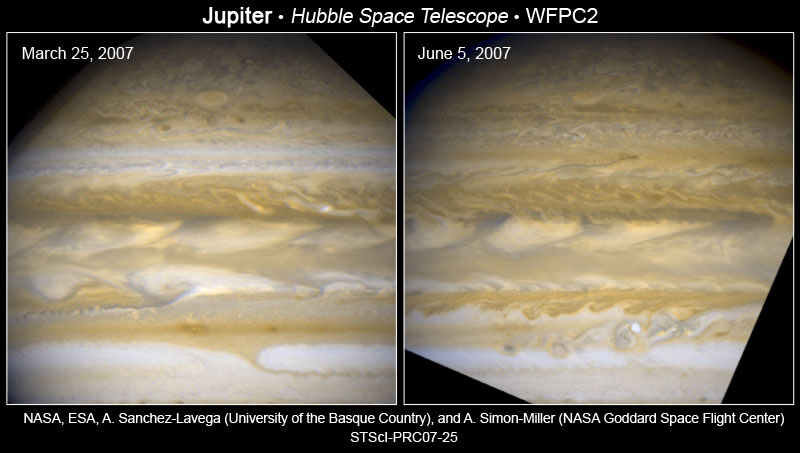
Massive Jupiter is undergoing dramatic atmospheric changes that have never been seen before with the keen "eye" of NASA's Hubble Space Telescope.

Jupiter's turbulent clouds are always changing as they encounter atmospheric disturbances while sweeping around the planet at hundreds of miles per hour. But these Hubble images reveal a rapid transformation in the shape and color of Jupiter's clouds near the equator, marking an entire face of the globe.

The semi-major axis of Jupiter's orbit about the sun is 483 million miles. The planet has a diameter of roughly 88,789 miles (142,984 km) at the equator.


NASA, ESA, A. Simon-Miller (NASA Goddard Space Flight Center), A. Sánchez-Lavega, R. Hueso, and S.

Juries across the country make decisions every day on the fate of defendants, ideally leading to prison sentences that fit the crime for the guilty and release for the innocent. Yet a new Northwestern University study shows that juries in criminal cases many times are getting it wrong.

In a set of 271 cases from four areas, juries gave wrong verdicts in at least one out of eight cases, according to “Estimating the Accuracy of Jury Verdicts,” a paper by a Northwestern University statistician that is being published in the July issue of Journal of Empirical Legal Studies.

The High Resolution Stereo Camera (HRSC) on board Mars Express has provided snapshots of the Aeolis Mensae region. This area, well known for its wind-eroded features, lies on a tectonic transition zone, characterised by incised valleys and unexplained linear features.

Illuminated by the Sun from the west (right side in the image), the pictures are of a ground resolution of approximately 13 metres per pixel. The region, imaged on 26 and 29 March 2007, during Mars Express orbits 4136 and 4247, is located at approximately 6° South and 145° East.