Banner
The Scorched Cherry Twig And Other Christmas Miracles Get A Science Look

Bleeding hosts and stigmatizations are the best-known medieval miracles but less known ones, like ...

$0.50 Pantoprazole For Stomach Bleeding In ICU Patients Could Save Families Thousands Of Dollars

The inexpensive medication pantoprazole prevents potentially serious stomach bleeding in critically...

Metformin Diabetes Drug Used Off-Label Also Reduces Irregular Heartbeats

Adults with atrial fibrillation (AFib) who are not diabetic but are overweight and took the diabetes...

Your Predator: Badlands Future - Optical Camouflage, Now Made By Bacteria

In the various 'Predator' films, the alien hunter can see across various spectra while enabling...

User picture.
News StaffRSS Feed of this column.

News Releases From All Over The World, Right To You... Read More »

Blogroll

A drug that shuts down a critical cell-signaling pathway in the most common and aggressive type of adult brain cancer successfully kills cancer stem cells thought to fuel tumor growth and help cancers evade drug and radiation therapy, a Johns Hopkins study shows.

In a series of laboratory and animal experiments, Johns Hopkins scientists blocked the signaling system, known as Hedgehog, with an experimental compound called cyclopamine to explore the blockade’s effect on cancer stem cells that populate glioblastoma multiforme. Cyclopamine has long been known to inhibit Hedgehog signaling.

Yes, last week science said Song Debunked: Breaking Up Actually Not So Hard To Do but it's a new week and this is a different study.

They use the same song example, though.

Dr. Bronwen Lichtenstein, UA assistant professor of criminal justice who specializes in women’s issues, recently completed a study of the health risks women over age 35 faced when they returned to the dating scene after the breakup of a long-term relationship.

Lichtenstein was investigating the theory that after an older woman leaves a long-term relationship she may make risky dating choices.

Health food is extremely popular in America yet obesity levels continue to rise. A new study in the Journal of Consumer Research explains that paradox.

It turns out that when consumers see a healthy choice, be it drinks, deserts or food, they end up consuming 131% more calories.

“In our black and white view, most food is good or not good,” explain Pierre Chandon (INSEAD, France) and Brian Wansink (Cornell University). “When we see a fast-food restaurant like Subway advertising its low-calorie sandwiches, we think, ‘It’s OK: I can eat a sandwich there and then have a high-calorie dessert,’ when, in fact, some Subway sandwiches contain more calories than a Big Mac.”

Weather conditions, including record summer temperatures and hot dry winds, have made parts of the Mediterranean, including Greece and southern Italy, a tinderbox, the United Nations Food and Agriculture Organization said.

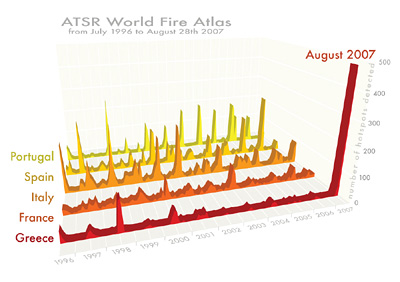
Greece has experienced more wildfire activity this August than other European countries have over the last decade, according to data from ESA satellites. The country is currently battling an outbreak of blazes, which began last Thursday, that have spread across the country killing more than 60 people.

The ATSR World Fire Atlas provides data approximately six hours after acquisition. All available satellite passes are processed to create the ATSR World Fire Atlas. In addition to maps, the time, date, longitude and latitude of the hot spots are provided.

Astronomers at the University of Rochester have discovered five Earth-oceans’ worth of water that has recently fallen into the planet-forming region around an extremely young, developing star.

Dan Watson, professor of physics and astronomy at the University of Rochester, believes he and his colleagues are the first to see a short-lived stage of protoplanetary disk formation, and the manner in which a planetary system’s supply of water arrives from the natal envelope within which its parent star originally formed.

The findings, published in today’s Nature, are the first-ever glimpse of material directly feeding a protoplanetary disk.


Artist's rendition of the forming system at IRAS4B. Credit: JPL/CalTech

Throughout Earth's history, 90,000 out of every 100,000 years have been ice ages - and it's been 12,000 years since the last one. You can thank global warming, it seems.

Future ice ages may be delayed by up to 500,000 years by greenhouse gas emissions from fossil fuels, according to recent work by Dr Toby Tyrrell of the University of Southampton.

If their numerical model is accurate, this sets a new standard for detailing the disruption of long-term planetary processes by human activity.