Banner
Social Media Is A Faster Source For Unemployment Data Than Government

Government unemployment data today are what Nielsen TV ratings were decades ago - a flawed metric...

Gestational Diabetes Up 36% In The Last Decade - But Black Women Are Healthiest

Gestational diabetes, a form of glucose intolerance during pregnancy, occurs primarily in women...

Object-Based Processing: Numbers Confuse How We Perceive Spaces

Researchers recently studied the relationship between numerical information in our vision, and...

Males Are Genetically Wired To Beg Females For Food

Bees have the reputation of being incredibly organized and spending their days making sure our...

User picture.
News StaffRSS Feed of this column.

News Releases From All Over The World, Right To You... Read More »

Blogroll

Many scientists assume people have sex for simple and straightforward reasons such as to experience sexual pleasure or to reproduce, but new research at The University of Texas at Austin reveals hundreds of varied and complex motivations that range from the spiritual to the vengeful.

After conducting one of the most comprehensive studies on why people have sex, psychology researchers David Buss and Cindy Meston uncovered 237 motivations, which appear in the August issue of Archives of Sexual Behavior.

Excavations of an underwater Stone Age archaeological settlement dating back 8000 years are taking place at the National Oceanography Centre, Southampton.

Maritime archaeologists from the Hampshire and Wight Trust for Maritime Archaeology (HWTMA) have been working at the site just off the Isle of Wight coast. Divers working at depths of 11 metres have raised sections of the seabed, which have been brought to the NOCS laboratories for excavation.

The ALMA (Atacama Large Millimeter/submillimeter Array) Project is a giant, international observatory currently in construction on the high-altitude Chajnantor site in Chile, and composed initially of 66 high-precision telescopes, operating at wavelengths of 0.3 to 9.6 mm.

ALMA will be the forefront instrument for studying the cool universe - the relic radiation of the Big Bang, and the molecular gas and dust that constitute the very building blocks of stars, planetary systems, galaxies, and life itself.

Because ALMA will observe in the millimetre and submillimetre wavelengths the atmosphere above the telescope must be transparent. This requires a site that is high and dry.

Cows are having a difficult month.

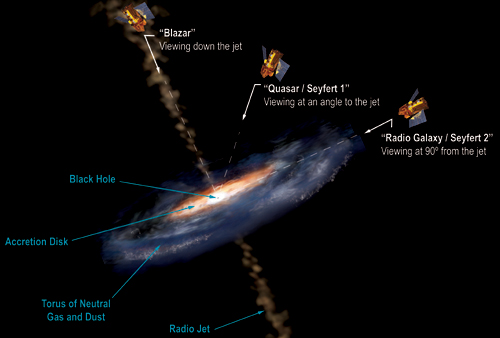
You’d think that astronomers would have found all the different classes of active galaxy nuclieu (AGN ) - after all, AGN such as quasars, blazars, and Seyfert galaxies are among the most luminous objects in our Universe, pouring out the energy of billions of stars from a region no larger than our solar system.

But a team has discovered that a relatively common class of AGN has escaped detection until now.

Scientists here have developed new dye-sensitized solar cells (DSSCs) that get their pink color from a mixture of red dye and white metal oxide powder in materials that capture light.

Currently, the best of these new pink materials convert light to electricity with only half the efficiency of commercially-available silicon-based solar cells -- but they do so at only one quarter of the cost, said Yiying Wu, assistant professor of chemistry at Ohio State.

And Wu is hoping for even better.

"We believe that one day, DSSC efficiency can reach levels comparable to any solar cell," he said. "The major advantage of DSSCs is that the cost is low. That is why DSSCs are so interesting to us, and so important."