Banner
Social Media Is A Faster Source For Unemployment Data Than Government

Government unemployment data today are what Nielsen TV ratings were decades ago - a flawed metric...

Gestational Diabetes Up 36% In The Last Decade - But Black Women Are Healthiest

Gestational diabetes, a form of glucose intolerance during pregnancy, occurs primarily in women...

Object-Based Processing: Numbers Confuse How We Perceive Spaces

Researchers recently studied the relationship between numerical information in our vision, and...

Males Are Genetically Wired To Beg Females For Food

Bees have the reputation of being incredibly organized and spending their days making sure our...

User picture.
News StaffRSS Feed of this column.

News Releases From All Over The World, Right To You... Read More »

Blogroll

A fat-derived protein known for its effects on the liver and skeletal muscle might also serve as an energy-conserving signal to the brain during periods of starvation, suggests a new study.

The substance, known as adiponectin, acts on the brain to boost appetite and slow energy expenditure in an effort to maintain adequate fat stores during lean times, the researchers report.

“Energy homeostasis may be mediated by both short-term regulators, such as gut hormones, and long-term regulators,” said Takashi Kadowaki of the University of Tokyo. “In this study, we identified, for the first time, a potential long-term regulator that allows energy to be stored efficiently, namely, adiponectin.”

Women don't just like men with muscles — they go for them.

Men who are more muscular than average are much more likely to have short-term affairs and multiple sex partners than their scrawnier peers, according to new UCLA research published in the August issue of the Personality and Social Psychology Bulletin.

"If you're trying to figure out why men — especially young men — spend so much time at the gym, here's your answer," said David Frederick, lead author and a UCLA doctoral candidate in psychology. "The stereotype is that men work out to compete with each other, but our research suggests that pumping iron is a way for men to enhance their attractiveness to women."

A multi-institutional consortium including Duke University has created startlingly crisp 3-D microscopic views of tiny mouse brains -- unveiled layer by layer -- by extending the capabilities of conventional magnetic resonance imaging.

"These images can be more than 100,000 times higher resolution than a clinical MRI scan," said G. Allan Johnson, Duke's Charles E. Putman Distinguished Professor of radiology and professor of biomedical engineering and physics.


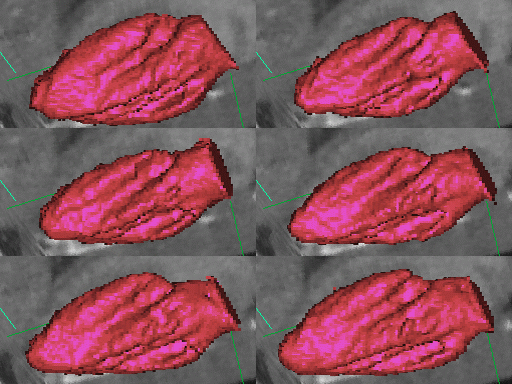
These animated micro-CT based images show the moving blood in the left ventricle (LV) of a mouse heart during one heartbeat. The temporal resolution is 10 ms and the spatial resolution is 100 microns on all axes.

Looking at the chemical composition of stars that host planets, astronomers have found that while dwarf stars often show iron enrichment on their surface, giant stars do not. The astronomers think that the planetary debris falling onto the outer layer of the star produces a detectable effect in a dwarf star, but this pollution is diluted by the giant star and mixed into its interior.

"It is a little bit like a Tiramisu or a Capuccino," says Luca Pasquini from ESO, lead-author of the paper reporting the results. "There is cocoa powder only on the top!'

Just a few years after the discovery of the first exoplanet it became evident that planets are preferentially found around stars that are enriched in iron.

Johns Hopkins researchers have added to the growing mound of evidence that many of the genetic bits and pieces that drive evolutionary changes do not confer any advantages or disadvantages to humans or other animals.

“For a long time, the basic belief of evolution was that all random genetic changes that manage to stick around have some selective advantage,” says Nicholas Katsanis, Ph.D., Associate Professor at Hopkins’ Institute of Genetic Medicine. “But our work adds to the case that frequently, we are what we are largely due to random changes that are completely neutral.”

By looking at temperature fluctuations and reduced agricultural production in eastern China's past, David Zhang from the University of Hong Kong and his colleagues say they can predict the geopolitics of global warming's future.

They found that warfare frequency in eastern China, and the southern part in particular, significantly correlated with temperature oscillations. Almost all peaks of warfare and dynastic changes coincided with cold phases.

Looking to the future and applying their findings, Zhang and colleagues suggest that shortages of essential resources, such as fresh water, agricultural land, energy sources and minerals may trigger more armed conflicts among human societies.