Banner
Pilot Study: Fibromyalgia Fatigue Improved By TENS Therapy

Fibromyalgia is the term for a poorly-understood condition where people experience pain and fatigue...

High Meat Consumption Linked To Lower Dementia Risk

Older people who eat large amounts of meat have a lower risk of dementia and cognitive decline...

Long Before The Inca Colonized Peru, Natives Had A Thriving Trade Network

A new DNA analysis reveals that long before the Incan Empire took over Peru, animals were...

Mesolithic People Had Meals With More Tradition Than You Thought

The common imagery of prehistoric people is either rooting through dirt for grubs and picking berries...

User picture.
News StaffRSS Feed of this column.

News Releases From All Over The World, Right To You... Read More »

Blogroll

The simultaneous effect of habitat fragmentation, overexploitation, and climate warming could accelerate the decline of populations and substantially increase their risk of extinction, a study published in the Proceedings of the Royal Society B has warned.


The viability of many marine and terrestrial species could be impaired due to interacting human activities that cause the loss of species' habitats, overexploitation of their populations and warming of their environments. Credit: Top left: John Veron from Corals of the World. Top right: Wolcott Henry/Marine Photobank, Bottom left: Steve Spring/Marine Photobank, Bottom right: NASA-GSFC/Marine Photobank

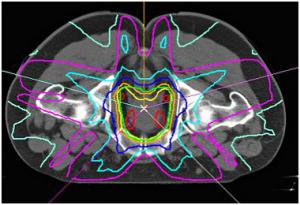
A new computer-based technique could eliminate hours of manual adjustment associated with a popular cancer treatment. In a paper published in the Feb. 7 issue of Physics in Medicine and Biology, researchers from Rensselaer Polytechnic Institute and Memorial Sloan-Kettering Cancer Center describe an approach that has the potential to automatically determine acceptable radiation plans in a matter of minutes, without compromising the quality of treatment.


Prostate CT: The automatic radiation planning algorithm results in beamlet intensities that produce equal-dose contours. The prostate (center) receives a high dose, while nearby tissue receives a low dose. (Credit: Rensselaer/Richard Radke)

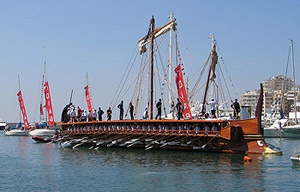
We may not be as fit as the people of ancient Athens, despite all that modern diet and training can provide, according to research by University of Leeds exercise physiologist, Dr Harry Rossiter.

Dr Rossiter measured the metabolic rates of modern athletes rowing a reconstruction of an Athenian trireme, a 37m long warship powered by 170 rowers seated in three tiers. Using portable metabolic analysers, he measured the energy consumption of a sample of the athletes powering the ship over a range of different speeds to estimate the efficiency of the human engine of the warship. The research is published in New Scientist today (February 8).


Trireme in a harbour. (Image courtesy of University of Leeds)

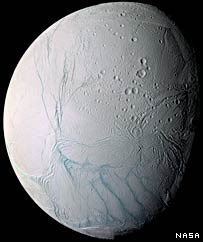
Astronomers from the University of Virginia and other institutions have found that Enceladus, the sixth-largest moon of Saturn, is a “cosmic graffiti artist,” pelting the surfaces of at least 11 other moons of Saturn with ice particles sprayed from its spewing surface geysers. This ice sandblasts the other moons, creating a reflective surface that makes them among the brightest bodies in the solar system (Enceladus, itself a ball of mostly ice, is the single most reflective body in our solar system).

“Enceladus’ art is a work-in-progress, constantly altering the surfaces of other moons orbiting within this moon’s beautiful swirl of ice particles,” said Anne Verbiscer, a research scientist in the astronomy department at the University of Virginia and the study’s lead investigator.

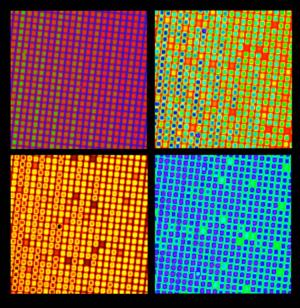
Physicists at the Commerce Department's National Institute of Standards and Technology (NIST) have taken the first ever two-dimensional pictures of a "frequency comb," providing extra information that enhances the comb's usefulness in optical atomic clocks, secure high-bandwidth communications, real-time chemical analysis, remote sensing, and the ultimate in precision control of atoms and molecules.


False-color images of the "fingerprints" of molecular iodine, each taken under different experimental conditions using a NIST frequency brush created with an ultrafast visible laser. The squares within each frame reveal the frequency and intensity of light from individual "bristles" of the brush.

Four million people die every year from respiratory diseases such as viral influenza. For elderly people in particular, an infection can be dangerous. What is more, the flu vaccine is not as effective with this risk group as it is with younger people. The reason for this is that with age the fire power of the immune system is reduced. Why this is the case is largely unknown. An international EU project led by the University of Bonn is now starting which aims at shedding light on this. Among other things, the researchers want to get a step closer to solving this riddle by examining tens of thousands of blood samples.