Banner
Pilot Study: Fibromyalgia Fatigue Improved By TENS Therapy

Fibromyalgia is the term for a poorly-understood condition where people experience pain and fatigue...

High Meat Consumption Linked To Lower Dementia Risk

Older people who eat large amounts of meat have a lower risk of dementia and cognitive decline...

Long Before The Inca Colonized Peru, Natives Had A Thriving Trade Network

A new DNA analysis reveals that long before the Incan Empire took over Peru, animals were...

Mesolithic People Had Meals With More Tradition Than You Thought

The common imagery of prehistoric people is either rooting through dirt for grubs and picking berries...

User picture.
News StaffRSS Feed of this column.

News Releases From All Over The World, Right To You... Read More »

Blogroll

Groundhogs and other hibernators take a very sensible approach to winter: They slip into a state of suspended animation and let the worst of the cold weather pass.

The cold prompts profound physiological changes in these animals, causing their normally fast metabolism to come almost to a stop during winter. With metabolism slowed to a crawl, the animal draws on its fat stores sparingly to make it through the winter.

Hibernation has become the focus of interesting physiological research. A hibernating squirrel's heart may fall from 300 beats per minute to just three per minute. Its oxygen consumption can drop to just 2% of normal.

Tricking a key enzyme can soothe over-excited receptors in the brain, say neuroscientists, calling this a possible strategy against stroke, Alzheimer's and other neurodegenerative diseases.

Lead author Michel Baudry of the University of Southern California, his graduate student Wei Xu and collaborators from the University of British Columbia outline their technique in the Feb. 1 issue of Neuron.

The researchers injected laboratory mice with a decoy peptide containing a snippet of a receptor that facilitates cell death in neurodegenerative diseases.

British Petroleum announced today that it has selected the University of California, Berkeley, in partnership with Lawrence Berkeley National Laboratory (LBNL) and the University of Illinois at Urbana-Champaign, to lead an unprecedented $500 million research effort to develop new sources of energy and reduce the impact of energy consumption on the environment.

The funding will create the Energy Biosciences Institute (EBI), which initially will focus its research on biotechnology to produce biofuels — that is, turning plants and plant materials, including corn, field waste, switchgrass and algae, into transportation fuels.

At a press conference this morning at UC Berkeley, Robert A. (Bob) Malone, chairman and president of BP America Inc., joined California Gov.

"Time" is the most popular noun in the English language, yet how would we tell time if we didn't have access to the plethora of watches, clocks and cell phones at our disposal?

For decades, scientists have believed that the brain possesses an internal clock that allows it to keep track of time. Now a UCLA study in the Feb. 1 edition of Neuron proposes a new model in which a series of physical changes to the brain's cells helps the organ to monitor the passage of time.


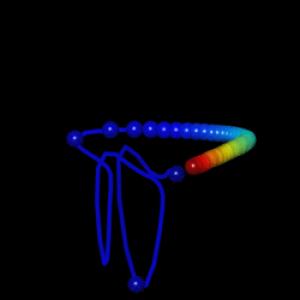
The changing colors reflect how a brain cell network evolves over time in response to stimuli. (Credit: Buonomano Lab)