
Banner
Social Media Is A Faster Source For Unemployment Data Than Government

Government unemployment data today are what Nielsen TV ratings were decades ago - a flawed metric...

Gestational Diabetes Up 36% In The Last Decade - But Black Women Are Healthiest

Gestational diabetes, a form of glucose intolerance during pregnancy, occurs primarily in women...

Object-Based Processing: Numbers Confuse How We Perceive Spaces

Researchers recently studied the relationship between numerical information in our vision, and...
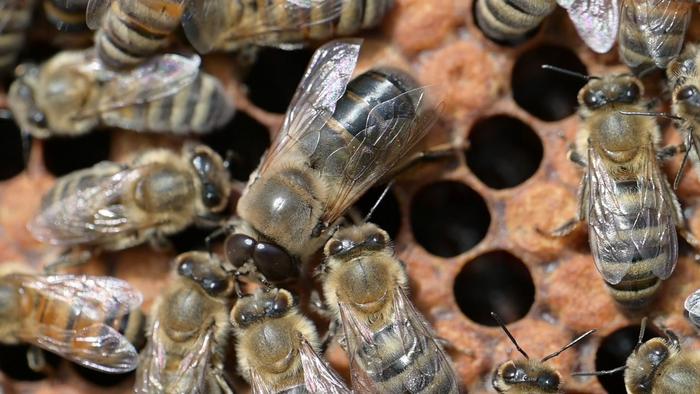
Males Are Genetically Wired To Beg Females For Food

Bees have the reputation of being incredibly organized and spending their days making sure our...

User picture.
News StaffRSS Feed of this column.

News Releases From All Over The World, Right To You... Read More »

Blogroll
Using ESO's Very Large Telescope, astronomers have gained new insights about the atmosphere of Pluto - (it's a dwarf now, get over it.)

What stands out?   Large amounts of methane in the atmosphere and it's hotter than the surface by about 40 degrees, though -180 degrees Celsius is still not the place for your interplanetary tropical vacation. These properties of Pluto's atmosphere may be due to the presence of pure methane patches or of a methane-rich layer covering the dwarf planet's surface.

pluto atmosphere
Astronomers using a telescope aboard the NASA Swift Satellite have captured information from the early stages of a gamma ray burst - the most violent and luminous explosions occurring in the Universe since the Big Bang.

Swift is able to both locate and point at gamma ray bursts (GRBs) far quicker than any other telescope, so by using its Ultraviolet/Optical Telescope (UVOT) the astronomers were able to obtain an ultraviolet spectrum of a GRB just 251 seconds after its onset - the earliest ever captured. Further use of the instrument in this way will allow them to calculate the distance and brightness of GRBs within a few hundred seconds of their initial outburst, and gather new information about the causes of bursts and the galaxies they originate from.
When Alan Pradel of the Muséum National d'Histoire Naturelle in Paris CAT scanned a 300-million-year-old fossilized iniopterygian from Kansas, he and his colleagues saw a symmetrical blob nestled within the braincase.

This turned out to be the oldest brain found in fossil form, a wholly unexpected and rare discovery.
A female moth selects a mate based on the scent of his pheromones. An analysis of the pheromones used by the European Corn Borer (ECB, Ostrinia nubilalis) shows that females can discern a male's ancestry, age and possibly reproductive fitness from the chemical cocktail he exudes.

Jean-Marc Lassance and Christer Löfstedt from Lund University, Sweden, studied the influence of pheromones on mating preferences and carried out an analysis of the composition of the scent and genetic makeup of the animals involved. In addition, they compared the odor bouquet used by males with the scent used by females to attract potential mates.

If you're about to invest in a lot of DVDs for your new baby, here's a way to save some money; they won't help.  Of course, there is some correlation/causation data to classical music but it's correlation/causation data because parents who listen to classical music and buy it for their kids tend to be better educated and care about their kids' education, which is reflected in more ways than just music.

Planetary geologists at Brown University have found a gully fan system on Mars that formed about 1.25 million years ago. The fan offers compelling evidence that it was formed by melt water that originated in nearby snow and ice deposits and may stand as the most recent period when water flowed on the planet.

Gullies are known to be young surface features on Mars. But scientists studying the planet have struggled with locating gullies they can conclusively date. In a paper that appears on the cover of the March issue of Geology, the Brown geologists were able to date the gully system and hypothesize what water was doing there.