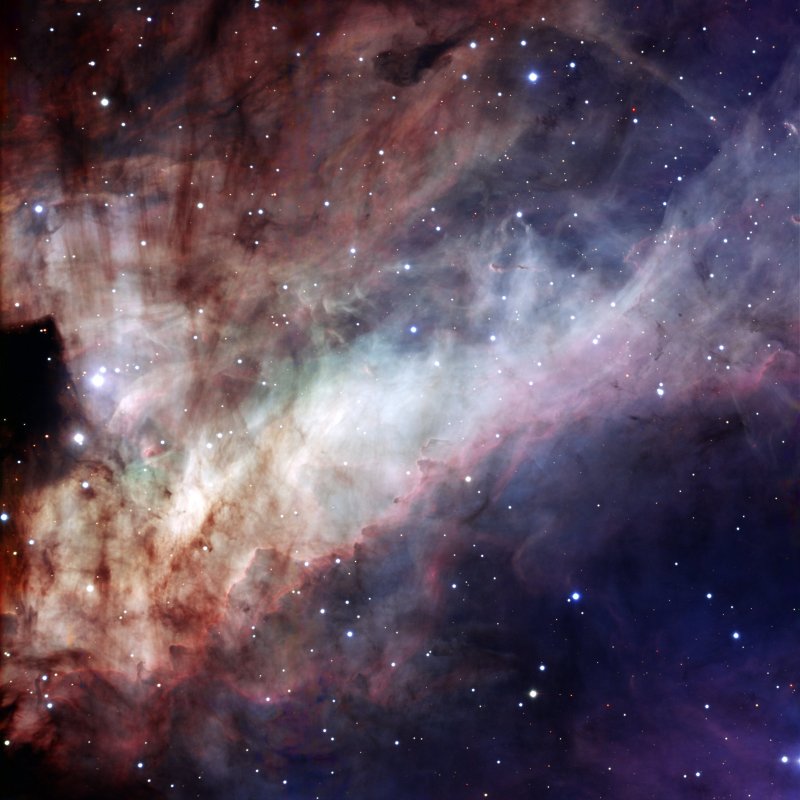
The Swan Nebula, also called the Omega Nebula because when seen through a small telescope the nebula has a shape that reminds some observers of the final letter of the Greek alphabet, omega, while others see a swan with its distinctive long, curved neck, is a dazzling stellar nursery located about 5500 light-years away towards the constellation of Sagittarius (the Archer).
Don't feel left out, lawn games and crustaceans, it is also called the Horseshoe and the Lobster Nebula.
No matter its name, it is an active star-forming region of gas and dust about 15 light-years across and has recently spawned a cluster of massive, hot stars. The intense light and strong winds from these hulking infants have carved remarkable filigree structures in the gas and dust.
The Young People's Development Programme (YPDP) in England, a government-backed youth development pilot program aimed at reducing teenage pregnancies, drunkenness and cannabis use not only didn't reduce teenage pregnancies or drunkenness or marijuana use, it might actually have increased pregnancies, according to research led by Meg Wiggins of the Institute of Education, University of London and Chris Bonell at the London School of Hygiene and Tropical Medicine.
They were commissioned by the Department of Health to carry out an independent evaluation of the YPDP, which was initiated in 2004.
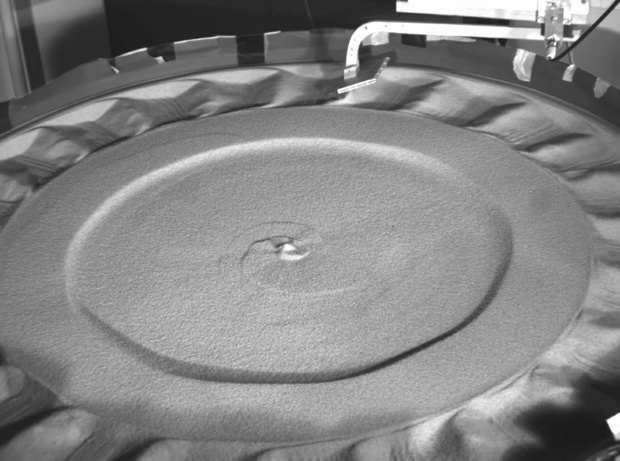
Any road with a loose surface like or gravel or snow can develop ripples that make driving a very shaky experience. A team of physicists from Canada, France and the United Kingdom have recreated this "washboard" phenomenon in the lab with surprising results: ripples appear even when the springy suspension of the car and the rolling shape of the wheel are eliminated. The discovery may smooth the way to designing improved suspension systems that eliminate the bumpy ride.
"The hopping of the wheel over the ripples turns out to be mathematically similar to skipping a stone over water," says University of Toronto physicist, Stephen Morris, a member of the research team.
The Amazon River has been around for 11 million years ago and in its shape for the last 2.4 million years ago, according to a study on two boreholes drilled in proximity of the mouth of the Amazon River by Petrobras, the national oil company of Brazil.
Until recently the Amazon Fan, a sediment column of around 10 kilometres in thickness, proved a hard nut to crack, and scientific drilling expeditions such as Ocean Drilling Program could only reach a fraction of it. Recent exploration efforts by Petrobras lifted the veil, and sedimentological and paleontological analysis on samples from two boreholes, one of which 4.5 kilometres below sea floor, now permit an insight into the history of both Amazon River and Fan.
In the 1980s, a popular hypothesis was that any number of people were suffering from trauma they knew nothing about; dissociative amnesia, or repressed memories.
At issue is how to prove whether memories of trauma, such as childhood sexual abuse, could be repressed and then resurface later in life. Overzealous therapists and willing victims led to any number of false allegations and the resulting damage to families can't be overstated. Even a hint of child abuse is guilt in the minds of many.
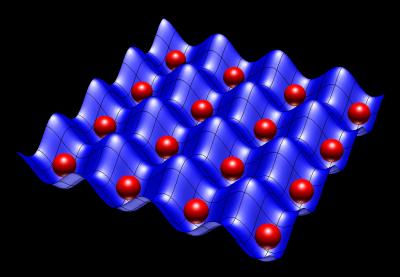
Physicists at the National Institute of Standards and Technology (NIST) have devised a viable way to manipulate a single 'bit' in a quantum processor without disturbing the information stored in its neighbors, using polarized light to create "effective" magnetic fields.
A great challenge in creating a working quantum computer is maintaining control over the carriers of information, the "switches" in a quantum processor while isolating them from the environment. These quantum bits, or "qubits," have the uncanny ability to exist in both "on" and "off" positions simultaneously, giving quantum computers the power to solve problems conventional computers find intractable – such as breaking complex cryptographic codes.


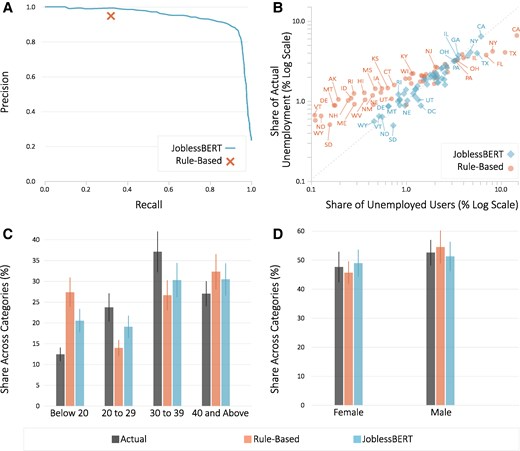 Social Media Is A Faster Source For Unemployment Data Than Government
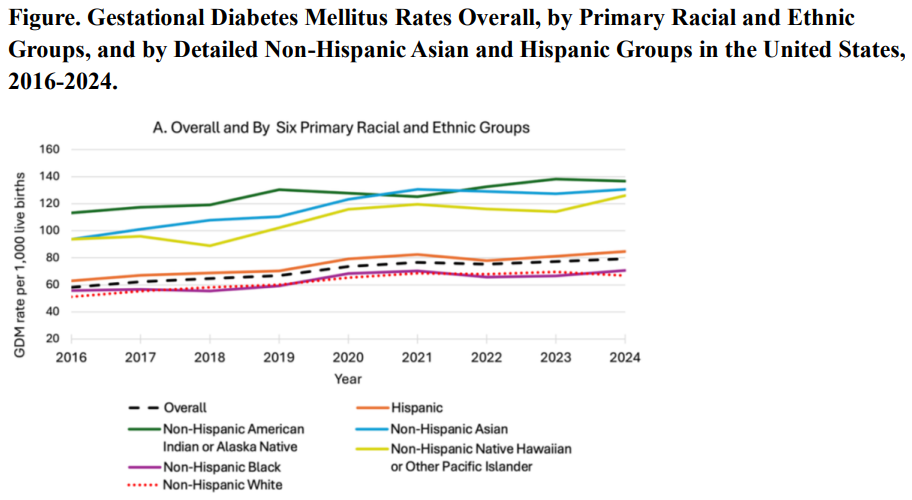 Gestational Diabetes Up 36% In The Last Decade - But Black Women Are Healthiest
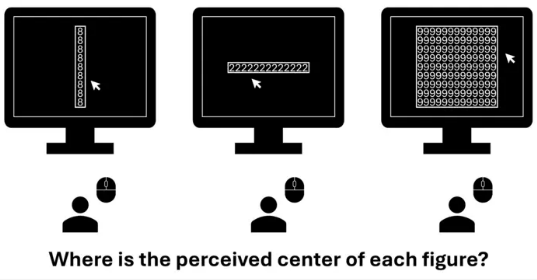 Object-Based Processing: Numbers Confuse How We Perceive Spaces
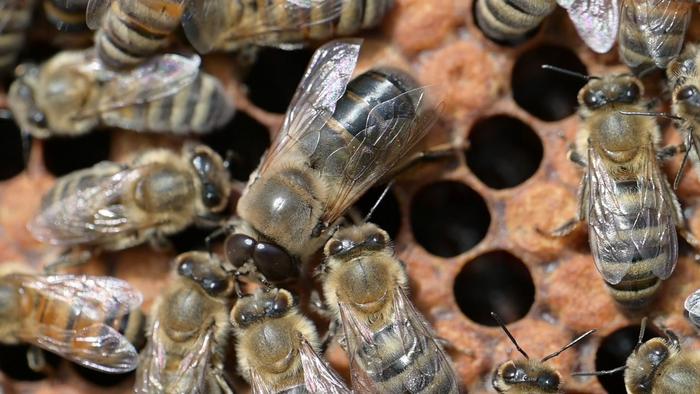 Males Are Genetically Wired To Beg Females For Food