Banner
Social Media Is A Faster Source For Unemployment Data Than Government

Government unemployment data today are what Nielsen TV ratings were decades ago - a flawed metric...

Gestational Diabetes Up 36% In The Last Decade - But Black Women Are Healthiest

Gestational diabetes, a form of glucose intolerance during pregnancy, occurs primarily in women...

Object-Based Processing: Numbers Confuse How We Perceive Spaces

Researchers recently studied the relationship between numerical information in our vision, and...

Males Are Genetically Wired To Beg Females For Food

Bees have the reputation of being incredibly organized and spending their days making sure our...

User picture.
News StaffRSS Feed of this column.

News Releases From All Over The World, Right To You... Read More »

Blogroll
Robots, lacking families and pensions, will rush into scenarios where humans fear to tread, like rescue missions following natural disasters.   So they need our support.  

RoboCup Rescue is a new effort to promote research and development in the field of rescue robotics. Robots for search and rescue missions, the efficient co-ordination of rescue services or decision-support systems are all the practical result of rescue robotics research. Two RoboCup leagues give an insight into digitally supported rescue possibilities: Rescue Simulation and Real Rescue.

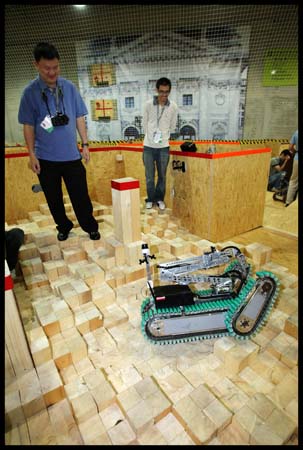
Rescue Robot RoboCup 2009
Rescue Robot at RoboCup 2009.  Photo: TU Graz
Six groups of scientists from the Departments of Biology and Chemistry at the University of York and the Astbury Centre for Structural and Molecular Biology, Faculty of Biological Sciences, at the University of Leeds have set out discover how a group of proteins that are highly effective at killing bacteria could hold the key to developing new types of antibiotics.

Researchers from the Universities of York and Leeds have been awarded £3.3m from the Biotechnology and Biological Sciences Research Council (BBSRC) to find out how a family of proteins known as colicins force their way into bacterial cells before destroying them.
Have a really smart kid who loves big trucks but you can't stand loud, growling voices with too much reverb in stadiums?   You're in luck.    MANTRA (The Manufacturing Technology Transporter) is a specially modified monster truck that is packed with the latest machinery and simulators rather than baseball caps and flannel shirts.

The 14 meter long MANTRA truck will take to the road with a dedicated team to demonstrate the manufacturing and assembly line technology of the future and help to inspire young people to take up careers in engineering.
Paperless office?  An optimistic pipe dream.    We use more paper documents than at any time in history despite the prevalence of the Internet and digital technology.    Part of the reason is lousy copy protection of scanned documents and storing them online.

But a new approach to archiving scanned documents that makes the text searchable and adds a watermark to images for copy protection and validation reported in the inaugural issue of the International Journal of Reasoning-based Intelligent Systems may herald some forward progress.
If you read internet science in 2006, you'd have thought former president George W. Bush's limitations of use of embryonic stem cell lines had killed science.  In reality, embryonic stem cell research only received $15 million in US funding when the restrictions were imposed and it grew to billions per year during his presidency so some of that rhetoric was designed simply to engage in cultural spin and mobilize votes for Democrats.

With a Democrat president and a bulletproof majority in the Senate, culturally-inclined science bloggers can now instead focus on religion and maybe the few Republicans still out there and the rest of us can tackle serious issues, like how to educate people on stem cell research so they can make informed policy decisions.
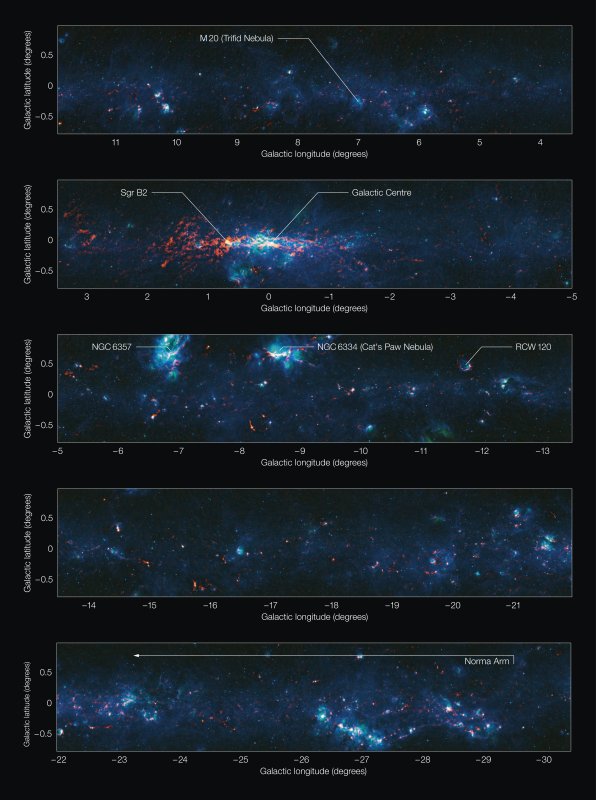
Astronomers have unveiled a new atlas of the inner regions of the Milky Way - that's our home galaxy, if you're from someplace else - and it's peppered with thousands of previously undiscovered dense knots of cold cosmic dust, the potential birthplaces of new stars. Using observations from the APEX telescope in Chile, this survey is the largest map of cold dust so far.

This new guide for astronomers, known as the APEX Telescope Large Area Survey of the Galaxy (ATLASGAL) shows the Milky Way in submillimetre-wavelength light (between infrared light and radio waves. Images of the cosmos at these wavelengths are vital for studying the birthplaces of new stars and the structure of the crowded galactic core.