Fake Banner
Does Stress Make Holidate Sex More Likely?

Desire to have a short-term companion for the holidays - a "holidate" - is common enough that it...

To Boomers, An AI Relationship Is Not Cheating

A recent survey by found that over 28 percent of adults claim they have an intimate, even romantic...

'The Operating Reality Has Changed' - Without Mandates, The Electric Car Market Is Collapsing

Ford is the latest company to take a massive write-off on current electric car production- nearly...

Berkeley STEM Teacher Peyrin Kao Criticized Israel - Was He Wrong To Get Suspended?

With criticism due to an overspending frenzy funded by student loan debt still in full swing, some...

User picture.
picture for Fred Phillipspicture for Tommaso Dorigopicture for picture for Patrick Lockerbypicture for Hontas Farmerpicture for Ilias Tyrovolas
Hank CampbellRSS Feed of this column.

I founded Science 2.0® in 2006 and since then it has become the world's largest independent science communications site, with over 300,000,000 direct readers and reach approaching one billion. Read More »

Blogroll

Albert Fert of Université Paris-Sud and Peter Grünberg of Forschungszentrum received the Nobel Prize in Physics for 2007 for their independent work on Giant Magnetoresistance (GMR), which basically blazed the trail for high-capacity storage devices in small form factors like MP3 players.

The Scientist.com takes on the American Chemical Society. Some of it is a little silly, discussing an anonymous email that implies the ACS hates open access and bonuses they pay executives are tied to that. No proof to that and TheScientist.com seems a little put out that executives make money on profitability. No kidding? They want to make money and expect executives with six figure incomes to do that? My only dealing with them was sort of ridiculous. An author did a pretty good article and we wanted to reprint it rather than condense it into a news article.

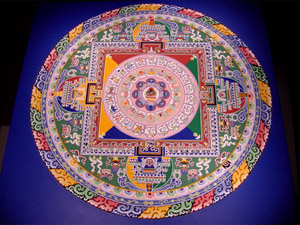
The Mandala is a detailed sand representation of the residence of the Medicine Buddha and one will be constructed by Tibetan monks over four days in Paris while simultaneously being displayed virtually in Second Life.

This confluence of technology and religion will get the message out about the situation in Burma, according to members of the Mind Science Institute and executives at a London think tank called Unfrozenmind, who have collaborated on the Second Life simulcast of the actual event.

Not everyone - okay, no one outside the Chinese government - is all that happy about things in Burma these days so they believe this will promote awareness of the situation there and aid Monks and Nuns of Burma in their efforts at independence.

'Social science' is not like the social sciences - economics, psychology, etc. - rather it's a mix of science and 'social news.' We're in the social news business but a niche part of it. We stick to science yet we're social news because a great part of the content is decided by you: you write it, you read it and your interest in specific articles is what decides the content on the main page. The more people that like an article and comment on it, the higher up it appears on our site.

Web 2.0, Science 2.0, whatever we call it, it's catching on. From the beginning of our private beta in February until now we have gone from no readers to hundreds of thousands per month.

Shelley Batts at Retrospectacle, one of my favorite science writers that, ummmm, isn't writing here ( sorry folks - we can't have all the good ones ) is in the running for a $10,000 student blogging scholarship. Yep, someone will give up $10K for great writing. Okay, not really, it's a popularity contest. But she deserves it for the great writing. So go vote for her at: http://www.collegescholarships.org/blog/2007/10/08/vote-for-the-winner-of-the-2007-blogging-scholarship/
I found this blog by Jim Till at the University of Toronto. He's a big fan of open access and, of course, we are too. Check him out.