Fake Banner
Enrico Stomeo - A Lifelong Passion For Meteor Studies

I was reached this evening by the news of the passing of a dear friend, Enrico Stomeo. Enrico was...

Surviving Queues: 1 - At The Airport

Nobody likes to wait in line. Whether you are sitting in your car waiting to reach the toll booths...

Choosing Your Bets: The Selection Bias

As some of the long-time readers of this blog know, in this column I have occasionally discussed...

Have A Master In Science, Want A Post-Doc Position Directly?

Do you have a master in Science, and want to start a Post-Doc position directly? You can have it...

User picture.
picture for Hank Campbellpicture for Heidi Hendersonpicture for Patrick Lockerbypicture for Bente Lilja Byepicture for Sascha Vongehrpicture for Johannes Koelman
Tommaso DorigoRSS Feed of this column.

Tommaso Dorigo is an experimental particle physicist, who works for the INFN at the University of Padova, and collaborates with the CMS and the SWGO experiments. He is the president of the Read More »

Blogroll
As a 20-year-long (ok well, 19) member of the CDF collaboration, I am very proud of this wonderful experiments' accomplishments in all areas of high-energy physics, from exotic searches to Higgs searches, from top quark measurements to b-physics measurements, and what not. CDF is a landmark in experimental physics, and the longest-lasting physics experiment ever. But it is not foulproof - nobody is in this wild world of statistical flukes and impossible-to-unearth systematic effects.
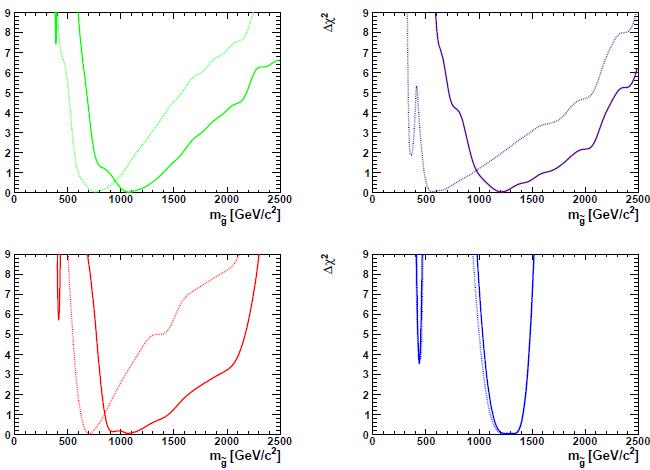
While experimentalists gathered in Grenoble present the latest results on High-Energy Physics searches and measurements, phenomenologists like Sven Heinemeyer are working 24/7 to update the picture of the breathing space left for Supersymmetry, in the light of the most recent searches.

You of course do not need to be reminded that Supersymmetry is not a theory but a framework, within which a host of possible manifestations of subnuclear physics are configurable based on the value of 120-or-so free parameters. Because of that, if one wants to discuss in detail what are the most likely versions of SUSY left on the table, and what is the value of the most representative and critical theory parameters, one needs more than paper and pencil.
In the last few days I described in some detail (here and here) the six searches for the Standard Model Higgs boson just produced by CMS, the experiment at the CERN Large Hadron Collider to which I proudly belong.
In my short summary of analyses recently published by CMS, yesterday I left out one which had not yet been released. It is the search for the "golden channel" of Higgs decay, the one which motivated the construction of detectors with large acceptance to energetic leptons: the decay to two Z bosons, with a subsequent decay of the Z's to two charged leptons each.
An orgy of new results has started. Let me just show a few of them concerning Higgs searches in CMS - I am on vacation after all, and I have little time left to comment these interesting new papers and plots after all the sunbathing and restaurants.

Let us start with the Higgs search in the diphoton decay mode by CMS (paper here). With 1.09 inverse femtobarns of data, CMS has a pretty good reach even to this very rare decay mode of the Higgs boson. Let me remind you that only a handful every thousand Higgs particles decay into two photons, in the most favourable circumstances.
Impressive. If you had been seeking for top quarks in 4-inverse-picobarns datasets since 1992 as I have, and then rejoiced at the 7-event signal from which CDF extracted in 1994 mass and cross section of the long-sought sixth quark, you would now also be looking for adjectives upon having a look at the figures in the new CMS paper, which uses over one inverse femtobarn of proton-proton collisions to measure the tiny asymmetric kinematics of top quark pairs produced at the LHC.