Fake Banner
Enrico Stomeo - A Lifelong Passion For Meteor Studies

I was reached this evening by the news of the passing of a dear friend, Enrico Stomeo. Enrico was...

Surviving Queues: 1 - At The Airport

Nobody likes to wait in line. Whether you are sitting in your car waiting to reach the toll booths...

Choosing Your Bets: The Selection Bias

As some of the long-time readers of this blog know, in this column I have occasionally discussed...

Have A Master In Science, Want A Post-Doc Position Directly?

Do you have a master in Science, and want to start a Post-Doc position directly? You can have it...

User picture.
picture for Hank Campbellpicture for Heidi Hendersonpicture for Patrick Lockerbypicture for Bente Lilja Byepicture for Sascha Vongehrpicture for Johannes Koelman
Tommaso DorigoRSS Feed of this column.

Tommaso Dorigo is an experimental particle physicist, who works for the INFN at the University of Padova, and collaborates with the CMS and the SWGO experiments. He is the president of the Read More »

Blogroll
A paper describing the first evidence of top pair production in association with a energetic photon has just appeared on the Cornell Arxiv. This search has been performed by the CDF collaboration in a sample of 6 inverse femtobarns of proton-antiproton collisions.

There is nothing strange or particular about the fact that any hard production process at a hadron collider can produce, in addition with a massive state such as a top pair, additional energetic photons. That is because any charged particle involved in the process will have a small but finite chance of radiating electromagnetic energy, with a strength governed by our good-old fine-structure constant.
The ATLAS Collaboration, one of the two high-energy physics experiments at the CERN Large Hadron Collider, has just produced updated results of their ongoing search for new heavy particles decaying into lepton pairs. They are now using up to 236 inverse picobarns of 7 TeV collisions, which is seven times more data than previous searches based on 2010 datasets. A seven-fold increase in data size grants a significant increase in sensitivity, so it is worth taking a look at what they see.
New results from the T2K collaboration have been presented at a KEK Physics Seminar today, and they are really interesting stuff. In a nutshell, six electron neutrino events have been seen by their far detector, illuminated by a pure and intense beam of muon neutrinos. The estimated backgrounds from non-oscillating-neutrino sources are estimated to amount to 1.5+-0.3 events, and the observed counts thus constitute a 2.5-standard-deviation effect, hopefully a first hint of direct detection of nu_mu -> nu_e oscillations.
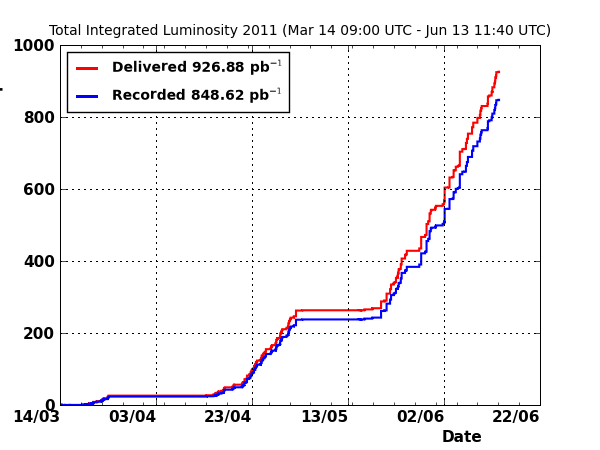
The LHC has been running very well in the last few weeks, and I can announce, with some anticipation, that the 1-inverse-femtobarn line will be crossed in the next few days. Check it out in the figure below, which shows, together with the delivered luminosity (red line), the one acquired by the CMS experiment (that is, the part acquired with CMS fully operational).

The total bounty available before the next shutdown (end of June) is probably going to amount to 1.3-1.4/fb. Expect exciting new results by ATLAS and CMS for the summer 2011 conferences!
CMS has recently produced an updated search for black hole production in the 7 TeV proton-proton collisions delivered by the LHC. The data sample now consists of 190 inverse picobarns of collisions collected in 2011, and the limits set on black hole production are more stringent.
And here they come. Much awaited (and anticipated), today the DZERO collaboration presents their findings in the search of the same dijet resonance which made it to the New York Times as well as to several physics blogs around the web, and which brought frantic theorists back to the blackboard to try and figure out a model that could allocate the cumbersome new find.