Fake Banner
Enrico Stomeo - A Lifelong Passion For Meteor Studies

I was reached this evening by the news of the passing of a dear friend, Enrico Stomeo. Enrico was...

Surviving Queues: 1 - At The Airport

Nobody likes to wait in line. Whether you are sitting in your car waiting to reach the toll booths...

Choosing Your Bets: The Selection Bias

As some of the long-time readers of this blog know, in this column I have occasionally discussed...

Have A Master In Science, Want A Post-Doc Position Directly?

Do you have a master in Science, and want to start a Post-Doc position directly? You can have it...

User picture.
picture for Hank Campbellpicture for Heidi Hendersonpicture for Patrick Lockerbypicture for Bente Lilja Byepicture for Sascha Vongehrpicture for Johannes Koelman
Tommaso DorigoRSS Feed of this column.

Tommaso Dorigo is an experimental particle physicist, who works for the INFN at the University of Padova, and collaborates with the CMS and the SWGO experiments. He is the president of the Read More »

Blogroll
I was unaware of the following story, which was brought to my attention by Monica Pepe-Altarelli yesterday. Since I totally agree that nobody should be detained without proof of guilt for long periods of time, and since we are talking of a physicist, I am glad to broadcast the story here.
The presentation of data is a very rich subject, on which there is a whole lot to discuss, even by restricting to the issues relevant to our dear field of experimental high-energy physics. Usually too little thought is given to it, even by expert researchers, so I thought that maybe today I would offer here some ideas on one very basic issue, the one of how to choose the width of the bins of a histogram.
The measurement of the production rate of top quark pairs at the Tevatron is by now a very well developed technology, where it is hard to invent anything new. Eight years ago, however, there was still the chance to develop new techniques and explore new land.
Okay, the riddle I posted two days ago  was indeed solved by theorists - albeit ones with good internet connections and smart search engines.

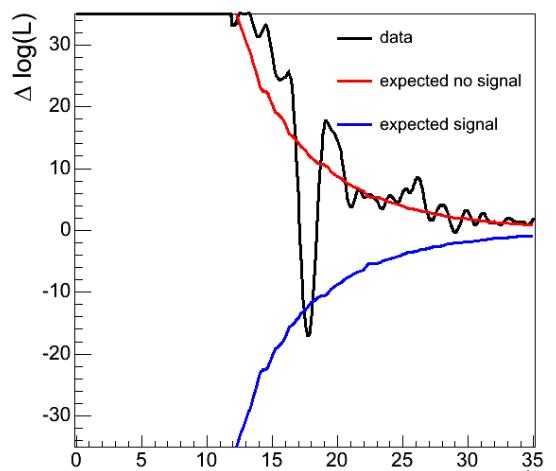
The figure, pasted below for your convenience, is from the CDF collaboration, and it refers to a "famous" analysis - one of the few important measurements for which Run II at the Tevatron was considered a good idea (thank god that one sold with the funding agencies, because there were sooo many others that eventually paid off!).


In a display of nonchalance that should teach us a thing or two, the ATLAS collaboration has put an end to the Easter Higgs Rumour (EHR), which brought the blogosphere in an excited state for at least a week, and experimentalists and theorists for even more time. They did so by publishing a very narrow-focused document, totaling less than five pages, where they discuss the backgrounds to Higgs boson decays in the diphoton final state.
My attempt at stimulating your curiosity with a scientific graph last time worked quite well, and I want to try it again. This time, however, you should not consider yourself eligible to participate if you are an experimental particle physicist (or in the process of becoming one). That's because I want to "lower the bar" a little, allowing non-experts in the game, and an experimentalist in HEP should recognize what this figure is quite easily. If you are a theorist, I am not sure -today's plot might be instantaneous for you to recognize, or not easy, depending on what you work on. I'll take Lubos as a testing ground. Lubos ?