One of the reasons why I love my job as a researcher in experimental physics is that every day brings along a new problem to solve, and through decades of practice I have become quick at solving them, so I typically enjoy doing it. And it does not matter whether the problem at hand is an entirely new, challenging one or a textbook thing that has been solved a million times before. It is your problem, and it deserves your attention and dedication.
In
the previous post I mentioned a research project that I was about to conclude, centered on the detection of anomalies in multidimensional data. Here I would like to give some more detail of that research, as the article I wrote on the subject is now
publically accessible in the Cornell preprint arXiv (and is being sent to a refereed journal).
Usually, when we talk about our research we discuss things we have recently published, highlighting the importance or novelty of their contribution to the advancement of human understanding or knowledge of the specific field of Science we work on.
So it is only normal for me to try and go against that particular cliché here, and talk about things I will publish in the future. Admittedly, it is a bit of a mine field (it is never easy to be an anticonformist), but I will try to avoid stepping on the most obvious triggers (violations of confidentiality, scooping risks, impossible promises).
1. A new tool for anomaly detection
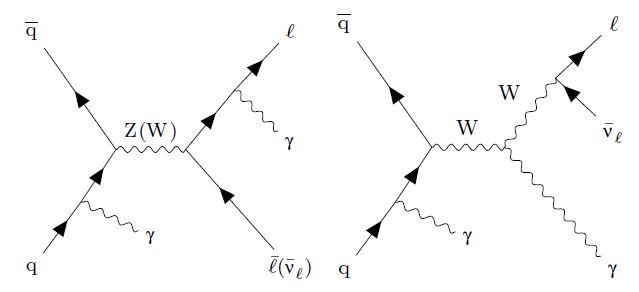
The CMS Collaboration submitted for publication last week a nice new result, where proton-proton collisions data collected by the experiment during the past run of the Large Hadron Collider were scanned in search of very peculiar events featuring a weak boson (W or Z) along with two energetic photons. The rate of these rare processes was measured and found in good agreement with predictions of the Standard Model of particle physics.
The title of this post coincides with the one of a scientific report which was submitted for publication in Reviews in Physics last Sunday; and it is also the meaning of the acronym
"AMVA4NewPhysics", the name of an European Union-funded Innovative Training Network I directed as scientific coordinator from 2015 to 2019.
Quantum Mechanics (QM), the theory that describes the behaviour of matter at microscopic distance scales apparently unfathomable by our senses, is very hard to understand and make sense of. And indeed to this day, 100 years after its first formulation, there are thick debates among theorists on the very meaning and interpretation of the wave function, which is the mathematical description of a quantum system. Yet we deeply rely on QM to figure out the organization of matter at molecular, atomic, and subatomic level. It works, despite the open questions. And today we deeply rely on QM for our technology.


 Enrico Stomeo - A Lifelong Passion For Meteor Studies
 Surviving Queues: 1 - At The Airport
 Choosing Your Bets: The Selection Bias