For some reason today I remembered that 11 years ago (wow time flies) I wrote a two-parts piece on advices for PhD students doing a thesis in experimental particle physics. As I checked it out, I found that I mostly share the views I had back then (TBH that's not necessarily a good thing - consistency requires you to be as ignorant as you were earlier on). Since I think that stuff I posted over 10 years ago are otherwise lost in oblivion and not picked up by generic google searches, I decided it is time to recycle that text - here it is below, unamended but collated into a single longish article. Enjoy!
Particle Physics deals with the study of the elementary constituents of matter, and the interactions that they withstand. When non-insiders hear of elementary particles and the experiments that study them, probably their mind goes to experiments at the Large Hadron Collider, CERN's giant accelerator of protons and heavy ions that produced the collisions used by the ATLAS and CMS experiments in 2012 to discover the Higgs boson. The association with LHC and the Higgs particle is very likely because that discovery took the media by storm when it was announced, and rightly so.
W bosons, what are they? To answer this question, let me first tell you that our world is made of matter held together by forces. If you look deep within, you will realize that matter is essentially constituted by "fermions": quarks and leptons, particles that possess a half-integer unit of spin, in a certain meaningful system of measurement units. Forces, on the other hand, are the result of fermions exchanging different particles called "bosons", particles that possess integer units of spin.
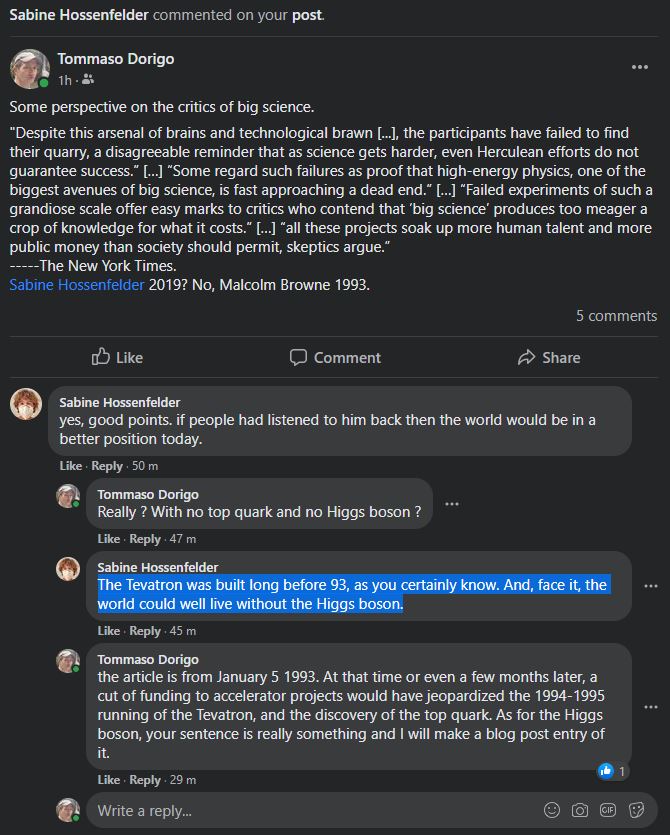
"Anti-scientific thinking" is a bad disease of our time, and one which may affect a wide range of human beings, from illiterate fanatics such as anti-vaxxers and religious fundamentalists on one side, to highly-educated and brilliant individuals on the other side. It is a sad realization to see how diversified and strong has become this general attitude of denying the usefulness of scientific progress and research, especially in a world where science is behind every good thing you use in your daily life, from the internet to your cell-phone, or from anti-cavity toothpaste to hadron therapy against tumours.
As every other aspect of human life, science communication has suffered a significant setback due to the ongoing Covid-19-induced pandemic. While regular meetings of scientific teams can be effectively held online, through zoom or skype, it is the big conferences that are suffering the biggest blow. And this is not good, for several reasons.


 Enrico Stomeo - A Lifelong Passion For Meteor Studies
 Surviving Queues: 1 - At The Airport
 Choosing Your Bets: The Selection Bias