I was notified today that within three weeks I am due to write a proceedings article for the "
Physics in Collision" conference I attended in Kobe two weeks ago. The task is not too stimulating for me, given that the material it has to cover just consists in projections of the discovery reach of the Higgs boson, based on simulated data; but to add unexcitement to the whole thing, I found out that I am bound to stay within the limit of
two pages of text.
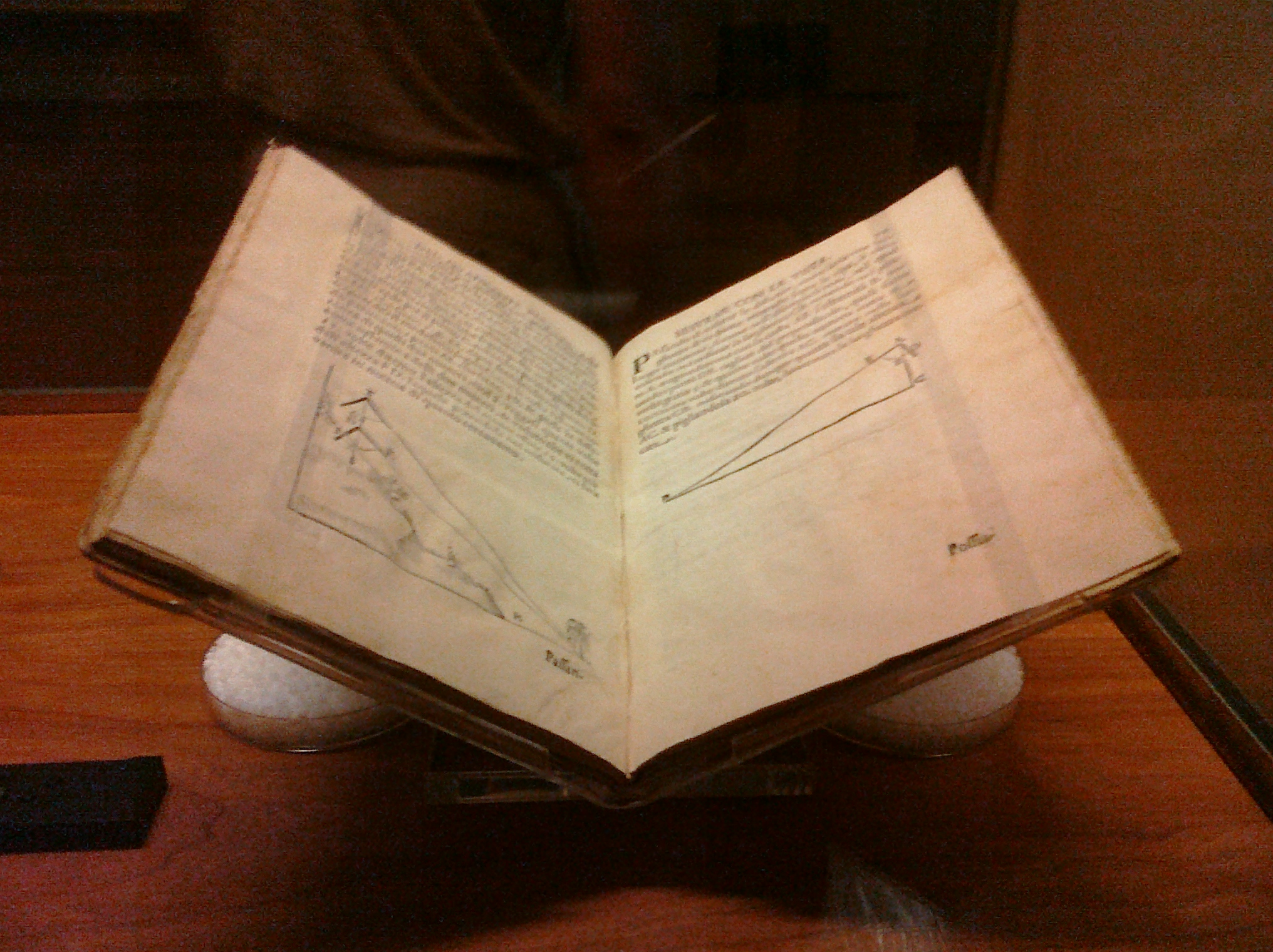
Galileo's contributions to science in general, and optics and astronomy in particular, were so monumental that over 350 years later we still discuss them in introductory physics courses.
Planck, a European-US collaborative mission launched by ESA, has provided its first pictures.
Planck is a followup to WMAP, and looks at the cosmic microwave background. But it has a host of other detectors and purposes, too. Stealing blatently from
Wikipedia, Planck will do:
- High resolution detections of both the total intensity and polarization of the primordial CMB anisotropies
- Creation of a catalogue of galaxy clusters through the Sunyaev-Zel'dovich effect
- Observations of the gravitational lensing of the CMB, as well as the integrated Sachs-Wolfe effect
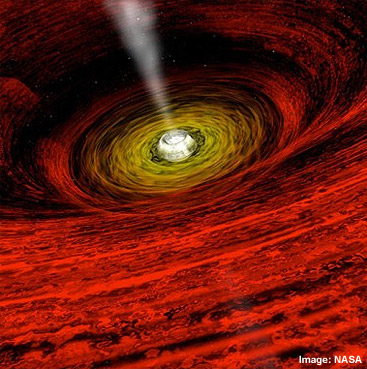
Black holes are invading stars, according to a new hyposthesis for the origin of the bright flashes in the universe that are one of the biggest mysteries in astronomy today.
Those flashes, known as
gamma ray bursts, are beams of high energy radiation produced by jets of plasma from massive dying stars. The current model for these cosmic 'jet engines' involves plasma being heated by neutrinos in a disk of matter that forms around a black hole, which is created when a star collapses.
Meteorites discovered with known orbits are incredibly rare but researchers using cameras which capture fireballs streaking across the night sky have managed to find not only a tiny meteorite on the vast Nullarbor Plain, but also mathematically determine its orbit and the asteroid it came from.
The ability to track meteorites back to their asteroid home also means it is an incredibly cheap way of sampling that asteroid, rather than conducting an expensive space mission.
To find the meteorite, the team deployed three 'all sky cameras' on the Nullarbor Plain to form a fireball camera network. The cameras take a single time lapse picture of the sky throughout the entire night to record any fireballs over the Plain.
Freedom of the press is integral to a functioning democracy and respect for human rights, it is said, and a new study tackles the effects of media freedom in countries that lack democratic institutions like fair elections.
The findings? By itself, freedom of the press doesn't accomplish much. Media freedom in the absence of other institutional outlets for dissent is actually associated with greater oppression of human rights, Jenifer Whitten-Woodring, a doctoral candidate in political science and international relations at USC, found utilizing data from 93 countries for the years 1981-1995.
Galileo Galilei wasn't just an Italian physicist, mathematician, astronomer, philosopher and heresy suspect (not to mention father of modern observational astronomy, modern physics, science, and modern science, that last one he was named by both Hawking and Einstein). He was also a friend of the Medici, the political Italian dynasty whose patronage of scientists and artists led to the Renaissance.1
Did you know that
Isabella Rossellini writes, co-directs, and stars in a show about reproductive behavior and conservation? The show is called
Green Porno. Yes, really!
It has just come to my attention that Season Three includes a squid episode! It's pretty awesome and only a few minutes long, so you should definitely
go the website and check it out.
If Isabella Rossellini were a squid, she claims:
"Everyone would want to eat me." So true! Any marine predator (and even some terrestrial and avian predators) that can fit a squid in their mouth will happily devour these swimming protein bars.
An article entitled "
Can Robots Make Ethical Decisions" was recently published wherein the authors claim that they have successfully modeled difficult moral problems in computer logic, further asserting that morality is no longer solely within the realm of philosphers.
But is this true?
In the first place the "moral problems" selected are uncharacteristically binary in their approach and while they may represent a kind of moral dilemma, aren't particularly difficult to assess. More importantly, the central question of ethics is precisely that it isn't subject to a simple algorithm to determine the appropriateness of any particular action.
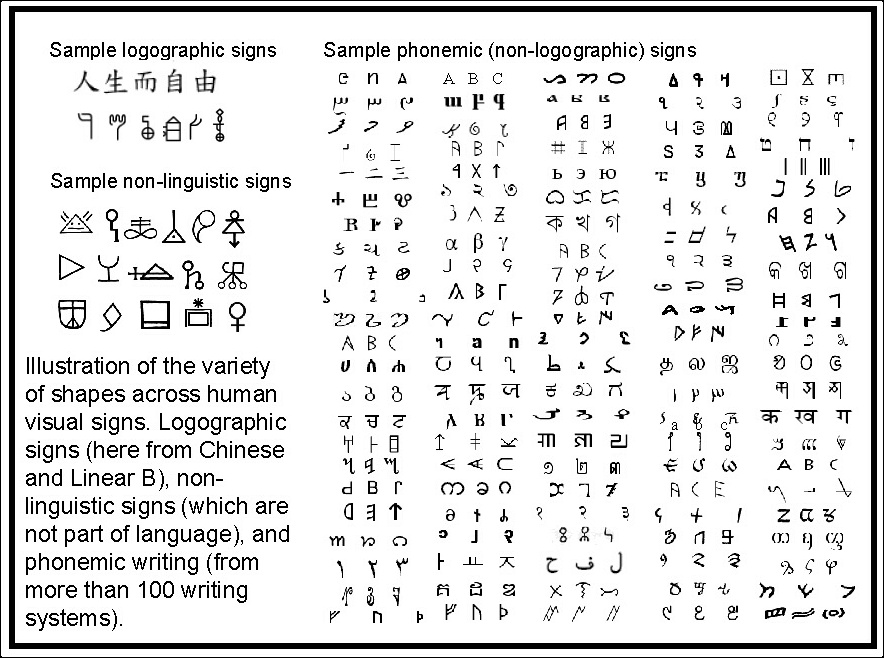
Reading pervades every aspect of our daily lives, so much so that one would be hardpressed to find a room in a modern house without words written somewhere inside. Many of us now read more sentences in a day than we listen to. Not only are we highly competent readers, but our brains even appear to have regions devoted to recognizing words. A Martian just beginning to study us humans might be excused for concluding that we had evolved to read.
But, of course, we haven’t. Reading and writing is a recent human invention, going back only several thousand years, and much more recently for many parts of the world. We are reading using the eyes and brains of our illiterate ancestors. Why are we so good at such an unnatural act?