









The first major global assessment of climate change science in six years has concluded that changes in the atmosphere, the oceans and glaciers and ice caps show unequivocally that the world is warming.

The Intergovernmental Panel on Climate Change (IPCC) concludes that major advances in climate modelling and the collection and analysis of data now give scientists “very high confidence” (at least a 9 out of 10 chance of being correct) in their understanding of how human activities are causing the world to warm.

In an advance that could lead to composite materials with virtually limitless performance capabilities, a University of Wisconsin-Madison scientist has dispelled a 50-year-old theoretical notion that composite materials must be made only of "stable" individual materials to be stable overall.

Writing in the Feb. 2 issue of the journal Physical Review Letters, Engineering Physics Professor Walter Drugan proves that a composite material can be stable overall even if it contains a material having a negative stiffness, or one unstable by itself-as long as it is contained within another material that is sufficiently stable.

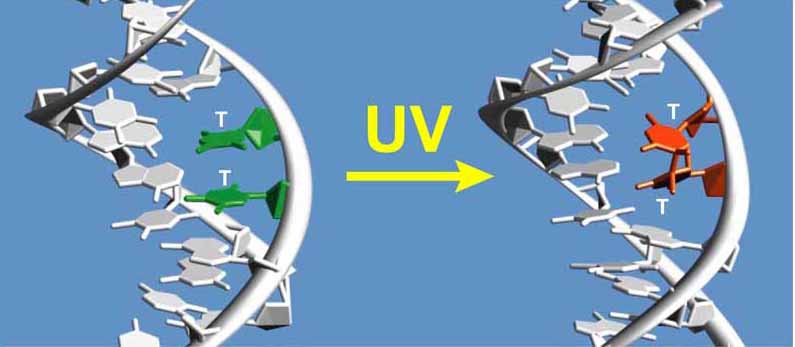
For the first time, scientists have observed DNA being damaged by ultraviolet (UV) light.

Ohio State University chemists and their colleagues in Germany used a special technique to watch strands of DNA in the laboratory sustain damage in real time.

They observed the most common chemical reaction among a family of reactions on the DNA molecule that are linked to sunburn, and discovered that this key reaction happens with astounding speed -- in less than one picosecond, or one millionth of one millionth of a second.


An undamaged stack of thymine bases is colored green in the DNA double helix on the left.

 HopeLab is a non-profit organization that combines rigorous research with innovative solutions to improve the health and quality of life of young people with chronic illness. What does it mean? They've created a PC-based video game, Re-Mission which is a 3D shooter with 20 levels that takes the player on a journey through the bodies of young patients with different kinds of cancer.

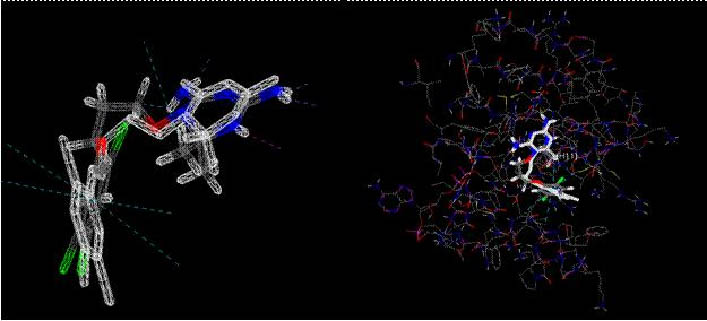
Malaria kills more than one million people each year, most of them young children living in Africa. Now physicists in the UK have shared their computers with biologists from countries including France and Korea in an effort to combat the disease.

Using an international computing Grid spanning 27 countries, scientists on the WISDOM project analysed an average of 80,000 possible drug compounds against malaria every hour. In total, the challenge processed over 140 million compounds, with a UK physics Grid providing nearly half of the computing hours used.

The computers are all part of EGEE (Enabling Grids for E-sciencE), which brings together computing Grids from different countries and disciplines.

Groundhogs and other hibernators take a very sensible approach to winter: They slip into a state of suspended animation and let the worst of the cold weather pass.

The cold prompts profound physiological changes in these animals, causing their normally fast metabolism to come almost to a stop during winter. With metabolism slowed to a crawl, the animal draws on its fat stores sparingly to make it through the winter.

Hibernation has become the focus of interesting physiological research. A hibernating squirrel's heart may fall from 300 beats per minute to just three per minute. Its oxygen consumption can drop to just 2% of normal.

They sure did. Seven leaders who contributed mightily in 2006 are being hailed by the UN Environment Programme (UNEP) as 2007 Defenders of the Planet or the Jusice League or whatever we are supposed to call them.


No, no, this is a different group.

News of the winners comes in advance of UNEP’s annual gathering of environment ministers taking place next week at the organization’s headquarters in Nairobi, Kenya. The risks and opportunities of globalization, in relation to environmental issues, will be high on the agenda of the conference.

Tricking a key enzyme can soothe over-excited receptors in the brain, say neuroscientists, calling this a possible strategy against stroke, Alzheimer's and other neurodegenerative diseases.

Lead author Michel Baudry of the University of Southern California, his graduate student Wei Xu and collaborators from the University of British Columbia outline their technique in the Feb. 1 issue of Neuron.

The researchers injected laboratory mice with a decoy peptide containing a snippet of a receptor that facilitates cell death in neurodegenerative diseases.

