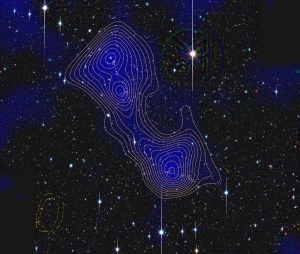

Technological advances may be ushering in a new era of understanding in the search for fundamental physical particles - including dark matter - said Professor Alex Murphy of the University of Edinburgh's School of Physics and Astronomy at the AAAS meeting in Washington, D.C.

Deep space observations together with experiments far underground are hunting for dark matter - an elusive material which, together with dark energy, is thought to account for about 94 percent of the universe.  You can read all about dark matter and dark energy here.

HOUSTON - (Feb. 13, 2016) - A Rice University researcher will discuss images that may show the formation of a planet -- or a planetary system -- around a distant binary star at the annual meeting of the American Association for the Advancement of Science in Washington, D.C., today.

Andrea Isella, an assistant professor of physics and astronomy, will present images of the binary system known as HD 142527, captured by the new Atacama Large Millimeter/submillimeter Array (ALMA) radio telescope in Chile.

Isella said the binary system has long been known to harbor a planet-forming corona of dust and gas, but ALMA images are providing more detail than ever and allowing for better analysis of the system's contents and mechanics.

Strides are being made with wildlife conservation that invites recreational wildlife enthusiasts to report online observations that help with modeling and migration. Work is also being done to use crowdsourcing to help discover new materials for more environmentally friendly fuels, batteries, etc.

HOUSTON -- (Feb. 13, 2016) -- Rice University computer scientist Moshe Vardi expects that within 30 years, machines will be capable of doing almost any job that a human can. In anticipation, he is asking his colleagues to consider the societal implications. Can the global economy adapt to greater than 50 percent unemployment? Will those out of work be content to live a life of leisure?

"We are approaching a time when machines will be able to outperform humans at almost any task," Vardi said. "I believe that society needs to confront this question before it is upon us: If machines are capable of doing almost any work humans can do, what will humans do?"

Hijacking a Conference's Credibility

Scientists have inventoried and categorized all of Earth's rare mineral species described to date, each sampled from five or fewer sites around the globe. Individually, several of the species have a known supply worldwide smaller than a sugar cube.

These 2,550 minerals are far more rare than pricey diamonds and gems usually presented as tokens of love. But while their rarity would logically make them the most precious of minerals, many would not work in a Valentine's Day ring setting. Several are prone to melt, evaporate or dehydrate. And a few, vampire-like, gradually decompose on exposure to sunlight.

The rapid pace of artificial intelligence (AI) has raised fears about whether robots could act unethically or soon choose to harm humans. Some are calling for bans on robotics research; others are calling for more research to understand how AI might be constrained. But how can robots learn ethical behavior if there is no "user manual" for being human?

Researchers Mark Riedl and Brent Harrison from the School of Interactive Computing at the Georgia Institute of Technology believe the answer lies in "Quixote" -- to be unveiled at the AAAI-16 Conference in Phoenix, Ariz. (Feb. 12 - 17, 2016). Quixote teaches "value alignment" to robots by training them to read stories, learn acceptable sequences of events and understand successful ways to behave in human societies.

ANN ARBOR--On Charles Darwin's 207th birthday, a new study of evolution in a diverse group of wild tomatoes is shedding light on the importance of genetic variation in plants.

The work, reported today in the journal PLoS Biology, uses genome-wide sequencing to reveal details about the evolutionary mechanisms that drove genetic divergence in 13 species of wild tomatoes that share a recent common ancestor.

First author of the study is University of Michigan postdoctoral fellow James Pease, who conducted the work for his doctoral dissertation at Indiana University. The in-depth genetic analysis was led by IU's Leonie Moyle.

Lincoln, Neb., Feb. 12, 2016 -- Amid the season known for transforming Nebraska into an outdoor ice rink, a University of Nebraska-Lincoln-led research team has predicted a new molecular form of the slippery stuff that even Mother Nature has never borne.

The proposed ice, which the researchers describe in a Feb. 12, 2016 study in the journal Science Advances, would be about 25 percent less dense than a record-low form synthesized by a European team in 2014.

If the ice can be synthesized, it would become the 18th known crystalline form of water -- and the first discovered in the United States since before World War II.

A new survey finds that 15 percent of U.S. adults (that's about 36 million people) cook in the nude. Or at least have.

Meanwhile, 20 percent of Americans say someone who is a good cook turns them on the most while 19 percent are most turned on by a nice body. Good luck finding those two together. Gender roles no longer apply, 85 percent of Americans say both the man and woman do the cooking in a relationship, according to an online survey commissioned by HelloFresh, a meal kit delivery company. The sample was 1,007 adults, 18 to 70 years old, living in the continental U.S., and conducted by CARAVAN® Survey, January 14-17, 2016.

