






Hangry, a portmanteau of hungry and angry, is widely used in everyday language but the phenomenon has not been widely explored by science outside of laboratory environments. You have probably seen it in television commercials, where someone is irritable, complains a lot, or fatigued until they get a candy bar, when they revert back to themselves.

A new survey finds it is not just clever marketing. 

The team recruited 64 adult participants from central Europe, who recorded their levels of hunger and various measures of emotional wellbeing over a 21-day period.

Prior to the 1980s, most thermometers were both inaccurate and not placed using scientific methodology. But tree rings need time and ice cores even longer, which means for recent periods of time have to rely on observational claims and hope to control for their accuracy.

Our modern human diet is remarkably versatile. Modern farming practices and technological innovations allowed an unprecedented variety of dietary choices. Our hunter-gatherer ancestors, though, didn't have this luxury. The harsh climate during cold seasons forced them to hunt for prey to satisfy their caloric needs when  plants were too scarce. The hunting pressure was so high that it drove many species to extinction, including mammoths.

Why do most people eat dessert after dinner but not before? Culture, or the brain? 

The prevailing belief is that the body often needs protein so only after that is obtained are carbohydrates 'craved', to add to the body’s fat stores. Yet it is not so simple and a new study combines effects to see how the brain's parallel internal states guide behavior.
We all know people who have poor impulse control. They can't open a bag of chips without eating the whole thing, or they lose their temper over something minor and can't calm down. A new study finds it may involve two major circuits in the basal ganglia. 
Yes, I know - I have touched on this topic already a couple of times in this blog, so you have the right to be bored and surf away. I am bound to talk about this now and then anyway, though, because this is the focus of my research these days. 
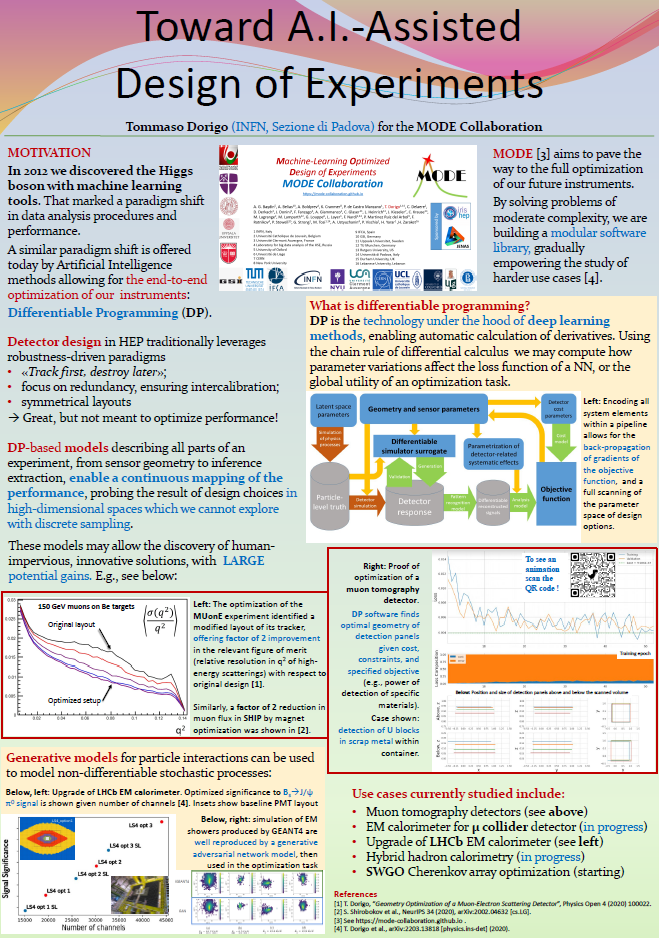
Recently I was in the Elba island (a wonderful place) for a conference on advanced detectors for fundamental physics, and I presented a poster there on the topic of artificial-intelligence-assistend design of instruments for fundamental physics. Below is the poster (I hope it's readable in this compressed version - if you really want a better pic just ask).


Eukaryogenesis is the point at which animal and plant cells separate from bacteria. In animal and plant cells, tubulin forms microtubules which are critical to their internal organization, because they support the cell, giving it structure, shape, and internal organization.

Because it is so essential to the cell, uncovering the origin of tubulin would be a remarkable step in understanding how the complex cells found in animals and plants diverged from the single cells of bacteria.
In the 1960s and '70s, population apocalypse stories were popular. Movies like "Soylent Green" and books like "The Population Bomb" and "Ecoscience" provided dystopian views of the future, where science would fail and government would be forced to get drastic, with forced sterilization and abortion needed until the number of people got down to a limit farming could sustain.

That never happened. Progress did. Companies created new agricultural tools, herbicides were created that avoided resistance. Then we got GMOs. First in insulin, then they saved the papaya in Hawaii, and then we got common products like corn, soybean, and cotton. Food got more plentiful and more affordable.
A saying in psychology goes that more truth comes out when people are drunk. This is even when it comes to politics, where studies showed that young people who espouse more liberal beliefs get more conservative when they are inebriated. They stop saying what they think they should be saying based on what people want to hear.

Along that line, a wealthy person who was raised poor is more likely to see through excuses of poor people than someone born into money, according to a new paper. They are less 'sympathetic' than people who have never had to struggle.

