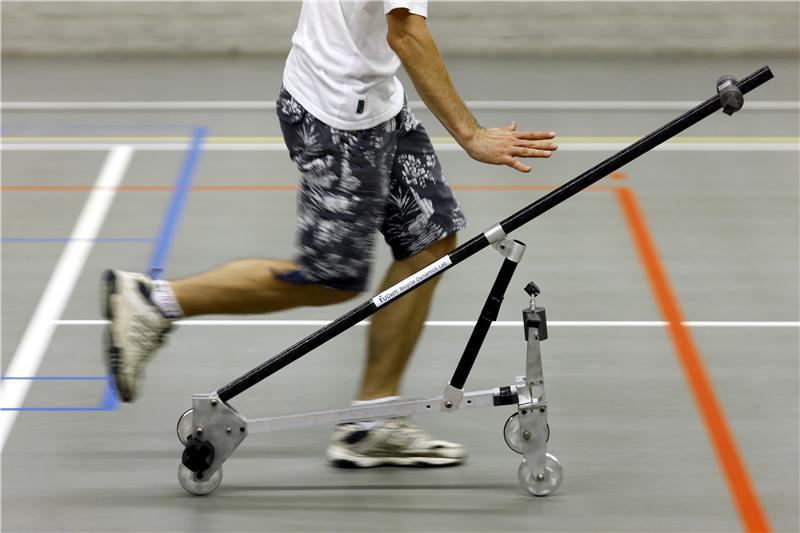
You know this already - given sufficient forward speed, a bicycle pushed sideways will not fall over.
Since the bicycle was invented, scientists have postulated various reasons as to why a bicycle is self stable above a certain speed. The consensus has been that a bicycle's stability is related to two factors: First, the rotating wheels of the bicycle provide stability through gyroscopic effects; secondly, that the ‘trail’, the distance by which the contact point of the front wheel trails behind the steering axis, plays an important part.
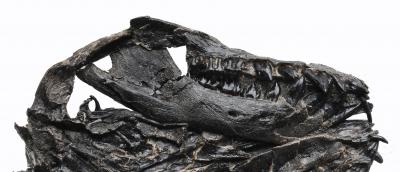
A new study of the eyes of fossil animals in Science overturns the conventional wisdom that dinosaurs were active by day while early mammals moved at night. Instead, dinosaurs like velociraptor hunted by night while the big plant-eaters browsed around the clock.
The first large-scale picture of the electrical conductivity of the underground molten rock that feeds the Yellowstone supervolcano suggests that the plume beneath the volcanically active area, known for geysers and hot springs, is even bigger than it appeared in images made with earthquake waves.
In the past 2 million years, three eruptions at Yellowstone have spewed enough volcanic ash to cover half of North America. The new study doesn't speculate about the chances of another cataclysmic caldera eruption at Yellowstone but it gives new perspective on the deep reservoir of fiery material that feeds eruptions.
The Xenon 100 collaboration has finally released the results of their data analysis, and the results are saying that there is no Dark Matter in sight so far. Since we live in an age where time is precious, I think many of you are only interested in the bottomline. I can give it to you straight away, in the form of the plot which summarizes the results.
Xenon 100 finds three events compatible with a dark matter signal, with a background expected from more mundane sources amounting to 1.8+-0.6 events. The limit they extract on the cross section versus mass of the hypothetical particle are shown below by a thick blue curve, which cuts into the flesh of the preferred parameter space of constrained minimal supersymmetric theories (in grey), pushing them farther away.
The greatest hurdle before committing suicide is the fear of dying and death as well as the fear of hurting people we care about. In order to assist suicide, Suicidal Philosophy alleviates these fears rather than stoking them like traditional Philosophy of Suicide does. Suicidal Philosophy is much more science than philosophy, as the following outtake of a long article aimed at helping people in distress exemplifies. It explains why it is that if you jump out of a 20 story building, your life already ends peacefully more than six meters before impact with the ground:
Written with Kathleen Leopold and originally posted at Autism Blogs Directory (and edited for a wider audience)
Arctic Ice April 2011
The Nares ice bridge is still blocking the strait. My forecast of breakup on April 07 ± 3 days was wrong. A forecast is only as good as the assumptions it is based on. My forecast was based on valid assumptions, but I missed something vital: the 'plug' in the ice bridge isn't just consolidated ice: it is homogenous ice. It is likely also that it is less salty than ordinary first year sea ice. That would mean that the ice bridge is much stronger than average.
Liaoconodon hui, a complete fossil mammal from the Mesozoic, has been found in China and includes a long-sought transitional middle ear. The specimen shows the bones associated with hearing in mammals (the malleus, incus, and ectotympanic) decoupled from the lower jaw, as had been predicted, but were held in place by an ossified cartilage that rested in a groove on the lower jaw.
The paper in Nature also suggests that the middle ear evolved at least twice in mammals, for monotremes and for the marsupial-placental group.
When we are 'up', we are happy, 'down' not so much. 'Right' is trustworthy while 'in left field' not so much, according to language and culture.
But we don't all think right is right. Take handedness - people associate 'goodness' with the side they can act more fluently on. Right-handed people prefer the product or job applicant positioned to their right. Lefties prefer the opposite. And those linguistic tropes? They probably "enshrine the preferences of the right-handed majority," says psychologist Daniel Casasanto, who believes "We use mental metaphors to structure our thinking about abstract things. One of those metaphors is space."