




LONDON, February 9 /PRNewswire/ --

- Latest Upgrades to AmberFin's iCR Software Fuels the Transition to HD, Enables Enhanced Interoperability and Delivers Greater Operational Efficiencies

- Native support for Avid DNxHD and Final Cut Pro - Extended MXF capabilities - Simultaneous ingest and transcoding - Motion compensate SD frame rate conversion included as standard - Enhanced pre-processing capabilities

In the latest upgrade to its flagship content mastering and transcoding software solutions, AmberFin announces the immediate availability of iCR 4.5, which further enhances file-based workflow efficiency and raises the bar on image quality, while reducing cost per deliverable.

There's no question younger scientists who have only really known the Bush presidency believe that Bush was a problem in science, despite the budget increases and the fact that a lot of really terrific science got done in the last 8 years - so they may not see that a stimulus package in science under a president everyone has enthusiasm for could be setting us up for the very same funding bubble (and collapse) that occurred under Bush.
You mat have read recently about chemical fossils discovered in sedimentary rocks in Oman.   Those fossil steroids, remnants of a type of sponge known as Demosponges, are between 635 and 750 million years old. They date back to around the time of the Marinoan glaciation, the last of the huge ice ages at the end of the Neoproterozoic era.

Many of the world's cultural treasures are creations made of organic materials such as paper, canvas, wood and leather which, in prolonged warmth and dampness, attract mold, micro-organisms and insects, causing decay and disintegration.

Show Me The Science Month Day 12

Natural selection is often much like Goldilocks - an organism's traits shouldn't be too hot or too cold; natural selection likes them just right. In other words, traits are under pressure to remain near an optimum. If they deviate too far, natural selection will not-so-gently prod things back to the center. This phenomenon is known as stabilizing selection.

Stabilizing selection has to push against another powerful evolutionary force - random drift. Much of our genetic makeup is influenced by non-adaptive processes, that is, processes that are not particularly favored or disfavored by natural selection, and which do not perform some function that improves the fitness of the organism. Selection and drift have been especially hard to tease apart when it comes to gene regulation. Related species regulate their genes in different ways, but how many of those differences are simply due to random divergence? Trevor Bedford and Daniel Hartl at Harvard University take a crack at this question in a recent paper. They use a mathematical model based on Brownian motion (the kind of random motion you see when you watch pollen grains buffeted about in a drop of water) to determine how well stabilizing selection counteracts the battering of random drift.
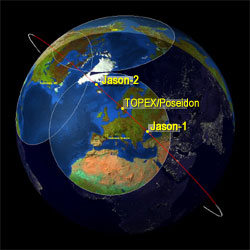
Right now we have a tandem situation. Jason-1 and Jason-2 are flying in tandem above our heads. Sounds like fun perhaps, but who cares? And who are Jason and what's with the numbers, anyways?

If Google is hoarding all of the information in the world, I want in on some of it.  Lured by the siren song of  the new ocean features in Google Earth 5, I took the plunge.  Embarked upon my maiden voyage.  Threw myself in with the sharks.  Ran out of sea cliches.  Downloaded Google 5 in all of its beta-riffic glory.
Researchers at the Swedish medical university Karolinska Institutet have shown for the first time that the active training of the working memory brings about visible changes in the number of dopamine receptors in the human brain. The study, which is published in the prestigious scientific journal Science, was conducted with the help of PET scanning and provides deeper insight into the complex interplay between cognition and the brain's biological structure.

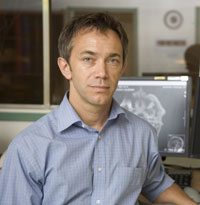
"Brain biochemistry doesn't just underpin our mental activity; our mental activity and thinking process can also affect the biochemistry," says Professor Torkel Klingberg, who led the study. "This hasn't been demonstrated in humans before, and opens up a floodgate of fascinating questions."
Sensors able to identify individuals’ brain patterns and heart rhythms could become part of security systems which also use more traditional forms of biometric recognition, thanks to pioneering work being done by European researchers. 

Since 9/11, the need to secure important facilities from terrorist attack has become a top priority around the world. And one of the keys to this is making sure the right people are allowed into sensitive areas and the wrong people are kept out.

A range of technologies and systems have been deployed in the past few years, but the more successful they are the more obtrusive they tend to be, causing disruptions and delays.
Want to learn how to survive in exteme environments?   A marine bacterium living 8,000 feet below the ocean's surface can show you the way.   

The bacterium Nautilia profundicola, a microbe that survives near deep-sea hydrothermal vents, was found in a fleece-like lining on the backs of Pompeii worms, a type of tubeworm that lives at hydrothermal vents, and in bacterial mats on the surfaces of the vents' chimney structures.

One gene, called rgy, allows the bacterium to manufacture a protein called reverse gyrase when it encounters extremely hot fluids from the Earth's interior released from the sea floor.

