

M.A.D. 2.0

M.A.D. 2.0

Aug 22 2010 | comment(s)

M.A.D. 2.0

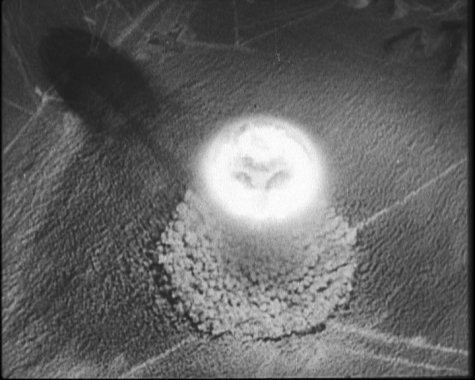
The greatest fear of mankind after World War 2 was the real possibility of a World War 3.

It was a rational fear of a very real threat: the global destruction of civilization.

Nations, most especially the USA and the former USSR, found themselves in a mad race to build more bombs, more powerful bombs, megadeath bombs.

The military theory behind this madness was that if a nation had weapons enough to utterly destroy any enemy then it would not be attacked.  But a first strike might reduce the ability to launch a counterstrike powerful enough to utterly destroy the enemy, so it was thought necessary to keep in constant readiness far more than enough weapons to destroy any enemy.
Fear blinds us, immobilizes us, and makes fools of us. Scary stories abound on the internet, through emails, and in conversations, and dangers lurk in the dusty corners waiting to pounce on us and tear our loved ones from our grasps. We know this. We feel it viscerally. And sometimes we shake in our boots. 

We've got enough real dangers, and we do, without adding in made-up ones. We do a terrible job at assessing risk. Don't believe me? Which is safer? Driving or flying? If you said driving, you're so terribly wrong and have let both the illusion of control and the availability heuristic make you run with your gut. 

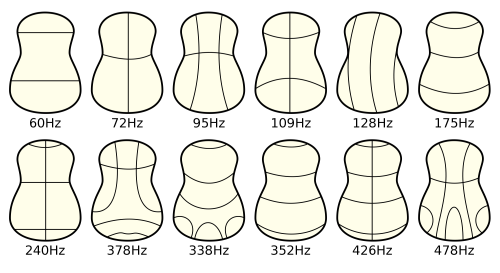
When I was in my late teens, my father (a chemical engineer) took an interest in quantum mechanics.  Two words from his conversation at that time stuck in my mind, namely Hamiltonian and eigenfunction.  The former was almost certainly due to the Scottish part of my ancestry, but with the latter it was the word itself.

Indeed, it at first sight seems quite an intimidating word, along with its relatives eigenvalues and eigenvector.  Fear not – I will show you that it despite its fearsome bark, it has a very soft bite.

Look at a waterfall for 30 seconds. Now look at something stationary. The stationary object will appear to drift upwards. The same phantom movement is true after stepping off an airport walkway: if you close your eyes and stand still, you should continue to feel yourself moving.
Coincidences in fundamental physics, sometimes in the form of so called “fine tunings”; what are they? Generally speaking, some parameter happens to have a value very close to some other interesting number, and we do not see why. Often, some totally unrelated parameters are equal, at least as far as we can tell given measurement accuracy and finite resolution.
There has been much debate surrounding Ray Kurzweil and his talk at the Singularity Summit on August 14th 2010, where he discussed reverse engineering the brain, among other things. He was criticized quite harshly by science blogger and biologist PZ Myers (of ScienceBlogs), based mainly on a second-hand account of the presentation by a journalist who covered the event. Ray has since responded to these criticisms, and I have collected the links to those arguments/responses here.
I took a moment to look at Ray Kurzweil's response to PZ Myers' second-hand dissection of his talk at the Singularity Summit(1) I attended last weekend (see The Singularity Stole My ATM Card) because Andrea Kuszewki is on the case and trying to keep things on track (like, can we reverse engineer the brain?
A couple months shy of a year ago, I was raving about the news that a new giant squid documentary was in the works.

Guess what? It's still in the works!

If this weren't so deadly serious (joke) I'd be laughing my head off about the meta-meta-reporting. I'm writing a blog post . . . about an article . . . about a documentary . . . that hasn't been filmed yet. And you're still reading? You should probably just go outside a watch a tree grow.

But wait, before you go, a pop quiz: Can squid hear?
Fix can mean to repair or to gimmick, as in 'the fix is in'.  I'm not going to tell you how to repair science journalism.  A few wingnuts stalwarts here at Science 2.0 beat that to death.  Their suggestions include sack the journalists, and also rehire journalists.  Be like ESPN.  Be ISO9000 (say what you'll do then do what you say).  Possibly, don't fix it.