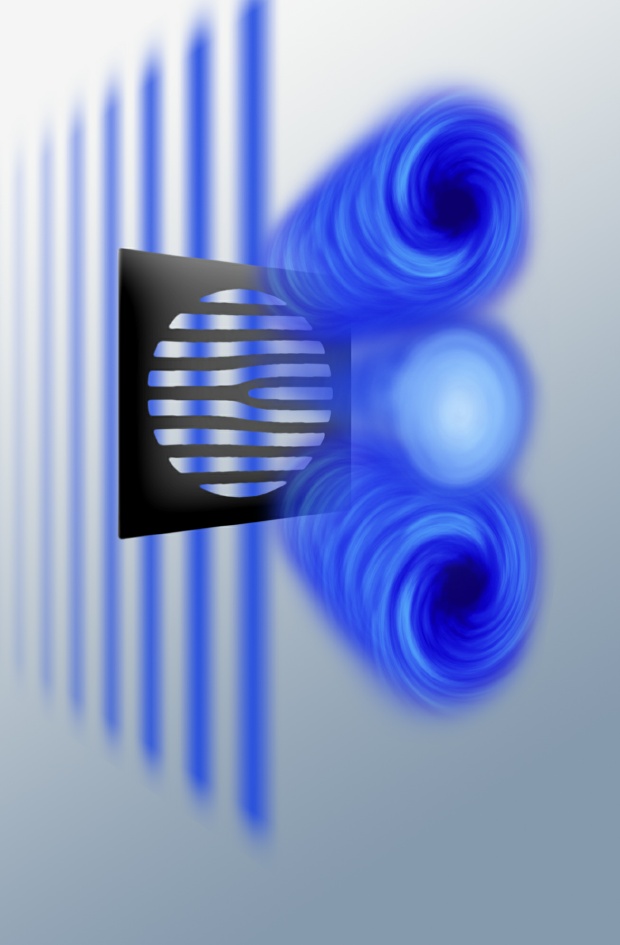
A group of researchers have developed what are known as vortex beams - rotating electron beams - which make it possible to investigate the magnetic properties of materials and in the future it may be possible to manipulate the tiniest components in a targeted manner and set them in rotation also.
Electron beams have been used to analyze materials for a while, such as in electron microscopes. For the most part, the beams' rotation does not affect this analysis because in classical physics, an electron current in a vacuum does not have any orbital angular momentum. But in quantum mechanics, the electrons must be envisaged as a wavelike current, which can rotate as a whole about its propagation direction, similar to the air flow in a tornado.
India, due to its unique variety of geographical and climatic factors, has a rich and varied flora of medicinal plants. No wonder that out of a total number of over 15,000 plant species in India, about 2,000 are known to have medicinal properties and some of them are used even as home remedies in the rural and remotest parts of our country (Arora, 1985).
Ethnobotany
Do you remember Stanley Milgram's famous authority experiments that found participants were willing to shock the living hell out of people if ordered to do so?
If you’re not familiar with this, just google “Milgram experiment” and get ready for some scary reading. If you ARE familiar with this,
check out this link to a Washington Post article which describes a recent French reality show that found contestants willing to kill for cash. Here is a BBC excerpt on Milgram's work.
Obesity is on the rise and one cause for that may be that young people do even less on the weekend than they do during the week - the number of those with inactive lifestyles goes up 100% when they're out of school. Instead, boys primarily play video games and teenage girls prefer to surf the Internet.
The research, which forms part of the European HELENA study, has shown how the proportion of young people who watch television and play on the computer for more than two hours per day doubles at the weekend.
Two popular supplements taken by millions of people around the world to combat joint pain, glucosamine and chondroitin, do not work, according to research published today - but they don't hurt you either. Basically, they are expensive placebos.
Glucosamine and chondroitin are either taken on their own or in combination to reduce the pain caused by osteoarthritis in hips and knees. The researchers, led by Professor Peter Jüni at the University of Bern in Switzerland, state that although they don't work these supplements are not dangerous - "we see no harm in having patients continue these preparations as long as they perceive a benefit and cover the cost of treatment themselves."
The
prospective launch of the ambitious and successful Copenhagen Suborbitals rocket received a lot of press. The subsequent
launch-abort and delay to spring may not seem an upbeat thing. In a broad sense, though, it is.
"MAIN LOX VALVE FAILURE
I remember, as a child, being very upset by a ventriloquist’s dummy at a show, and crying out and making a ‘scene’. Even well into my teens and beyond, I felt disturbed by “magic”, even in mathematics or science. One particular incident I remember was being shown in class the ‘proof’, by an elementary form a calculus of variations, that the shortest path[1] between two coordinates is a straight line. This left me with an uncomfortable feeling.