



In the ongoing culture war among climate scientists, climate scientologists and climate deniers, few things stands out like the effect of volcanoes. 

Volcanoes are well-known for cooling the climate but how much has been unclear, leading to radically differing claims and interpretations. Atmospheric chemists from the Tokyo Institute of Technology and the University of Copenhagen say that patterns of isotopes found in ancient volcanic sulfur trapped in ice cores, and patterns due to stratospheric photochemistry, are a way to say for sure which historic episodes of global cooling were caused by volcanic eruptions. 

Researchers employing an extensive analysis of genomic information have identified micro RNA 506 (miR-506) as a potential therapeutic candidate for advanced or metastatic ovarian cancer
situations. This high-risk cohort of ovarian cancer patients can be tested in mouse models of the disease to try and find better treatments. 

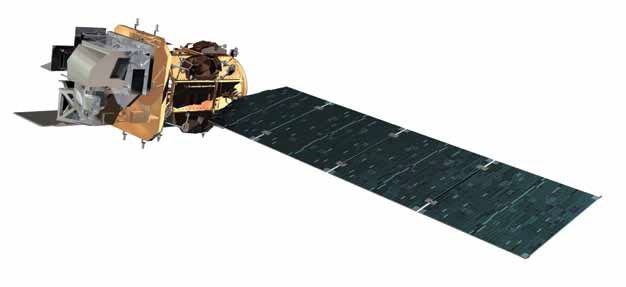
NASA has got the hang of it now. Creating an almost unbearable suspense before the launching of a new satellite, that is. Actually, the last time NASA tortured us with excitement was in connection with a landing, and not a launching. I am of course referring to Curiosity's landing on Mars. That went well, to put it mildly. Both the 'show' and now the results that are ticking in from the mission. Currently it is drill baby, drill mode on Mars!

Landsat 8 satellite
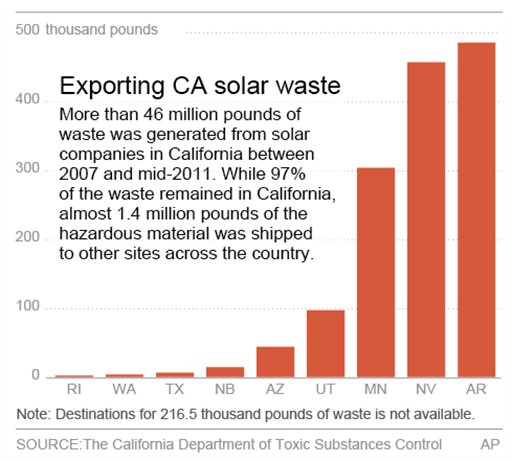
There is a good reason I was not a fan of Energy Secretary Steven Chu's nationalistic claim that we are in a 'race' to beat China in creating cheap solar panels.  
Quite some time ago I discussed here the tentative Y(4140) resonance  claimed by the CDF collaboration in their Run II data. This was a peak which was found in B-decay data containing a J/Psi signal, a phi meson, and an additional kaon track, and it resulted from the  study of the mass difference of the J/Psi + phi signal and the J/Psi alone.

Confused ? You have all rights to be. I will explain everything in good order, but be sure that the matter was puzzling not only for laymen but also for insiders: because the find was mysterious, not predicted by existing models, and potentially controversial.

B Decays and the CDF Claim
Guns

Guns

Feb 11 2013 | comment(s)

I’m going to go out on a limb, and write about guns. Specifically, handguns and so-called “assault weapons.”

I’m not going to opine about what the law should or shouldn’t be, but only about the personal advisability of owning these kinds of firearms.

Likewise I make no comment about shotguns and single-action rifles. If you enjoy owning them for skeet or target shooting, I’ve got no argument with you, and in fact I agree those activities are kind of fun. If you like them for dove or deer, more power to you, even though I don’t share your passion for hunting.

Pistols
Does naming every large storm something new and distinct help?

When all those media companies in midtown Manhattan wanted to put on their election push and remind America global warming would only happen if they voted for the wrong guy, they were disappointed that Hurricane Sandy was not actually a hurricane any more - so they called it Superstorm Sandy.  It was good marketing.

A few days ago, I got an email from the Weather Channel outlining all of their coverage for winter storm Nemo and where they would have meteorologists, etc.

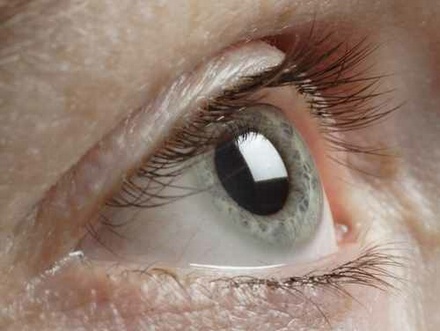
Researchers have discovered 24 new genes that cause refractive errors and myopia, commonly known as short-sightedness. 

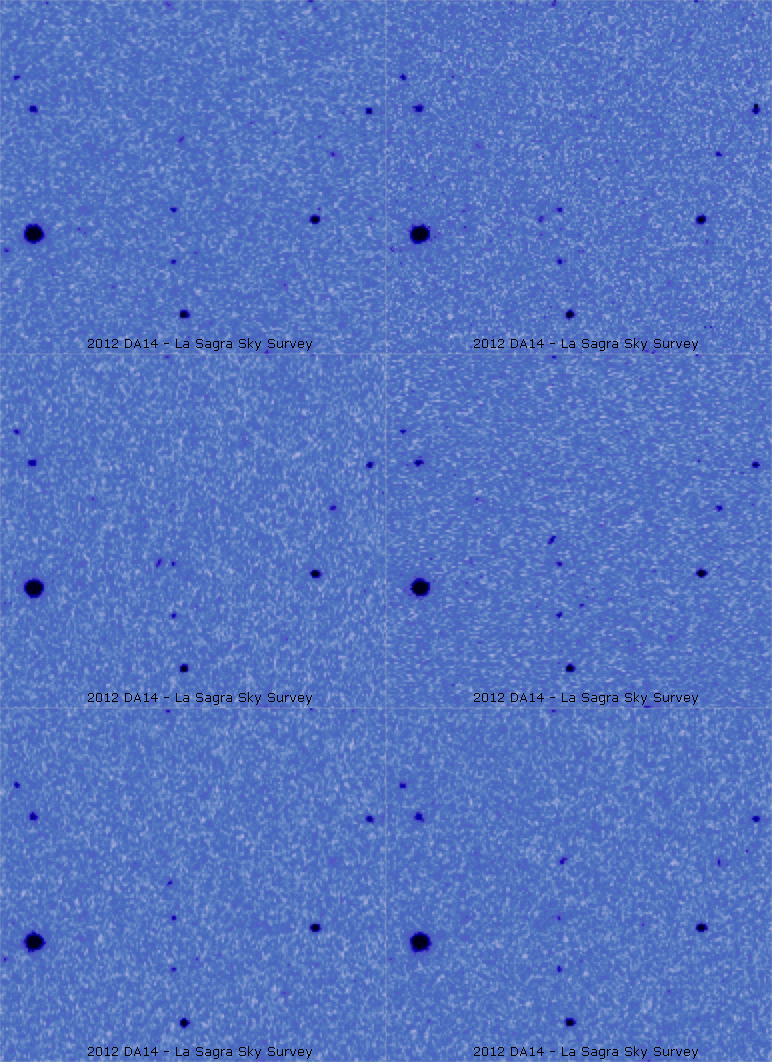
I have good news and bad news. The good news is that Asteroid 2012 DA14 is not going to hit Earth. The bad news is, even if it were going to hit Earth, it wouldn't happen until February 15th so you will still have to buy a Valentine's Day gift.

Asteroid 2012 DA14 was discovered last year, on February 22nd by astronomers at La Sagra Sky Survey observatory near Granada, Spain. Because it is small in size it was only noticed after it had flown past us, but astronomers knew then it would be back, this time much closer.

How close? 24,000 KM close.  As in the distance of some satellites. That means you will be able to see it with binoculars.

Humans have an unclear number of genes - ab initio gene finding and comparative gene finding yield different totals (see the Human Genome Project for details) - but it is likely in the low 20,000s and those genes make nearly as many proteins. The functions of most genes have not been fully determined, but knowing what a particular gene does could obviously help researchers understand disease processes and identify targets for new drugs.

