



A new study details changes in Earth's climate from more than 100,000 years ago and indicates that the last interglacial, the term for the periods between "ice ages", was warmer than previously thought. 

The research findings also indicate that melting of the massive West Antarctic ice sheet may have contributed more to sea-level rise at that time than melting of the Greenland ice sheet.

Can anyone ever truly take credit for a discovery? Every researcher stands 'on the shoulders of giants', as Sir Isaac Newton said. Scientists talk to each other and argue and hone their thoughts based on the criticisms and reactions they get. No one lives in a bubble and great things happen when a lot of smart people know each other and debate as often as possible.

But when the debates are well-known, it's difficult to assign credit and far too easy to take it away. In modern times, tearing down statues of giants and standing on the rubble happens more often than standing on their shoulders and reaching new heights. And everyone wants to stand on the rubble of Albert Einstein.

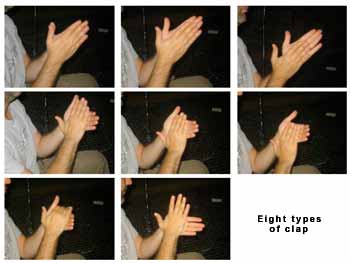
“Hand claps are a relatively primitive conveyor of sonic information, yet they are widely applied for different purposes.”

The DZERO collaboration has released last week the result of their search for the rare decay of B_s mesons into muon pairs, based on the full statistics of proton-antiproton collisions acquired during Run II - a total of 10.4 inverse femtobarns of integrated luminosity.


Does the adoption of GM crops lead to more or less pesticide use?  This is a frequent topic of debate, but generally one that misses the point.  Both sides make the same erroneous assumption that all pesticide use is, by definition, a bad thing.  

We love our modern gadgets, so we sometimes forget we still have an energy problem our Founding Fathers faced - and it impacts everything from the usability of solar power to the uptake of electric cars also.

The remains of a calcified ovarian teratoma in the pelvis of the skeleton of a woman from the Roman era confirms the presence in antiquity of this type of tumor - formed by the remains of tissues or organs, which are difficult to locate during the examination of ancient remains.

Inside the small round mass, four teeth and a small piece of bone were found.


It's easy to blame weather forecasting when the forecast says one thing and ends up being another, but Brigham Young University mechanical engineering professor Julie Crockett says it may not be the fault of the meteorologists. 

According to Crockett, forecasters make mistakes because the models they use for predicting weather can't accurately track highly influential elements called internal waves.

Atmospheric internal waves are waves that propagate between layers of low-density and high-density air. Although hard to describe, almost everyone has seen or felt these waves. Cloud patterns made up of repeating lines are the result of internal waves, and airplane turbulence happens when internal waves run into each other and break.

Concern that many animals are becoming extinct before scientists even have time to identify them has led to some exaggeration, according to Griffith University researcher Professor Nigel Stork.

A number of misconceptions have fueled these fears, Stork said, and there is no evidence that extinction rates are as high as some have feared.

"Surprisingly, few species have gone extinct, to our knowledge. Of course, there will have been some species which have disappeared without being recorded, but not many we think," Professor Stork said.

Professor Stork said part of the problem is that there is an inflated sense of just how many animals exist and therefore how big the task to record them.

Epigenetics is a nascent, exciting field and due to its broad scope, it is used to rationalize the 'it might be so' potential of the mundane (evolutionary psychology) to the silly (social psychology) but some new research reveals a potential way for how parents' experiences could be passed to their offspring's genes. 

Epigenetics is a system that turns our genes on and off. The process works by chemical tags, known as epigenetic marks, attaching to DNA and telling a cell to either use or ignore a particular gene. The most common epigenetic mark is a methyl group. When these groups fasten to DNA through a process called methylation they block the attachment of proteins which normally turn the genes on. As a result, the gene is turned off.

