The coelacanth has one of the longest lineages, 400 million years, of any animal and is the closest living fish to all vertebrates alive on land. Now it has a new member.
Pieces of tiny fossil skull found in Fort Worth have been identified as 100 million-year-old coelacanth bones, according to paleontology graduate student John F. Graf of Southern Methodist University. That places it in the the Cretaceous geologic period, which extended from 146 million years ago to 66 million years ago.
Researchers have discovered bacteria that transmit electrons thousands of cell lengths away.
The Desulfobulbus bacterial cells, which are only a few thousandths of a millimeter long, are so tiny that they are invisible to the naked eye. And yet, under the right circumstances, they form a multicellular filament that can transmit electrons across a distance as large as 1 centimeter as part of the filament's respiration and ingestion processes. They are living power cables.
Some believe in the power of telepathy. Some believe in the power of fMRI. And putting the two together led a team of experimenters from the National Institute of Mental Health and Neurosciences, and the Swami Vivekananda Yoga Anusandhana Samsthana, Vivekananda Yoga Research Foundation, Bangalore, India to perform :
“Probably the first fMRI study to analyse the neuroanatomical correlates of telepathy.”
Human thought has led to a variety of remarkable and profound insights. Many of these insights are well established and have been embraced by a significant portion of the global population.
The earth being round, the atomistic nature of matter, our unremarkable place in the universe, and us being a product of evolution, all being examples of such insights. Other insights, although unanimously embraced by experts, have a long way to go for a larger population to accept them. More than for any other subject, this holds for quantum physics. No other product of human thought is as profoundly mysterious as quantum theory.
Both eugenics and social Darwinism had their moments in their sun, the optimistic goal of progressive techno-elites 100 years ago who wanted to use science to make the world a better place.
Sounds terrific, right? Isn't that what vaccines and genetically modified food do also?
Indeed, but vaccines and GMOs are for all people and not against some, the way eugenics was. The experience of eugenics may be why so many progressives, the group that embraced and mandated and enforced it as social policy, are so anti-science today; they don't trust science or themselves when science is under their control.
Alpha Centauri is the closest star system to Earth other than our own sun. So one would think if it had planets, we would know by now, right? Wrong, apparently. Astronomers just announced the discovery of an Earth-sized planet in Alpha Centauri, although it's closer to its star than Mercury is to our sun, so unlikely to have life. However, there may actually be even more planets further out from the star! So why are we only just now discovering planets in our nearest neighboring solar system, and why don't we know yet if there are more?
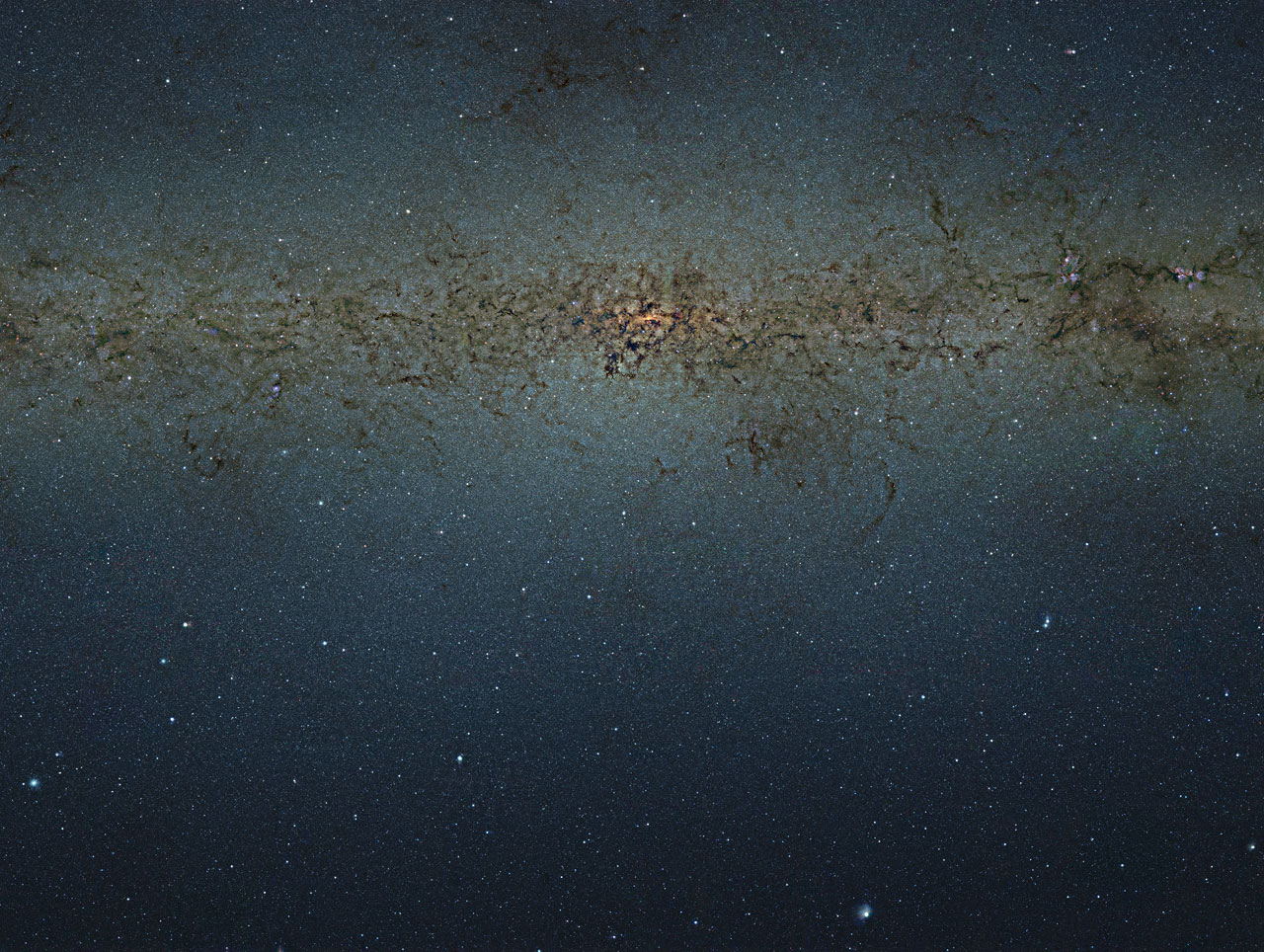
International astronomical photographers have created a catalog of over 84 million stars in the central parts of the Milky Way; 10X more stars than previous catalogs and a great leap forward in making some sense of our home galaxy. The image gives viewers an incredible, zoomable view of the central part of our galaxy. It is so large that, if printed with the resolution of a typical book, it would be 9 yards long and 7 yards high
Kids driving you crazy? Most parents don’t hesitate to pick up the phone and call grandma when they need a hand in caring for their children. Grandparents are often an invaluable resource when it comes to childrearing, and can be a lifesaver for frazzled parents everywhere.
A study led by Kristen Hawkes with mathematical biologist Peter Kim found that in a computer simulation of a population of chimpanzees the contribution of grandmothers in caring for infants and children increased the average lifespan by almost 25 years. Their findings ultimately support the ‘grandmother hypothesis’, which attempts to explain why humans survive long after their childbearing years have passed, a quality which is somewhat unique to humans.
Move over Flight of the Bumblebee. Hello Flight of the Butter Tubs.
That’s what you could call the daring 12,000 mile journey that Australian pilot Jeremy Rowsell is planning for early next year, when he will fly a single engine plane from Sydney to London on fuel that’s neither gasoline, kerosene nor any other traditional aircraft propellant.
Oh, it must be aviation biofuel? Or perhaps it’s some of that discarded cooking oil that has given lift to a few recent aerial stunts?
Wrong!
ExAblate(R)MRI-guided Focused Ultrasound is effective in reducing pain from bone metastases in patients who could not undergo radiation therapy. Patients reported significant improvement in well-being, function, and reduction in medication use.