Eugenics, the darling of elite, educated progressives 100 years ago in their quest to create Utopia, has been out of favor since those crazy Germans took it too far in the late 1930s, but there is one sound reason it found favor; why wouldn't we eliminate serious diseases beforehand instead of treating them after?
If you want to scare somebody, convince them that there is a remote chance of danger in their food, water or medicine. Even if there is no evidence to back up the claim, people respond strongly to such information, causing them to abandon safe foods for alternatives. Today this fear factor is being played to influence food policy and politics, as activists realize they can change consumption with distortions of truth and perpetuation of food phobias and food anxiety. Because it works like a charm.
The Red Scare of 1976
Most people do not want war in their backyard. In geopolitics, people claim to love their neighbor but they still prepare to fight; Switzerland, the home of neutrality, still has hundreds of forts built into their mountains and young men are required to own a gun(1).
Are psychopaths made in a certain way and unable to change?
Perhaps, says Aina Gullhaugen, a psychologist at the Norwegian University of Science and Technology, but there is a discrepancy between the formal characteristics of psychopathy and what she has experienced in meeting psychopaths - which is kind of like saying Stalin was not a psychopath if she had met him and he seemed different than what the DSM describes.
This is an almost verbatim copy of a press release from the
London Centre for nanotechnology.
When Watson, Crick and Wilkins discovered the DNA double helix nearly sixty years ago, they based their structure on an X-ray diffraction image (courtesy of Franklin) averaged over millions of DNA molecules (derived from squid sperm, I understand). Though the double helix has become iconic for our molecular-scale understanding of life, thus far no-one has ever “seen” the double helix of an individual double-stranded DNA in its natural environment, i.e, salty water.
Why do clowns freak us out? And why are robots cute until they look too much like people, and then then they creep us out?
It's our old friend
the Uncanny Valley and it basically postulates that the more realistic something gets to a human likeness, the more repulsive it is. I don't mean like realistic special effects as in "Wrath Of The Titans" - that giant, flaming lava hand of Chronos looks cool - but rather likeness when it comes to humanoids, be they zombies or robots.
Sometimes Science 2.0 has to swim against the stream. The stream, in this case, has been the long-standing irrational belief that America 'needs' more scientists.
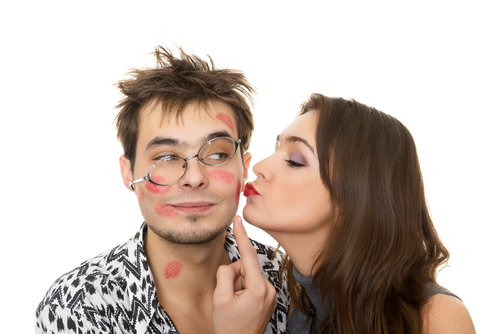
“…what happens if a person who prefers to kiss with the head turned to the right attempts to kiss a person who prefers to kiss with the head turned to the left.“?
This potentially awkward social situation is the subject of a new scientific analysis from researchers at the MOVE Research Institute based at Vrije Universiteit, Amsterdam, in the Netherlands.
If the millions of people suffering who have Multiple Sclerosis or muscular dystrophy could have one wish, it probably wouldn't be that they could use play video games - but until cures can be found, using a computer might make it a little better. costs less than £40.
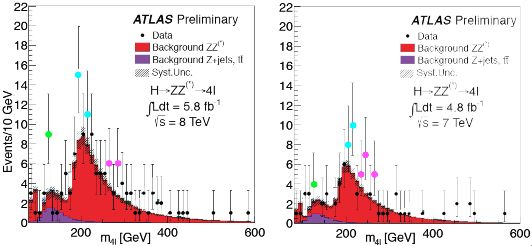
As I explained yesterday, I am in the process of receiving payment for a few bets on possible discoveries at the LHC. Two such bets were on between me and Tony Smith, a long time reader of this blog and a lawyer with deep interest in particle physics (and a few interesting ideas). Tony now concedes them. These are for a total of $200 and a bottle of Strega (an italian liquor); the latter has been agreed to be turned into a bottle of good wine, much closer to my taste. I will post here a picture of the wine as I get it; in the meantime, Tony agreed to write something to describe the heart of the matter to readers of this blog. So the text below is from him.
LEARNING FROM LOSING