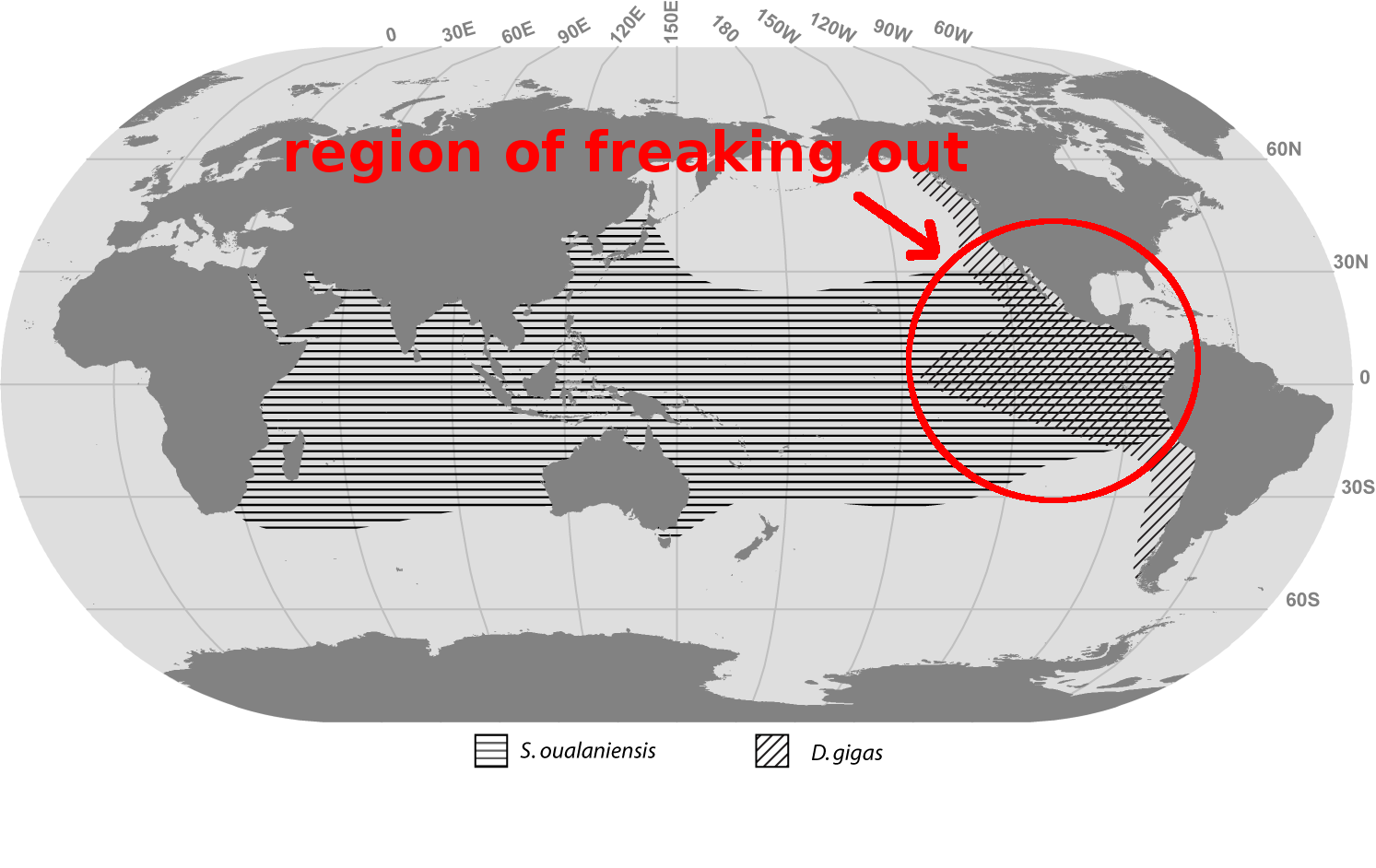
Dear squid blog, I am sorry that so many other projects have been keeping me from you lately! My love for squid remains undimmed. Just to prove it, I will share with the world a helpful chart that I drew several years ago and recently unearthed.
The Humboldt squid (Dosidicus gigas) and the purpleback flying squid (Sthenoteuthis oualaniensis) can look very similar. If you're fishing in a location where only one of them lives (like Indonesia for Sthenoteuthis or California for Dosidicus), no problem. But in certain areas of the Pacific Ocean--oh look I have a map--their ranges overlap, so there is confusion. Panic. Mayhem. Which squid is it?
Michael Richmond of Rochester Institute of Technology created a simple example for how to determine the astronomical unit - the distance from Earth to the Sun and therefore the basis for all modern measurements in space for the CLEA workshop in 2004, the last time we had a transit of Venus - and it won't happen again in our lifetimes so tomorrow is the last chance to see it.
For the second and last time this century, the planet Venus will pass over the visible disk of our Sun for observers located in the Americas (in the evening of June 5th) and western Europe (in the morning of June 6th). The event has a noteworthy scientific value -particularly for exoplanetary searches-, but it is also quite spectacular to observe, if you have some modest equipment (but you should be able to spot it with your naked eye, provided you only look through a thick-smoked glass; never look at the Sun directly!). The added value is that probably none of us will be around the next time this event occurs, in 2117.
A new durable, environmentally-benign (we all hope) blue pigment has also been found to have unusual characteristics in reflecting heat - it's much better at it than most blue pigments in use. The compound just received patent approval and was discovered by Oregon State University scientists who were instead studying some materials for their electrical properties.
Is immortality really ideal? Is the confusion and befuddlement worth surviving the times and ages? Much like Mary Shelley’s monster that arose from the dead, would we be wretched, dejected, and distraught by the prospects of a future that we can’t even hope to fathom? Frankenstein’s monster is composed of the separate body parts found at a morgue, the monster has lived in a previous era and was spawned in Frankenstein’s time. His creation had once died but was reborn in the future.
Very different complex networks, like global air traffic and neural networks, share very similar 'backbones', say a group of mathematicians, and by stripping each network down to their essential nodes and links, they found each network possesses a skeleton which shares common features, much like vertebrates do.
Mammals have evolved to look very different despite a common underlying structure and now it appears real-world complex networks have common descent in a similar way.
Tuesday, June 5th, 2012 at 3:03 PM PDT (California), Venus will do something we on Earth will have witnessed for only the eighth since the invention of the telescope - it will cross in front of the sun. This transit is among the rarest of planetary alignments and it has an interesting cycle. Two Venus transits always occur within eight years of each other and then there is a break of either 105 or 121 years before it happens again.
What evolutionary reason would tiny insects 100 million years ago have for collecting and transporting Gingko pollen? They had highly specialized hairs with a ringed structure to increase their ability to collect pollen grains. Their ringed hairs cannot have grown due to an evolutionary selection benefiting the trees so ancient thysanopterans, so-called thrips (a group of minute insects of less than 2 mm in length) must have fed their larvae with pollen. This suggests that this species formed colonies with larvae living in the ovules of some kind of gingko for shelter and protection, and female insects transporting pollen from the male Gingko cones to the female ovules to feed the larvae and at the same time pollinate the trees.
"Chagas Disease: “The New HIV/AIDS of the Americas”" screams the headline of an editorial in the open access journal PLoS Neglected Tropical Diseases, written primarily by two principal investigators of a vaccine against Chagas disease - and it has resounded with a thud among the actual people they think they are helping.
Almost exactly a year ago, I made a medium storm in the water glass by publishing my exchange with what I ironically called the "Future King of Physics". I then asked Perimeter Institute in Canada, Oxford University, and FQXi, to distance themselves from Joy Christian instead of any further supporting his pseudoscience.