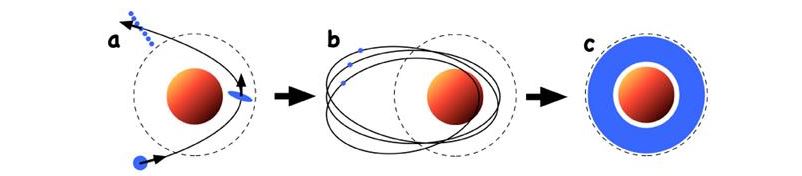


The giant planets in our solar system have very diverse rings. Observations show that Saturn’s rings are made of more than 95% icy particles, while the rings of Uranus and Neptune are darker and may have higher rock content. Since the rings of Saturn were first observed in the 17th century, investigation of the rings has expanded from earth-based telescopes to spacecraft such as Voyagers and Cassini. However, the origin of the rings was still unclear and the mechanisms that lead to the diverse ring systems were unknown.
In the late 16th century, two brothers from the illustrious Fugger merchant family had news from all over the world sent to them in Augsburg by mail. At the time, so-called "novellantes" compiled and wrote down news which they forwarded to wealthy subscribers such as the Fuggers, thus establishing the first commercial news medium in Europe.

The Fugger brothers had these newsletters bound and compiled in annual volumes, which eventually comprised about 16,000 newsletters in German and Italian.

If Elon Musk and Robert Zubrin have their way, we may get migrations of hopefuls setting off from Earth to Mars to colonize what they believe to be a "New World". If so, what they find there will be far more like the nineteenth century Antarctica than the seventeenth century "New World". Indeed, even the climbers who tackled Mount Everest in the twentieth century explored a far more hospitable place than Mars. You could breathe the air on the summit with only the need for an oxygen mask. It's also bitterly cold on Mars - a night in the Martian tropics is colder than the coldest night on Everest in the middle of winter. It's so cold that the air often starts to freeze out as dry ice at night.

The mystery of what clumps galaxy clusters together, and provides for a quarter of the matter-energy budget of the universe, really looks like _the_ most important scientific question we face today. There is nowadays compelling evidence of the correctness of the standard cosmological model, coming from the cosmic microwave background maps provided lastly by Planck as well as from a number of other observations - of supernovae, galaxy clusters, galaxy rotation curves, etcetera. So we know there has to be dark matter out there. But what is it?

The recent crash of the ExoMars Schiaperelli lander on Mars highlights how difficult it is to land there. So why is that? Why are landings on Mars so complex? And why do they fail so often? ESA is getting somewhat bad press for this. In my view it validates the foresight of their approach, to send a test lander first. It also highlights the risk for manned missions to Mars and the planetary protection issues with humans to the Mars surface, which I've written about many times.

Pancreatic cancer is one of the most lethal forms of cancer. Early detection is essential to improve prognoses. Working toward that goal, a collaboration of researchers in Japan has discovered proteins in the blood which improve the detection of pancreatic cancer. When used in combination with conventional pancreatic cancer biomarkers, it enables the diagnosis of early stage pancreatic cancer, which was previously thought to be difficult.

It is still true that far more men than women have leading roles in many organizations. If you ask women to explain this, as many researchers have, they point to workplace culture as a prime culprit.

A false history of science was used to initiate colonial education, in support of colonialism. This false history persists. In a recent article about decolonizing mathematics, for instance, Professor Karen Brodie asserts that, “Much, though certainly not all, of mathematics was created by dead white men.”

This is not true.

Since President Kennedy, the Pesident by tradition sets long term objectives for human spaceflight for NASA. President Bush's vision was a return to the Moon. President Obama's vision treats the Moon as of so little interest, that the next step on the way to their long term goal of Mars is to pluck a boulder from an asteroid to create a new moonlet orbiting the Moon for astronauts to visit. With a new President, there is often a change of human space flight policy. The Moon is far more scientifically interesting than we realized at the time of Apollo, not only more interesting than a boulder from an asteroid, as we will see, you could go as far as to say that the level of science interest for the Moon is not dissimilar from that of Mars.

On Thursday, Gold Coast man Gable Tostee was found not guilty of the murder of a woman, Warriena Wright, who fell to her death from his unit’s balcony.

The case raises questions about how common death by falling is – and how many such incidents are homicides.


