In
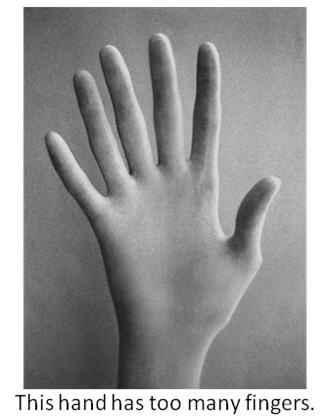
How Many Limbs Should Humans Have? I described my Limb Law, an empirical law I discovered which relates how long an animal’s limbs are to how many limbs it has. This law is explained by virtue of animals having evolved a limb design that minimizes the amount of needed materials to reach out into the world (see links to my academic work in the previous piece).
Thomas Sydenham (September 10, 1624 – December 29, 1689) was an English physician. Called "father of English medicine" or "English Hippocrates," told this quote:
"Among the remedies which it has pleased Almighty God to give to man to relieve his sufferings, none is so universal and so efficacious as opium."
What is nonlinear optics?
Newborns learn during sleep, say the authors of a new study in the Proceedings in The National Academy of Sciences. The findings reveal valuable information about how newborns are able to learn so quickly from their environment, researchers say.
The study could also lead to identifying those at risk for developmental disorders such as autism and dyslexia.
"We found a basic form of learning in sleeping newborns, a type of learning that may not be seen in sleeping adults," said Dana Byrd, a research affiliate in psychology at the University of Florida.
Why do we get intense desires to eat certain foods? A pair of psychologists from Flinders University, Australia, say they may know. The team authored a review of the literature on food cravings and found that mental imagery may be a key component of food cravings — when people crave a specific food, they have vivid images of that food. The review was published in Current Directions in Psychological Science.
A mass extinction of fish 360 million years ago hit the reset button on life, setting the stage for modern vertebrate biodiversity, say researchers writing in PNAS. The mass extinction scrambled the species pool near the time at which the first vertebrates crawled from water towards land. Those few species that survived the bottleneck were the evolutionary starting point for all vertebrates--including humans--that exist today.
"Everything was hit; the extinction was global," said Lauren Sallan of the University of Chicago and lead author of the paper. "It reset vertebrate diversity in every single environment, both freshwater and marine, and created a completely different world."
Eighteen year-old James Popper, from Marlborough College, Wiltshire, has scooped major prizes at the Intel International Science and Engineering Fair, in San Jose, California from 9-14 May.
A new study suggests that people with asthma should avoid a high fat diet. Study participants with asthma who consumed a high-fat meal showed increased airway inflammation just hours after the binge. The high fat meal also appeared to inhibit the response to the asthma reliever medication Ventolin (albuterol).
"Subjects who had consumed the high-fat meal had an increase in airway neutrophils and TLR4 mRNA gene expression from sputum cells, that didn't occur following the low fat meal," said Dr. Lisa Wood, Ph.D., research fellow of the University of Newcastle. "The high fat meal impaired the asthmatic response to albuterol. In subjects who had consumed a high fat meal, the post-albuterol improvement in lung function at three and four hours was suppressed."
Geologists led by Brown University say Lake Tanganyika, the second oldest and the second-deepest lake in the world, has experienced unprecedented warming during the last century, and its surface waters are the warmest on record. The finding is important because the warm surface waters likely will affect fish stocks upon which millions of people in the region depend.
The results of the study were published in Nature Geoscience.
The team took core samples from the lakebed that laid out a 1,500-year history of the lake's surface temperature. The data showed the lake's surface temperature, 26 degrees Celsius (78.8°F), last measured in 2003, is the warmest the lake has been for a millennium and a half.
A new study investigating the link between cell phone use and brain tumors has yielded inconclusive results. Over 10,000 people took part in the study: cell phone users; non cell phone users; cell phone users who survived brain cancer as well as brain cancer survivors who had never used cell phones. The results will be published this week in the International Journal of Epidemiology.