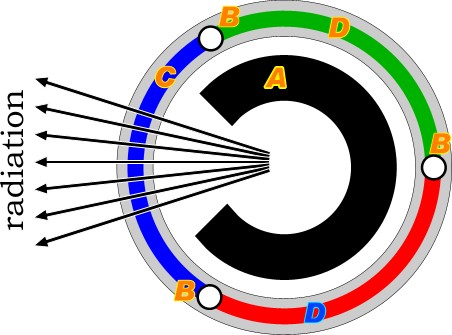
Our University’s former Safety-Office-in-Chief, who retired about ten years ago, had a line in horror stories while presenting training lectures. One of his “things” was always radiation checking a new piece of equipment before releasing it for use.
Federal Regulators Allowed Oil Companies To Decide Safety Issues
I noted in my recent article
Oil Spills And Troubled Waters:
When safety depends on the ability to shut down a system by blocking a fluid flow it is absolutely imperative that the system should incorporate 'fail safe' design principles: the system should fail into the safest possible state.
The most widely known fail safe devices are fuses and circuit breakers. It is basic common sense that a fault condition should shut off power rather than risk fire or electrocution.
“Is it schadenfreude, or is it something else?”
It is a question Harvard professor David Sinclair asks himself a lot of late.
No wonder.
Just about everyone doing cell biology has something—and usually critical—to say of him these days. There are loudmouth bloggers calling fraud and normally circumspect colleagues spouting uncomfortable questions about his work.
Pharmaceutical companies may be financing drug studies in order to influence their outcomes, say researchers writing in Deutsches Ärzteblatt International. The findings confirm the conclusions of two previous reviews published in 2003 which looked at the pharmaceutical industry's influence on research, the authors say.
Researchers studied 57 publications obtained from a systematic Medline search from November 1, 2002 to December 16, 2009. Selected studies were evaluated by two of the authors. These 57 papers were supplemented by studies found in their references sections.
The mainstream media is often accused of shilling for one political party or the other, but that accusation may not stick to all news sources. A new study in the Journal of Political Economy has found that local newspaper do a decent job of keeping politicians accountable to their constituents. In areas where members of Congress get lots of ink in local newspapers, voters are more informed and representatives do more to serve local interests, the study found.
Eyjafjallajoekull is erupting again and has sent another ash cloud, 1600 km wide, into the atmosphere. The brownish plume, traveling east and then south, is clearly visible in stark contrast to white clouds framing this Envisat image from 6 May.
The volcano began emitting steam and ash on 20 March, wreaking havoc on European aviation last month. Renewed activity earlier this week caused some flights to be suspended to and from Ireland, Northern Ireland and Scotland.
Authorities are monitoring the position and height of the ash cloud as well as the direction of prevailing Atlantic winds, which pose a problem when they blow south towards Ireland, located 1500 km southeast of the volcano.
Eyjafjallajoekull
New research has found that video gaming is an effective way to reduce anxiety and acute pain caused by medical procedures and could be a useful treatment for chronic pain. The research was presented this week at the American Pain Society’s annual scientific meeting
“Virtual reality produces a modulating effect that is endogenous, so the analgesic influence is not simply a result of distraction but may also impact how the brain responds to painful stimuli,” said Jeffrey I. Gold, Ph.D., associate professor of anesthesiology and pediatrics. “The focus is drawn to the game not the pain or the medical procedure, while the virtual reality experience engages visual and other senses.”
Despite ongoing threats to rain forests in the Amazon and Congo river basins, researchers studying the latest satellite data say that the greatest loss in forest cover from 2000 to 2005 wasn’t in rain forests, but in boreal forests in places like North America.
Their new study in PNAS found that losses were greatest in boreal forests, followed by humid tropical, dry tropical and temperate forests.
Two years ago I
discussed the results of a very interesting search performed by the CDF experiment in its dataset of 2-TeV proton-antiproton collisions, provided by the Tevatron accelerator at Fermilab.
The search focused on the hypothesis that a massive fourth-generation quark was produced in the collisions. What was assumed was that the quark was heavy -otherwise previous searches would have found it already-, and that it behaved similarly to the sixth quark, the top, which is by now a well-known animal of the particle zoo.
Not sure
chocolate can save the world? Here is your chance to take part in a study to find out. Volunteers selected will have chocolate delivered to their homes and be encouraged to eat 50g of it every day for eight weeks as part of a new research study.
Researchers at Queen's University Belfast, funded by Northern Ireland Chest, Heart&Stroke and the NI Research and Development Office, are to study 110 people with high blood pressure for the opening stage of a three-year project starting in August.