I'm sure many of you have heard the old story about a group of blind men trying to describe an elephant. One guy grabs the elephant's leg and says an elephant must be like a tree. Another guy grabs the end of its tail and says it's like a woman's ponytail. Another one catches a breeze from the elephant's flapping ear and says the creature is more like a large fan. (Okay, obviously I don't remember the details of the story, but you get the picture.) One of the places I heard this story in detail was in a course on Indian Philosophies, and it was used as a way of describing the difficulty any one person will have in understanding the whole of reality.
Rock Scissors Paper Custard
Ok, forget the scissors and paper - this article is about rocks
and custard.
The Sliding Rocks Of Racetrack PlayaRacetrack Playa is a dry lake bed in Death Valley National Park. It is famous for its sliding rocks. Theories that the rocks have been moved by people or animals have been ruled out. These rocks move according to some as yet unknown natural mechanism.
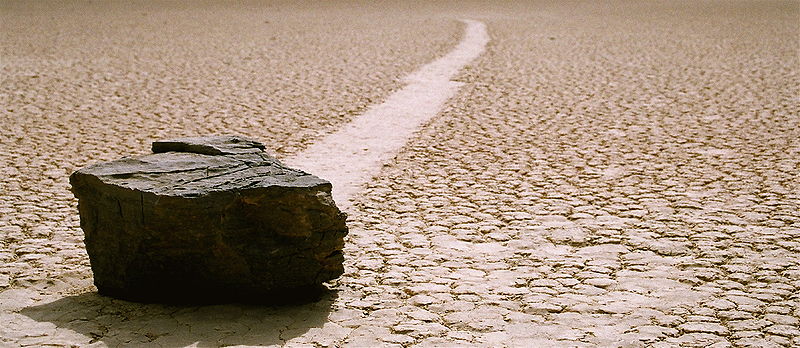
Image source: Wikimedia, Tahoenathan, GNU.
The sliding rocks are few in number and are found mainly in the southeast.
A brand new result in Higgs boson physics has been presented by my old-time CDF colleague Wei-Ming Yao at the Moriond QCD conference two days ago. It is the combination of CDF and DZERO limits on the Higgs boson, and it constitutes a significant advancement in our knowledge of the standard model.
The result is simple to state in a single sentence, although it will take me several pages to explain it acceptably. The Higgs boson is excluded at 95% confidence level in the 130-210 GeV mass range, if there are four generations of matter fields.
Anyone can help discover new stuff in Galaxy Zoo- but why do people bother in the first place? In the podcast
"Why Go to the Zoo?", Jordan Raddick responds with some unexpected insight into why people donate their time for open science.
Anyone can contribute to science these days-- and you don't even need to know any science! You can run the SETI@home screensaver, to help try to tease out potential alien signals in radio data. You can do protein folding, hunt for comets, search for solar flares, all from the comfort of your home.
EBOLA - CLINICAL SYMPTOMS:
Ebola was discovered in 1976 in Zaire and Sudan.
The virus called Ebola takes its name from the Ebola River, which flows into Zaire, where the virus was isolated for the first time.
Paleontologists have discovered a new raptor species in Inner Mongolia. The exceptionally well preserved dinosaur, named Linheraptor exquisitus, is the first near complete skeleton of its kind to be found in the Gobi desert since 1972, and will help scientists work out the appearance of other closely related dinosaur species.
A study documenting the find was published today in
Zootaxa.
Linheraptor is in the Dromaeosauridae family of the carnivorous theropod dinosaurs and lived during the Late Cretaceous period. In addition to Linheraptor and Velociraptor, theropod dinosaurs include charismatic meat-eaters like Tyrannosaurus rex and modern birds.

Despite several social psychological theories that suggest otherwise, failing to meet educational goals does not result in depression, say sociologists from Floria and Kansas State Universities.
Their study in American Sociological review indicates that making no attempt to achieve extravagant educational goals is, in fact, the way to encourage depression.
The authors used two national studies of youth, the National Longitudinal Study and the Longitudinal Study of Adolescent Health (ADD Health), both of which track respondents over a period of time, to test whether unrealized expectations are associated with depression in adulthood.
If the idea was ever in doubt, psychologists writing in Social Psychological and Personality Science say they have confirmed that pretty girls make boys do dumb things.
Specifically, they say the presence of an attractive woman elevates testosterone levels and physical risk taking in young men.
For the study, young adult men were asked to perform both easy and difficult tricks on skateboards, first in front of another male and then in front of a young, attractive female. The skateboarder's testosterone levels were measured after each trick.
Researchers have long been puzzled by large societies in which
strangers routinely engage in voluntary acts of kindness and respect even though there is often an individual cost involved.
Evolutionary forces associated with kinship and reciprocity can explain such cooperative behavior among other primates, but the same isn't true for large societies of strangers.
A new study published today in Science suggests that the cooperative nature of each society may be explained in part by religious beliefs and the growth of market transactions. The study also found the extent to which a society uses punishment to enforce norms increases and decreases with the number of people in the society.
Scientists at the University of California, San Diego are undertaking an expedition to explore the rupture site of the 8.8-magnitude Chilean earthquake.
The team hopes to capitalize on a unique opportunity to capture fresh data from the event by studying changes in the seafloor that resulted from movements along faults and submarine landslides.
The "rapid response" expedition, called the Survey of Earthquake And Rupture Offshore Chile, will take place aboard the research vessel Melville.
 Scientists will map the rupture site of the 8.8-magnitude earthquake in Chile.