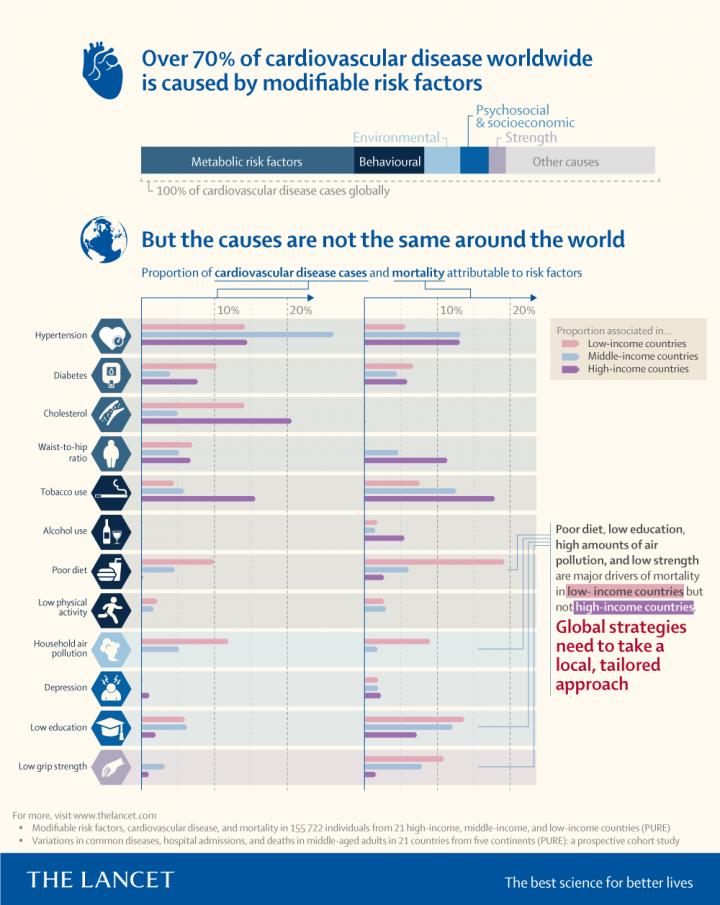









Two statistical analyses looked at common disease incidence, hospitalization and death, plus modifiable cardiovascular risk factors in middle-aged adults across 21 High-Income, Middle-Income, and Low-Income Countries and found that cancer is now the leading cause of death in wealthier countries.

That's a good thing. It means cardiovascular deaths are in decline, which means greater longevity. The number one risk factor for cancer is instead age.
Scientists believe two large holes in the roof of a T. rex's skull, called the dorsotemporal fenestra, were filled with muscles that assist with jaw movements. 

But Casey Holliday, a professor of anatomy at University of Missouri-Columbia, didn't think that made much sense. "It's really weird for a muscle to come up from the jaw, make a 90-degree turn, and go along the roof of the skull. Yet, we now have a lot of compelling evidence for blood vessels in this area, based on our work with alligators and other reptiles."

Though "medical" marijuana has long been available to much of the public, to the medical community it's been a joke. For example, over 60 percent of pain patients are older women, but the majority of medical marijuana users who got it for pain were young men. It's a nice non-specific system on a subjective scale so it became an easy route to get legal access to a drug.

And it is a drug, it does things to receptors, but what they are really accomplishing is unclear.
Humanities academics have so long signaled toward progressivism - even when progressives were eugenicists - that it is harm to imagine that they wouldn't become more inclusive without having it called out, but perhaps that is the nature of truly lacking inclusivity. 

You don't know you are missing something if everyone tells you that you're not. Like intolerance for plagiarism.
To clear blood clots in the brain, doctors often perform an endovascular procedure, where a surgeon inserts a thin wire through a patient’s main artery, usually in the leg or groin. Guided by a fluoroscope that simultaneously images the blood vessels using X-rays, the surgeon then manually rotates the wire up into the damaged brain vessel.

A catheter can then be threaded up along the wire to deliver drugs or clot-retrieval devices to the affected region.

Soon, a snake may be able to do it without the exhausting manual effort by a surgeon. 

The prototype of a catalytic reactor, an electrolyzer, uses carbon dioxide as its feedstock and produces high concentrations of formic acid, pure liquid fuel. 

In tests, the new electrocatalyst reached an energy conversion efficiency of about 42%. That means nearly half of the electrical energy can be stored in formic acid as liquid fuel. Formic acid produced by traditional carbon dioxide devices needs costly and energy-intensive purification steps.

Urban beards are all the rage this decade, often worn by men in Euroweenie tight suits who want to hearken back to older times, when men were manly and not afraid of science.

Not so today. If you wear a beard now, it means you want to look masculine while virtue signaling that removing certain chemicals in soap will prevent your erectile dysfunction.

In reality, such men probably needn't worry, women are swiping left because most don't want to date someone who looks ready for a Civil War re-enactment but they suspect has a bathroom filled with vegan skin care goop.


Not a Dr.
Prevailing sexual economics belief posits that women have less sexual bargaining power as they age. But Baumeister and Vohs' 2004 Sexual Economic Theory (it's a proper name, like String Theory, even though it isn't really a theory, also like String Theory) was built on the assumption that sexual (reproductive) access is an intrinsically valued commodity, the supply of which is controlled by younger women.

But in the modern era sex is about more than procreation, and survey results show older women are not in a worse position. And if the women are bisexual or pansexual, they even have more power than men who are such.
What is old hype is new again, which is to say population bombs, starvation in Africa, nuclear plant meltdowns, and atomic destruction because an aggressive American president makes a wholesome dictator in Russia nervous and nuclear bombs start going off.

These recurring doomsday narratives follow a predictable cycle:

1) Hysterical activist with a credible title engages in crisis inflation
2) It gets New York Times coverage and a whole bunch of other people talk about it
3) A few questionable academics jump on the bandwagon
4) Serious scientists debunk it, to little public acclaim
5) The original scientists back off
6) All the old critics die off
7) A new generation of activists claim it was not a myth
The U.S Government Accountability Office (G.A.O.) has had NASA on its High Risk list since 1990, due to persistent cost inflation and missed schedules of its programs.

Long before banks and General Motors set out to become "too big to fail", NASA had made it a core value.  There is no better example of how far NASA has fallen from the can-do group that gave us the Apollo program than the James Webb Space Telescope fiasco.

First proposed and funded in 1996 as the successor to Hubble, by 2002 they had told Congress that 11 years - longer than it took for the Apollo Program to put man on the moon from scratch - was not going to be enough time to send a mirror outside our atmosphere.

