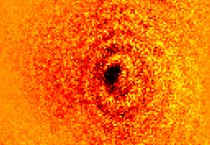
Dark matter and dark energy is thought to account for up to 80% of the matter in the universe. Does it exist? Well, it has to, we just can't see it. So what is it? We better know what it isn't.
I stayed up late (California) to watch the Higgs announcement and posted various thoughts of my own, and comments from the presentations, on my Twitter feed.
Living in the guts of worms are seemingly innocuous Photorhabdus luminescens bacteria that contribute to the worms' survival. Yet with a flip of a genetic switch, those same bacteria transform from harmless microbes into deadly insecticides.
How the photorhabdus bacteria and a single promoter inversion switches it from an upstanding community member in the gut microbiome to deadly killer in insect blood is the subject of a new study. The bacteria in question are bioluminescent insect pathogens. In their mutualistic state, they reside in the intestines of worms, growing slowly and performing other functions that aid nematode's survival, even contributing to reproduction.
Aerosols from relatively small volcanic eruptions can be boosted into the high atmosphere by weather systems such as monsoons and affect global temperatures, according to a new study.
The Superconducting Super Collider (SSC) was not too big to fail. Although it was a massive opportunity for the United States to maintain its primacy in high-energy physics and basic research, the SSC was not sufficiently big on the federal funding list back in the early 1990s even to get built.
Researchers have been able to photograph the shadow of a single atom for the first time.
And this absorption imaging took five years of work. They basically wanted to investigate how few atoms are required to cast a shadow and they found it takes just one. At the heart of the effort is a super high-resolution microscope, which makes the atom's shadow dark enough to see.
People still use optical microscopes in research? Apparently so. And the Griffith University team claims no other facility in the world has the capability for such extreme optical imaging. They did it by isolating it in a chamber and immobilizing it in free space using electrical forces.
Although boredom very rarely escapes the notice of those suffering from it, constructing a purely technical instrument for reliably recognising boredom in humans is currently rated as a non-trivial task.
But recently, a team from George Mason University, the University of North Carolina, the Georgia Institute of Technology and the Naval Research Lab, Washington, DC have between them devised a provisional system for doing just that.
Plato famously maintained that knowledge is “justified true belief,” meaning that to claim the status of knowledge our beliefs (say, that the earth goes around the sun, rather than the other way around) have to be both true (to the extent this can actually be ascertained) and justified (i.e., we ought to be able to explain to others why we hold such beliefs, otherwise we are simply repeating the — possibly true — beliefs of someone else).*
It is the “justified” part that is humbling, since a moment’s reflection will show that a large number of things we think we know we actually cannot justify, which means that we are simply trusting someone else’s authority on the matter. (Which is okay, as long as we realize and acknowledge that to be the case.)
Rolf is drawing the conclusions. He just asked the audience:
"I think we have it. Do you agree ?" And a roar of consensus fills the auditorium.
The slide says "The observation of a new particle consistent with a Higgs boson".
It is a historic milestone, but only the beginning.
A standing ovation follows. Then a connection with Melbourne, with the other auditorium applauding. Now questions in the CERN site ensuing.
Theorists take the stage, Higgs saying it is an extraordinary achievement for the lab, and that he is glad that it happened in his lifetime.
A very moving finale !