An organizer of the 18th Americas Conference on Information Systems (
http://amcis2012.aisnet.org/) sent a CFP for a minitrack on Trust in Information Systems:
A user’s trust and distrust in information systems [IS] are important components in the interactive relationship between users and their systems. A user has to trust a technology before the technology is adopted and fully used. While there is a rich literature on interpersonal trust, trust in information systems has been under-researched...
Those who somewhat grasp Einstein’s general theory of relativity are proud to be elevated over the folk-philosophical level. They understand that the Big Bang did not explode to expand space outwards into some “meta-space” that contains space. There is space, but not necessarily an outside, a space of space. The latter would start a so called regress without definite termination (similar to the Regress argument), namely the questioning of where that space of space in turn is located and what its physics would be. Such leads to the next level of the space outside of the space that contains space and so on.
36% of post-menopausal women who are treated for estrogen-sensitive breast cancer quit using drugs that help prevent the disease from recurring after four years.
Why? The first study to actually ask the women themselves reports those women quit early because of the medications' side effects, which are more severe and widespread than previously known. A new Northwestern Medicine survey reveals a big gap between what women tell their doctors about side effects and what they actually experience.
Babies love to communicate and they're great listeners, even early on.
New research shows that during the first year of life, when babies spend so much time listening to language, they're actually tracking word patterns that will support their process of word- learning that occurs between the ages of about 18 months and two years.
A recent article titled "
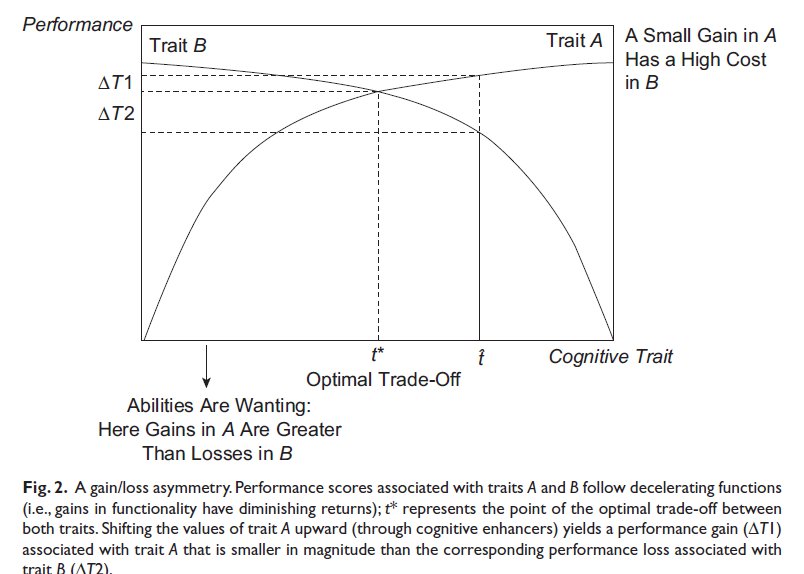
Our Brains Can't Evolve Any Further" drew my attention which ultimately lead me to the paper "Why Aren’t We Smarter Already: Evolutionary Trade-Offs and Cognitive Enhancements" (Thomas Hills and Ralph Hertwig; University of Basel).
Fortunately, this offered some interesting insights into the assumptions and conditions surrounding human intellect and its evolutionary implications.
Every once in a while Lubos pleases with one of his straight-leg tackles, as he deals with stuff he shouldn't be a-messing with (I am still giggling at an incident of a few years ago, when he
publically apologized after a week of nonsense). Today it's one of those blessed moments.
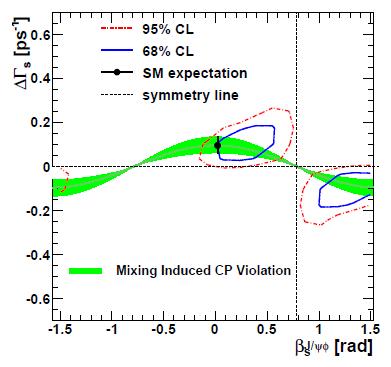
It is so annoyingly sweet to be right, when being right means that one's job is not going to become more exciting in the near future... Today CDF published their analysis of CP violation in the Bs sector, where a very exciting three-sigma deviation from the Standard Model predictions had been a bit prematurely and uncautiously claimed by a group of phenomenologists in 2008.
Infinity is a useful concept but it is often used inappropriately by being assigned as a trait to some object or another. Briefly, nothing can be infinite, since in order for something to "be", it must be defined and measurable. If it isn't, then the object would exist in a perpetual state of creation and couldn't be said to "be" anything at all ... yet.
Germany can again be recognized as a very special place regarding the sciences:
The advantage of a hazelnut rod ... is the possibility to attach test-nodes (Testnosoden) at the tip. This allows to search more aimed at different oscillation patterns. … on my left pinky finger, there is a polarization ring made from ferrite material; this serves the determination of polarization, which means, whether the water vein spins right or left handed.

As everybody knows, next Tuesday we will be treated with a CERN webcast of the analysis results on the Higgs boson searches by ATLAS and CMS. I imagine many of you will want to tune in, but fear you will not grasp much given the typically technical jargon that physicists use to communicate the details of their analyses.
So I thought I would provide here a very short glossary of terms you are likely to hear, and which you might have a hard time understanding correctly. Let me see if I can do a decent job.