In 2011, science has been confronted with several high profile awkward situations of having to explain why standard methods like classical significance analysis are acceptable in for example medical studies on the safety of a new vaccine but not when results put orthodoxy into doubt. The most infamous among them is the 6 sigma significance of the OPERA confirmation of previously by MINOS indicated faster than light neutrinos. Second place: evidence for precognition in a work [1] that abides by all the usual scientific methods and passed peer review in a top tier journal.
If you've ever thought you were being abducted by an alien or, if you are 400 years old, seduced by a succubus, and couldn't move, you are not alone. A new article in Sleep Medicine Reviews says 7.6% of the population has had the same experience and it's called sleep paralysis.
The psychologists define sleep paralysis as "a discrete period of time during which voluntary muscle movement is inhibited, yet ocular and respiratory movements are intact" and it often involves hallucinations.
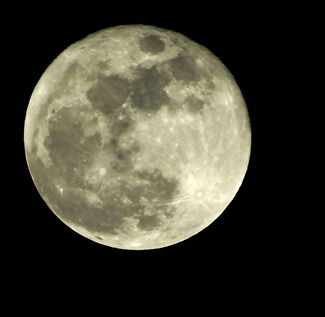
The moon has no global magnetic field yet Apollo astronauts found magnetized rocks on the lunar surface.
A new hypothesis proposes a mechanism that could have generated a magnetic field on the moon early in its history. The 'geodynamo' that generates Earth's magnetic field is powered by heat from the inner core, which drives complex fluid motions in the molten iron of the outer core. The moon is too small to support that type of dynamo but the researchers write in Nature that an ancient lunar dynamo could have arisen from stirring of the moon's liquid core driven by the motion of the solid mantle above it.
Anecdotes are not data, the saying goes, but people sure believe them. An article in JAMA says doctors should consider the use of narrative, patient stories and testimonials, to boost public acceptance of health issues such as cancer screenings and vaccination mandates.
They advocate "counternarratives" to neutralize personal stories, think celebrities in the news media sharing their health knowledge, that seek to support quackery like homeopathy and anti-vaccine beliefs, along with narratives about the process of scientific study and discovery, to unmask the often hidden work of researchers and guidelines committees.
It’s going to be a big day tomorrow when the Oregon football team comes to town. This year, we meet the team that handed us our only loss last season – but on our own turf. And although Stanford has played (mostly) with convincing dominance this season (and Oregon’s already picked up one loss), we’ll take all the home-field advantage we can get.
Sports fans everywhere understand the merits of playing at home: you know the quirks of the stadium, are acclimated to the local weather, and have a fan base that screams at your opponent and shuts up when you’re on offense. It’s the classic recipe for success.
But if you’re the rare team that plays best on the road, you might just shake up the league.
If you are of a certain age, perhaps your parents told you to eat slowly. They may have said something about better digestion but if you were one of many poor people it also had to do with feeling fuller on less food.
Common wisdom was your brain did not keep up with your stomach so if you slowed down, your brain had time to realize the stomach was full. In general experience, that seems to hold up. You rarely see obese people who eat really slow.(1) Two new studies by researchers at the University of Rhode Island bear this out and found that men eat significantly faster than women, heavier people eat faster than slimmer people and refined grains are consumed faster than whole grains, among other findings.
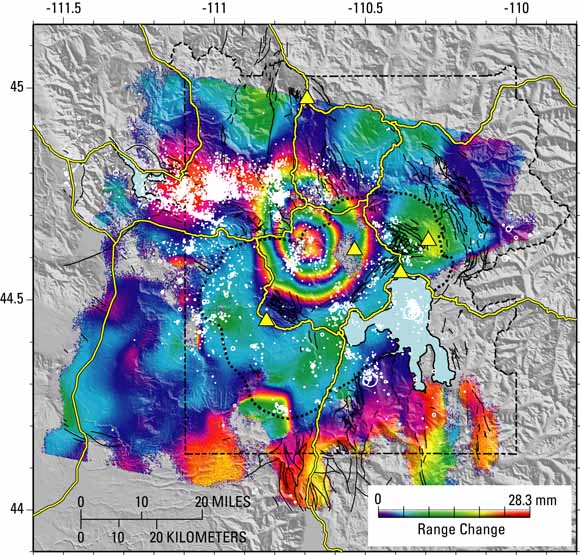
This post is the first of a new series I plan to write, on the techniques used to study and monitor volcanoes. The reason science is the best method we have of investigating the world around us is not so much what we know, but how we know it. I thought I'd start with a technique that always amazes me; we can measure centimetres of ground deformation over an area of many square kilometres, from an altitude of 800 km. Interferometric Synthetic Aperture Radar, InSAR for short.
Scientists have found pristine clouds of the primordial gas that formed just after the Big Bang and it matches the composition made by predictions, which adds to direct evidence in support of the modern cosmological explanation for the origins of elements in the universe. Only the lightest elements, mostly hydrogen and helium, were created in the Big Bang. A few hundred million years passed before clumps of this primordial gas condensed to form the first stars, where heavier elements were forged.
But astronomers have always detected "metals" (their term for all elements heavier than hydrogen and helium) wherever they have looked in the universe.
(That's glue made
by squids, not glue made
from squids. Don't be mean.)
Yesterday I explained that the little pygmy squid
Idiosepius' glue gland produces two different oozes, and so it must be either a
duo-gland or an
epoxy gland. (By the way, "duo-gland" is a very scientific term. "Epoxy gland" I just made up; glue scientists will probably look at you weirdly if you use it.)
And then I quoted some data from a paper arguing that it is probably an epoxy gland--that is, the two different oozes mix together to form glue.

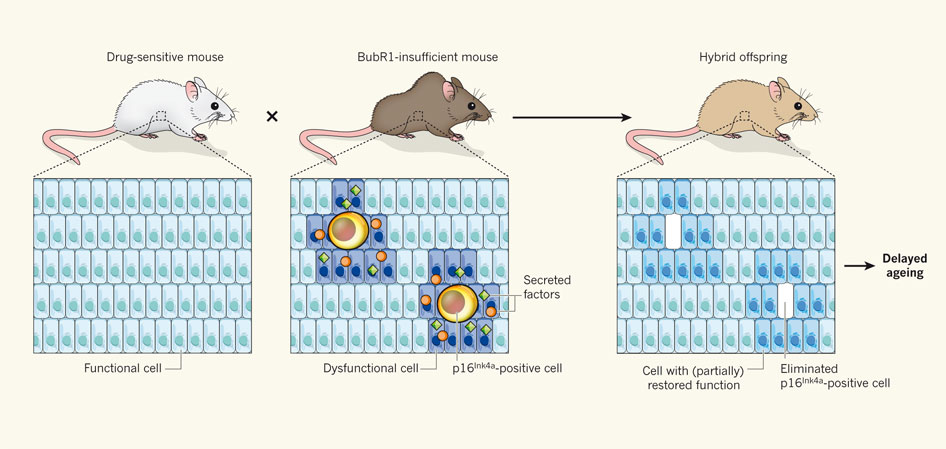
As we reach old age, our bodies undergo several changes. And not for the better. More and more people are beginning to wonder whether we can do something about this. A lot of research is going on to uncover the mechanisms of aging, which should give us a better understanding of the origin of the changes that occur. Some claim that with this understanding comes the increasing possibility that we will actually be able to do something about it.