



What is nothingness? It's a philosophical question, to be sure, but in physics the ground state of the universe can't be described by the absence of all matter, contend some theoretical physicists. There must be a 'quantum vacuum'.

The first theoretical consideration of the spontaneous decay of the quantum vacuum, believed to be a complex state of constantly fluctuating quantum fields with physical properties, dates back to the year 1931, but understanding is still in its infancy.

But it could soon happen that experimentalists are able to witness the spontaneous decay of the vacuum into pairs of particles of matter and antimatter in super strong electric fields. 

Statistical tests and economic forecasting are something of a joke; Paul Krugman is fun because he rants about Republicans in the New York Times but no one would ever actually let him manage money. 

Researchers from the University of Minho in Portugal have discovered that rats exposed before birth to glucocorticoids (GC) not only show several brain abnormalities similar to those found in addicts, but become themselves susceptible to addiction (the glucorticoids, which are stress hormones, were used to mimic pre-natal stress).  But even more remarkable, Ana João Rodrigues, Nuno Sousa and colleagues were able to reverse all the abnormalities  (including the addictive behavior) by giving the animals dopamine (a neurotransmitter/ brain chemical). 
Stress Kills

Stress Kills

Oct 30 2011 | comment(s)

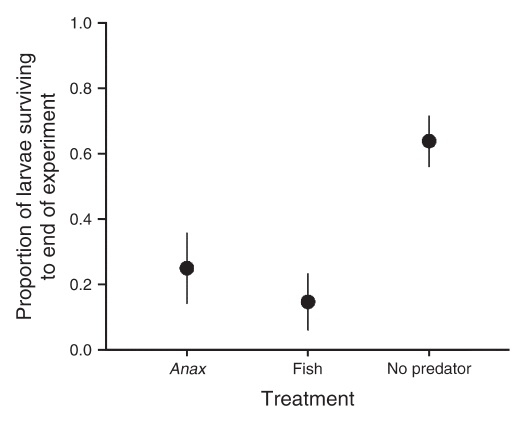
We all know chronic stress isn’t good for you. This seems to be true in all organisms. But can stress kill you? A new study says yes, if you’re a dragonfly larva at least.

Researchers from the University of Toronto investigated the effects of stress on the development and survival of dragonfly larvae, reared in the presence of a predator. These juvenile dragonflies were raised in aquaria that also contained a predator. Important is that this predator had no way to actually attack the larvae.

When we teach, and even communicate with people whom we assume to belong to some sort of common circle with ourselves, we simply assume that our audience knows or at least have heard about certain things.

For example, with people belonging in some sense to physics I would expect that my physics students would at least know about Bessel functions. I was wrong. One has heard the name, the others had not any idea. And they did not know practically how to plot functions on a computer. Two did know sort of, but only using "Origin". And so on. I do not want to complain. They are bright young people and they know lots of things, but not all what I - and most of my colleagues - would expect the students to know. 
It's always a little surreal to see a new comment in the email on an old article. The older the article is, the stranger it is, especially when the comment itself is bizarre.
252 million years ago there was a watershed moment in the history of life on Earth - namely that there was almost no life left on Earth. As much as 90 percent of ocean organisms were extinguished, ushering in a new order of marine species, some of which we still see today and land dwellers also sustained major losses.

A new paper in Proceedings of the Royal Society B undertook an exhaustive specimen-by-specimen analysis  of surviving land-based vertebrates. The survivors, a handful of genera labeled "disaster taxa," were free to roam more or less unimpeded, with few competitors in their respective ecological niches.

An underwater ridge may be the only thing holding back the retreat of Antarctica's fast-flowing Thwaites Glacier, which drains into west Antarctica's Amundsen Sea, and it could speed up within 20 years, says a new study in Geophysical Research Letters.

Thwaites Glacier is being closely watched for its potential to raise global sea levels as the planet warms but neighboring glaciers in the Amundsen region are also thinning rapidly, including Pine Island Glacier and the much larger Getz Ice Shelf. The study highlights the importance of seafloor topography in predicting how these glaciers will behave in the near future.

Quick, have you heard of Professor Curie?  How about Marie Curie?

If you're reading this article, you may have known who I meant with the first one, but how many of you instinctively thought of Pierre Curie, co-discoverer of Polonium and Radium, when I used the term 'professor'?  You all knew the name Marie Curie but to the bulk of the world, one of the most iconic scientists of the 20th century is known instead as "Madame Curie".
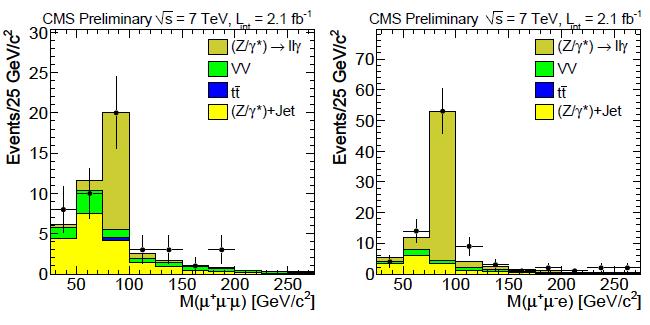
A process which caught some of the LHC Higgs analysts by surprise in the recent run of analyses for summer 2011 conferences is the production of multiple-lepton events by a process called "internal photon conversion in Z events". What is it, and how can we size it up ?

The conversion of a real, energetic photon into a fermion-antifermion pair readily occurs when the particle traverses a medium: the process is also known as "pair production", and is the leading form of energy loss of energetic photons in matter. It is thanks to it (and to the related process called "bremsstrahlung" of energetic electrons) that our electromagnetic calorimeters can measure electrons and photons!

