Rice accounts for nearly half the daily calories for the world's population but crops are at risk from tsunamis and tidal surges and perhaps future unknown effects of climate change.
But naturally occurring fungi called endophytes might come to the rescue.
In an effort to explore ways to increase the adaptability of rice to disasters that have already led to rice shortages, USGS researchers and their colleagues colonized two commercial varieties of rice with the spores of fungi that exist naturally within native coastal (salt-tolerant) and geothermal (heat-tolerant) plants.
An unusual number of destructive storm surges along the East Coast during the 2009-2010 El Niño winter could be a taste of things to come - with more destructive storm surges in future El Niño years, according to a new study by NOAA.
El Niño conditions are characterized by unusually warm ocean temperatures in the Equatorial Pacific that normally peak during the Northern Hemisphere 'cool season.' They occur every three to five years with stronger events generally occurring every 10-15 years. El Niño conditions have important consequences for global weather patterns, and within the U.S., often cause wetter-than-average conditions and cooler-than-normal temperatures across much of the South.
New research on Jakobshavn Isbrae, a tongue of ice extending out to sea from Greenland's west coast, shows that large, marine-calving glaciers don't just shrink rapidly in response to global warming, they also grow at a remarkable pace during periods of global cooling. Glaciers change.
Through an analysis of adjacent lake sediments and plant fossils, the researchers determined that the glacier, which retreated about 40 kilometers inland between 1850 and 2010, expanded outward at a similar pace about 200 years ago, during a time of cooler temperatures known as the Little Ice Age.
Trees absorb carbon dioxide from the atmosphere as they grow so forests are a completely natural way to offset climate change - but rather than let them passively sit there, the amount of carbon dioxide they extract from the atmosphere could be boosted by 400 percent if wood was harvested and used in smaller buildings instead of the steel and concrete that require a lot more fossil fuels during manufacturing, producing carbon dioxide.
Fact #1: There will be a solar event in the next five years that wipes out the electrical grid for the US.
Fact #2: Solar and space weather prediction is about as accurate as hurricane predictions-- lots of maybes and false warnings, but great after-disaster analysis.
Fact #3: It's hard to educate and convince at the same time, and the public doesn't know what space weather is, yet.
Query: Are we doomed?
In
Solar Cosmic Katrina and Chicken Little, we find out that:
The National Science Foundation and various other government groups with more funding than knowledge of the public wastes billions of dollars on STEM (Science Technology Engineering and Mathematics) outreach, using the strange mentality that smart kids who might otherwise become veterinarians or game designers need to become scientists and engineers or America will collapse.
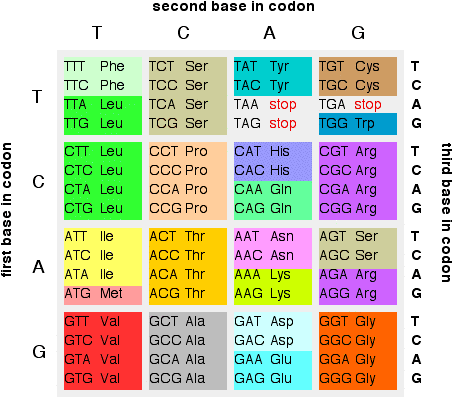
Editing DNA holds great promise, but like all new technologies that are still in their infancy, it’s still slow, expensive and hard to use. However, researchers are developing genome-scale editing tools that might aid in quickly and easily rewriting the genomes of living cells. Harvard-based researchers have developed a new way to edit the genome of living bacteria.
Have a computer? Of course you do, or you aren't reading this article. That, and a little space on your floor can make you a 'citizen seismologist.'
The Quake Catcher Network is 6,000 tiny sensors, part of the densest networks of seismic sensors ever devoted to studying earthquakes, and it began rolling out in the San Francisco Bay Area where volunteer installers delivered 200 sensors to people who signed up to host them.