




Nares Ice Bridge Breakup

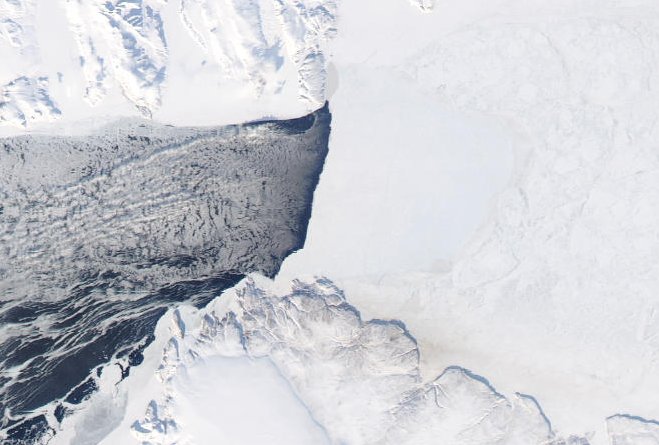
The ice bridge in Nares Strait at the Kane Basin outlet to Baffin Bay has begun to break up.

There was a plug of consolidated ice solidly wedged across the channel.  Consolidated ice is very strong in compression, but weak in tension, as I have noted in other articles, such as Bridges That Build Themselves.  From that article:

“Auntie”, better known as the BBC, has just treated us to a two-parter, Everything and Nothing, by Jim Al-Khalili.  He thoroughly knows his history of science, rather than treating it as an add-on, and delivers the significance of what he says without spoiling it through philosophy and vain deceit” [1].

The blurb says:

Why should technology not go on and accelerate like it has before? Why should humanoids not get ever brighter; why should democracy not grow until true communism emerges? Techno-progressives emanate an air of renegade radicalism. They like to accuse critics of not thinking things through sufficiently and stopping at the point best befit to rationalize beliefs.


Yet both, the critics and many proponents of technological enhancement alike agree on where to stop asking: a racist ‘we (I, humans, our planet) must survive and conquer’ plus lip-service toward a pseudo-democratic doctrine so comfortably ‘coincidentally’ at the helm as we speak. As bad as that may be regarding other issues, it turns into Jules Verne stories when discussing future.

Scientists are often portrayed as serious yet quirky, but many hide a prankish interior.  Here's a butcher's dozen of famous pranks by -- or at-- scientists.

The best lecture never heard.
Have you noticed that whenever a [natural]disaster strikes we quickly look around to find a guilty party? The first place we look is among politicians. The politicians are not to blame for the natural disaster of course, at least not the nature part of it. The dimensions of the disaster can however fairly easily be tracked back to humans, more specifically to the political leadership who are responsible for managing both natural and human resources.

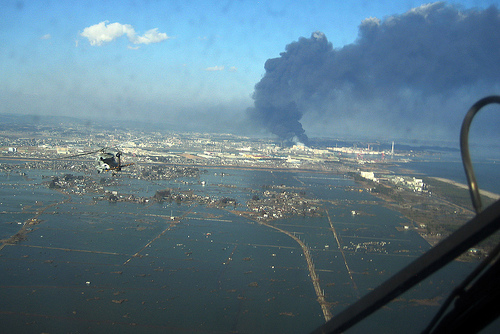
Tohoku-oki tsunami damages
Relic Finds Reveal Zulu War Cover-Up


Paleontologists searching for fossils in a remote area of South Africa were astonished to find spent bullets and cartridge case remnants in an area not previously known as a battle site.  A chemical analysis of the cases and traces of propellant identified the items as being from the time of Britain's wars with the Zulus and the Boers.  Investigators seeking further information about the previously unrecorded presence of British soldiers in the area have found papers in British Government archives which show that a third battle was fought after Isandlwana and
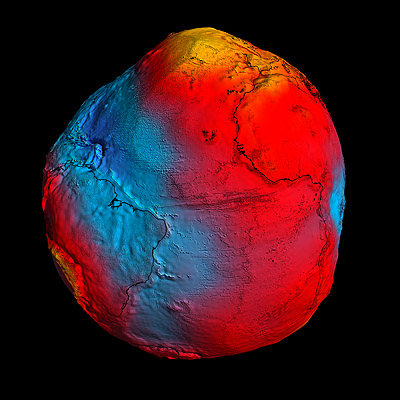
Gravity does funny things.   While the Earth looks rather round in pictures from space, the distortions that would have to occur in order to have uniform gravity everywhere would make it look more like...a potato, or a squashed basketball.

ESA's GOCE satellite has gathered enough data to map Earth's gravity with unrivaled precision, and so we get the most accurate model of the 'geoid' ever produced.  The geoid is the surface of an ideal global ocean in the absence of tides and currents, shaped only by gravity. It is a crucial reference for measuring ocean circulation, sea-level change and ice dynamics.  
Open access, where scientists pay a fee to publish so that the public and other scientists can read the study for free, is a negligible issue to most scientists, according to a new research report in The FASEB Journal.
An Arctic Decade 2001 - 2011


For thousands of years the Arctic has been covered in perennial ice with seasonal changes at the margins and some natural variation, seen as losses and recoveries of extent.

For hundreds of years observers have noted that seasonal and local variations at the margins can leave some relatively small regions ice free one year, and solidly iced up in other years.
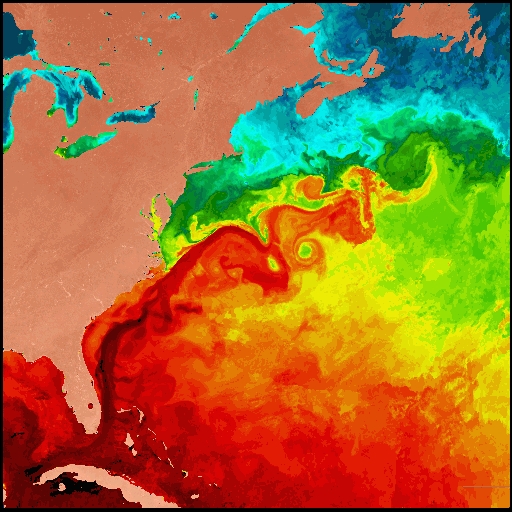
The eastern continental boundaries of America and Asia are colder than the same latitudes on their western boundaries -  no one thinks of Barcelona or London as colder than New York City but they are both north of the Big Apple.   I think any of us would trade a NYC winter for a Barcelona one.   Mountain ranges and warm ocean currents are the likely culprits, according to recent hypotheses.

