In the next few months, something big is going to happen - but don't worry if you miss it, in about 11 years, it will happen again.
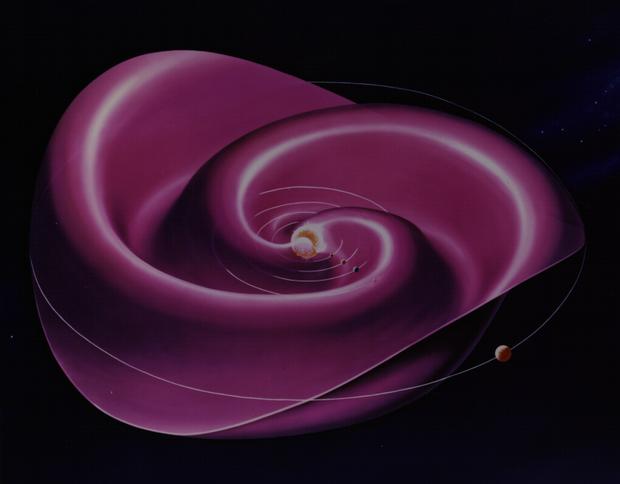
The sun's vast magnetic field is about to flip.
The sun's magnetic field changes polarity approximately every 11 years, at the peak of each solar cycle as the sun's inner magnetic dynamo re-organizes itself. The coming reversal will mark the midpoint of Solar Cycle 24, which means half of 'Solar Max' will be behind us, with half yet to come.
Over 12 billion years ago, a star exploded and blasting its remains outward in twin jets at nearly the speed of light. Its glow was a million times brighter than its entire galaxy.
After traveling across space for 12.7 billion years, that flash was seen by astronomers on a planet that didn't even exist when the explosion happened - Earth. By analyzing this light, astronomers learned about a galaxy that was otherwise too small, faint and far away for even the Hubble Space Telescope to see.
I've just returned from a week on Kauai. It is known as "The Garden Isle" of the Hawaiian chain, but recently that garden has been heavily sown with seeds of fear, suspicion, and conspiratorial narratives.
On Wednesday, the 31st of July, there was a marathon session of the County Council during which hundreds of people lined up to give testimony about Bill 2491 from 1 pm until midnight. Angst was a common theme. The activist speakers made hyperbolic assertions about heartless corporations perfectly willing to sicken the entire population of the island and destroy the environment. Many non-agricultural residents expressed their palpable fear for the safety of their families.
Celiac disease who had persistent intestinal damage - identified with repeat biopsy - showed a higher risk of lymphoma than patients whose intestines healed, according to a new paper.
Celiac disease is an autoimmune disease that affects up to one percent of individuals in Western nations and is characterized by damage to the lining of the small intestine that, over time, reduces the body's ability to absorb components of common foods. The damage is due to a reaction to eating gluten, which is found in wheat, barley, and rye.
Lifelong exposure to soy genistein, a bioactive component in soy foods, protects against colon cancer by repressing a signal that leads to accelerated growth of cells, polyps, and eventually malignant tumors, according to a new paper.
Chronic exposure to the soy isoflavone genistein reduced the number of pre-cancerous lesions in the colons of laboratory rats exposed to a carcinogen by 40 percent and reduced Wnt signaling to normal levels.
There is a possible new explanation for a mysterious type of crater on the surface on Mars. Double-layered ejecta craters (DLEs) are surrounded by debris excavated by an impactor just like other craters. What makes DLEs different is that the debris forms two distinct layers — a large outer layer with a smaller inner layer sitting on top. These distinctive craters were first documented in data returned from the Viking missions to Mars in the 1970s, and scientists have been trying ever since to figure out how the double-layer pattern forms.
A new study suggests that DLEs are the result of impacts onto a surface that was covered by a layer of glacial ice tens of meters thick.
If you ask conservationists in developed nations why East Africa's Maasai pastoralists hunt lions you get Anthropology 101: to retaliate against lions that kill livestock or to engage in a cultural rite of passage.
Aside from mistranslations of Maasai terms in that conclusion, it is also an oversimplification of their cultural traditions and their relationship with wildlife. What is happening as a result is that not only are outside conservation efforts failing to work on basic grounds, they may even be inciting Maasai to hunt more lions as a form of political protest against outsiders and being patronized.
There is a "thrifty phenotype" hypothesis which suggests that economic conditions present during fetal development that then improve dramatically during a person's childhood lead to poorer health in adulthood.
In other words, if people are poor, it might be healthier if they stay poor. The evidence: the strikingly high prevalence of Type 2 diabetes in the American South, which the author of a new paper suggests can be partially traced to rapid economic growth between 1950 and 1980.
In the past few weeks the Tevatron and LHC experiments have updated their results on some of the most important Standard Model parameters. Of these, notably the top quark mass is one where the Tevatron is still doing slightly better than the LHC, due to the longer running time of the CDF and DZERO experiments, which allowed for a more precise calibration of the jet energy scale - the largest systematic uncertainty in this kind of business.
I have updated you on the matter tangentially in the previous two posts, where I discussed the overall compatibility of top and W boson masses with the Standard Model predictions, where the latter depend on the now well-known mass of the Higgs boson. Here instead I want to focus briefly on the top quark mass.
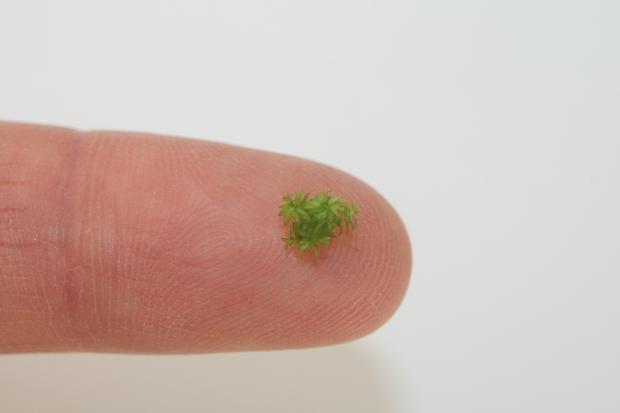
Mosses are tiny plants with a simple body plan - they have no roots, no flowers and do not produce seeds. It was reasonable to assume they were also simple organisms also at the genetic level.
Not so, a new study describes 32,275 protein-encoding genes from the moss Physcomitrella patens, about 10,000 genes more than the human genome contains.