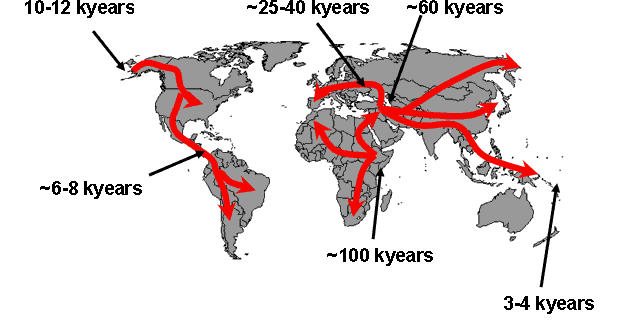
Why did the first human populations migrate out of Africa? It is the biggest debate in anthropology but no one can be sure of the answer. When it happened can at least be an informed debate and two hypotheses dominate the cultural landscape - but they both involve a common denominator that might shed light on why.
One popular belief is that human populations expanded rapidly from Africa to southern Asia via the coastlines of Arabia 50,000 or 60,000 years ago while another is that dispersal into the Arabian interior began 75,000 or even up to 130,000 years ago, but during multiple smaller phases as increased rainfall provided sufficient freshwater to support expanding populations.
Both involve climate change.
Cells lining the intestinal tract form a critical barrier, protecting our bodies from the billions of bacteria living in the gut. Breaches in this barrier are driven largely by a single signaling molecule called tumor necrosis factor (TNF), elevated amounts of which are associated with inflammatory bowel diseases like Crohn's disease and ulcerative colitis.
Governments and taxpayers deserve to know that their money is being spent on something worthwhile to society. Individuals and groups who are making the greatest contribution to science and to the community deserve to be recognized.
For these reasons, all research has to be assessed. Judging the importance of research is often done by looking at the number of citations a piece of research receives after it has been published.
Patients who increased doses of opioid medicines to manage chronic pain were more likely to experience an increase in depression, according a new paper in Pain which expands findings in a previous study of Veterans Administration (VA) patients.
Jeffrey Scherrer, Ph.D., associate professor for family and community medicine at Saint Louis University, and his colleagues studied questionnaires from 355 patients from nine practices in the Residency Research Network of Texas who reported chronic low back pain initially and at one-year and two-year follow ups. The respondents to the survey were 72.4 percent female, older than 46 (75.2 percent) and mostly of Hispanic or African-American descent (57.5 percent).
Contrary to claims by proponents, only a minimal amount of heavy metals are removed in the hookah 'filtration' process.
On average, only 3% of heavy metals present in tobacco are removed and this would not be enough to protect users from exposure to the toxins.
Shisha smokers claim that a hookah is less damaging than cigarette smoking due to 'filtering' by bubbling through water but a typical hookah smoking session can expose someone to 100-200 times the volume of smoke in a single cigarette.
There are many good reasons for increasing gender diversity on boards: better decisions, better performance, and better representation of the consumer base.
But the idea, put forward in a variety of research over the past twenty years or so, that women on boards improve the moral and ethical decision-making of those boards has a number of problems for both women and men, in the boardroom and out of it.
There has been a long-running belief that greedy insurance companies deny patients needed care to maintain profits but in hindsight it seems to have been just the opposite; health care was expensive because of defensive medicine policies needed to ward off lawsuits that could happen even if the care was fine but did not work.
Another example is dialysis for kidney patients. About 400,000 Americans are on it and many of them started sooner than ever before. There is no measurable difference in how sick patients are at the time of initiation or in the reasons for dialysis initiation other than doctors made a choice. The average cost per patient annually: $72,000.
Northern British Columbia's First Nation leaders repeatedly rejected the proposed Enbridge Northern Gateway Pipelines from Alberta and so oil companies are shipping more oil by rail, which requires no new approval, and is inherently more environmentally risky than the pipeline they said was too risky.
If you are more familiar with U.S. scientization of politics, it is like the Obama administration ignoring Yucca mountain science reports so that nuclear waste can remain in over 100 different locations of suspect quality: A win for environmental activists who wanted to flex their muscles but a loss for everyone else.
Mitochondria, the energy power plants inside our cells, are able to oxidize the food we eat to create a universal energy currency for all our currency. These intracellular organelles possess their own DNA, and proteins derived from their genetic instructions are produced according to a specific process which is not well known.
What is well-known is that misregulation of this process can cause mitochondrial diseases in humans. A team led by Jean-Claude Martinou, professor at the Faculty of Science of the University of Geneva (UNIGE), has discovered a new component of the process which was unknown in mammals. It relates to the biogenesis of ND6, a protein essential for mitochondrial activity and provides insight into the general process of mitochondrial RNA maturation.
Genetically modified crops have long drawn fire from environmentalists, who worry that there could be contamination of organic food or creation of FrankenWeeds. Properly used, there is no chance of that, the only thing that can happen is trace material.
Still, they have worries and science may have an answer: modern plant genes damaging the claims of the $105 billion organic food industry might be mitigated by...plant genes.