



NWA 7034 - Black Beauty - is a meteorite found a few years ago in the Moroccan desert. Now it has been shown to be a 4.4 billion-year-old chunk of the Martian crust, and according to a new analysis, rocks just like it may cover vast swaths of Mars.

In a new paper, scientists report that spectroscopic measurements of the meteorite are a spot-on match with orbital measurements of the Martian dark plains, areas where the planet's coating of red dust is thin and the rocks beneath are exposed. The findings suggest that the meteorite, nicknamed Black Beauty, is representative of the "bulk background" of rocks on the Martian surface, says Kevin Cannon, a Brown University graduate student and lead author of the new paper.

Mitochondria produce ATP, the energy currency of the body. The driver for this process is an electrochemical membrane potential, which is created by a series of proton pumps. These complex, macromolecular machines are collectively known as the respiratory chain. The structure of the largest protein complex in the respiratory chain, that of mitochondrial complex I, has been elucidated by scientists from the Frankfurt "Macromolecular Complexes" cluster of excellence, working together with the University of Freiburg, by X-ray diffraction analysis.

Peak Oil, which was supposed to have happened in 1992, set off the craze of declaring 'peak' everything, to such an extent it is a running joke now.(1)

The good news for Peak Oil believers is that they are going to be right eventually. Oil is a 'fossil' fuel and we aren't making any more giant dinosaurs. Even in the 1970s, when the peak oil date was floated, no one outside environmental doomsday prophets believed it, because it fell victim to the plight of most advocacy-based projections; it created a curve of demand but assumed technology and science, and therefore the supply, would be static. By creating a false metric they concluded all the oil that would ever be found had been found.
ATLAS sent today to the Cornell arxiv and to the journal JHEP their latest measurement of the top-antitop production asymmetry, and having five free minutes this afternoon I gave a look at the paper, as the measurement is of some interest. The analysis is done generally quite well, but I found out there is one things I do not particularly like in it... It does not affect the result in this case, but the used procedure is error-prone. 

But let's go in order. First I owe you a quick-and-dirty explanation of what is the top asymmetry and why you might care about it.

The process of converting the sun's energy into liquid fuels requires a sophisticated, interrelated series of choices but a solar refinery is especially tricky to map out because the designs involve newly developed or experimental technologies. This makes it difficult to develop realistic plans that are economically viable and energy efficient.

In a paper recently published in the journal Energy & Environmental Science, a team led by University of Wisconsin-Madison chemical and biological engineering Professors Christos Maravelias and George Huber outlined a tool to help engineers better gauge the overall yield, efficiency and costs associated with scaling solar-fuel production processes up into large-scale refineries.

Five genetic variants that influence the size of structures within the human brain have been discovered by an international team that included a Georgia State University researcher.

In the study led by Drs. Sarah Medland, Margie Wright, Nick Martin and Paul Thompson of the QIMR Berghofer Medical Research Institute in Australia, nearly 300 researchers analyzed genetic data and magnetic resonance imaging (MRI) scans from 30,717 individuals from around the world. They evaluated genetic data from seven subcortical brain regions (nucleus accumbens, caudate, putamen, pallidum, amygdala, hippocampus and thalamus) and intracranial volume from MRI scans.

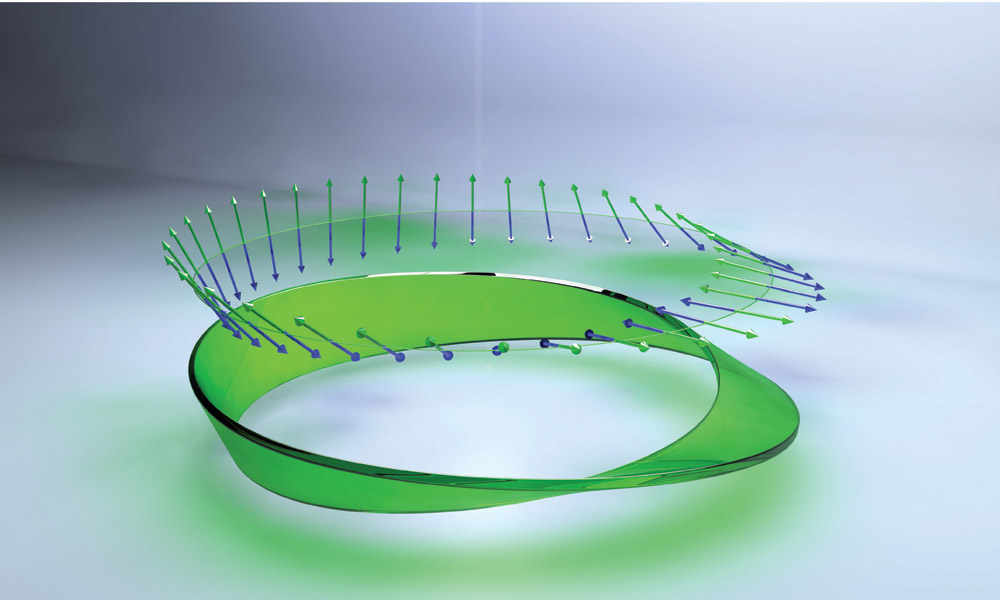
A collaboration of researchers have experimentally produced Möbius strips from the polarization of light, confirming a theoretical prediction that it is possible for light's electromagnetic field to assume this peculiar shape. 

Möbius strips are easy to create, of course. Millions of school children do it in classrooms every year by taking a strip of paper, twisting it once and joining up the ends. That's it, you have created a Möbius strip: a three dimensional structure that has only one side.

But finding Möbius strips occurring naturally is another issue.

Those video ads playing in the corner of your computer screen, in the midst of your multitasking, may have more impact than you realize. They may be as effective as the ads you're really watching, such as those during the Super Bowl, says a University of Illinois researcher.

It depends on how you perceive and process media content - whether your processing "style" is to focus more on one thing or to take it all in, according to Brittany Duff, a professor in Illinois' Charles H. Sandage Department of Advertising.

Will extending telomeres lead to longer, healthier lives? Researchers have taken a step toward answering this question by developing a new treatment used in the laboratory that extends telomeres.

One of the key aspects of aging is the shortening of telomeres over time. Telomeres, which serve as protective "end caps" for chromosomes, help keep DNA healthy and functioning as it replicates. Unfortunately, these protective end caps become shorter with each DNA replication, and eventually are no longer able to protect DNA from sustaining damage and mutations. In other words, we get older.

The betting line created for this weekend's Super Bowl is done by very smart people. They are not trying to fool anyone, they want the betting to be as even as possible and they make their money on a 'commission' - the vigorish or 'vig' - from the winners. It's not like selling football jerseys, where more volume helps, they need losers to fund the winners so making the odds as even as possible is important.

To do that, they try to take into account everything - which player has a cold, the type of field, the weather, the wind. According to a new study, they may take into account a biological clock.


