In Washington state, once retail sales were legalized, marijuana use by 8th and 10th graders actually declined.
An obvious argument is that by legalizing it, the black market began to evaporate, and ethical vendors with legal businesses to lose are less likely to give it to children. Smoking is a "pediatric" disease because if people don't take it up early, they likely never will. But when criminals are the source of something, it becomes cool to rebellious teens, and consorting with criminals adds another layer of risk.
A pilot study using drug-resistant cancer cells in cell cultures and in mice has found that the compounds
kahweol acetate and cafestol in coffee may inhibit the growth of prostate cancer. The results were presented at the European Association of Urology congress in Barcelona and published in The Prostate.
It won't be a surprise if you believe that most surgeons promote surgery - for you. For themselves, they're a little more cautious. It's no different than a real estate person who tells you to list your house at a lower cost than they would list it for themselves - their commission is 2-5% on your sale so moving a house faster is more important to them than if it was their own home, where they'd get up to 100% of the additional revenue and wait a little longer to get the higher price.
Semen stored in a laboratory in Sydney has been defrosted and successfully used to impregnate 34 Merino ewes, with the resulting live birth rate as high sperm frozen for just 12 months.
The authors believe the sperm used is the oldest viable stored semen of any species in the world and definitely the oldest sperm used to produce offspring. The original semen samples were donated from sires owned by the Walker family. Those samples, frozen in 1968 by Dr Steven Salamon, came from four rams, including 'Sir Freddie' born in 1963, owned by the Walkers on their then property at Ledgworth. The Walkers now run 8000 sheep at 'Woolaroo', at Yass Plains, and maintain a close and proud relationship with the animal breeding program at the University of Sydney.
Many people don't realize July 4th, 1776 was not the day the war between America and Britain started, it's simply the day we traitorous colonists finally had enough of our own country's army attacking us, taking over our homes, stealing our food, locking up our guns, and throwing us in jail for no reason and we put the separation in writing.(1)
With a strange verdict by a jury in San Francisco, it became open season on glyphosate, a common weedkiller in use for generations. One new claim is that it leads to higher phosphorous levels.
Yet glyphosate only contains trace nutrients, nothing like what fertilizer has. Overuse of phosphorus-based fertilizer in some areas have led to a saturation of the soil’s capacity to hold the nutrient, which increases the likelihood that any additional phosphorus applied to the land will run off into waterways and cause of harmful algal blooms and deoxygenation leading to fish death.
The U.S. college admissions scandal, where wealthy elites paid to circumvent an arbitrary entrance scoring system at some privileged schools by gaming it,
has already led to lawsuits because the value of a degree from USC, Stanford, Yale and others involved has been devalued, students and their lawyers claim.
Though the common refrain is that old growth rainforests are the only way to stave off global warming and must be preserved at all costs, a new analysis makes the case for logging and takes some hot air out of the environmental balloon.
It found that
the world’s largest carbon sinks are located in young, regrowing forests.
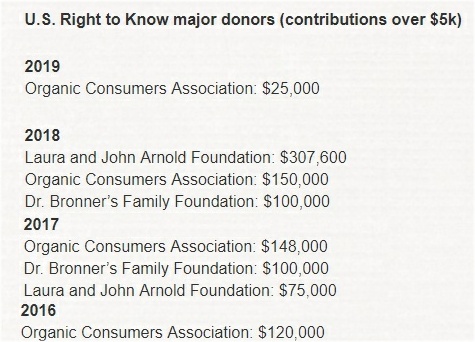
The Laura and John Arnold Foundation was created by a hedge fund magnate to devote some of their Wall Street wealth to education reform, public pension reform, criminal justice reform, dietary policy, and improving reproducibility in science.
Those are all positive things, so why last year did they also give money to one of the most corrupt, hate-filled, lying, mercenary organizations in America? U.S. Right To Know is an industry front group that exists to attack scientists and undermine public confidence in food and medicine for their donors/clients, who unfailingly sell "alternatives" to the science and health consensus. They even launder dark money payments to outlets willing to help. More on that below.
What is dark matter (DM)? This is one of the most pressing questions in fundamental science nowadays. We have observed that only one fifth of the matter that exists in the Universe clusters into stars and emits light - the rest appears to only interact gravitationally, producing phenomena we can study through the dynamics of galaxy rotation or by observing the deflection of light passing through it.