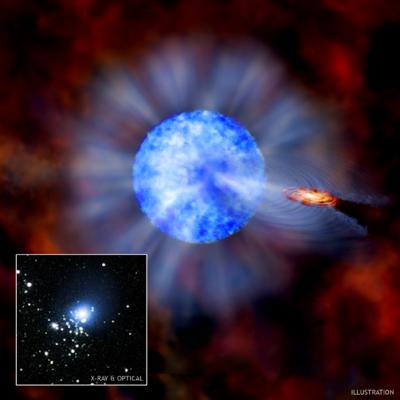




Astronomers have located an exceptionally massive black hole in orbit around a huge companion star. This result has intriguing implications for the evolution and ultimate fate of massive stars.

The black hole is part of a binary system in M33, a nearby galaxy about 3 million light years from Earth. By combining data from NASA’s Chandra X-ray Observatory and the Gemini telescope on Mauna Kea, Hawaii, the mass of the black hole, known as M33 X-7, was determined to be 15.7 times that of the Sun. This makes M33 X-7 the most massive stellar black hole known. A stellar black hole is formed from the collapse of the core of a massive star at the end of its life.

Cashew nut fossils have been identified in 47-million year old lake sediment in Germany, revealing that the cashew genus Anacardium was once distributed in Europe, remote from its modern “native” distribution in Central and South America.

It was previously proposed that Anacardium and its African sister genus, Fegimanra, diverged from their common ancestor when the landmasses of Africa and South America separated. However, groundbreaking new data in the October issue of the International Journal of Plant Sciences indicate that Europe may be an important biogeographic link between Africa and the New World.

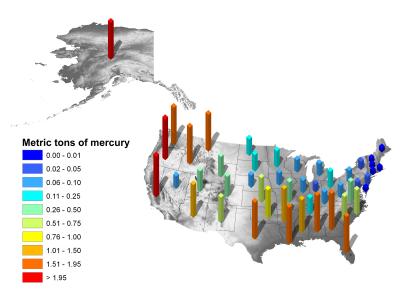
A new paper estimates that fires in the continental United States and Alaska release about 44 metric tons of mercury into the atmosphere every year. It is the first study to estimate mercury emissions for each state, based on a new computer model developed at NCAR.

The authors caution that their estimates for the nation and for each state are preliminary and are subject to a 50 percent or greater margin of error.

Forest fires and other blazes in the United States likely release about 30 percent as much mercury as the nation's industrial sources, according to initial estimates in a new study by scientists at the National Center for Atmospheric Research (NCAR).

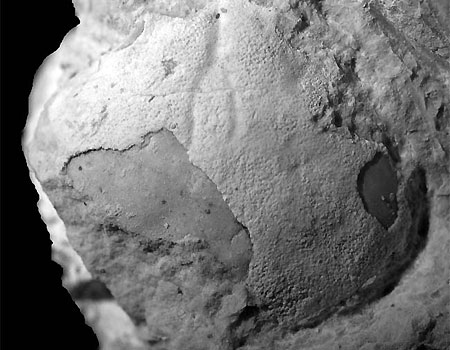
Researchers from Kent State University and the University of Bucharest, Romania, have discovered a new primitive crab species Cycloprosopon dobrogea in eastern Romania. Previously unexamined, these ancient crabs from the Prosopidae family existed more than 150 million years ago during the Jurassic period.

“Studying primitive and extant crabs helps determine various aspects of biodiversity and patterns of evolution, such as when arthropods diversified,” says Dr. Carrie Schweitzer, associate professor of geology at Kent State University.

Have you ever wondered why you inherited your mother’s smile but not your father’s height? Researchers at the Universities of Leeds and Dundee are one step closer to unravelling how nature combines both maternal and paternal DNA to create genetically unique offspring.

In a world first, Leeds researchers Professor Simon Phillips, Dr Stephen Carr and Dr Jonathan Hadden, together with Professor David Lilley at Dundee, have mapped the 3 dimensional structure of an enzyme responsible for splitting DNA strands – a process at the heart of human individuality.

The discovery of the T7 endonuclease 1 enzyme’s structure was made by using x-ray crystallography techniques.

A hot topic during the 2008 elections will be proposals for national health care.

Australia’s coral reefs, particularly the Great Barrier Reef, are national icons, of great economic, social, and aesthetic value. Tourism on the Great Barrier Reef alone contributes approximately $5 billion annually to the Australia’s economy. Income from recreational and commercial fishing on tropical reefs contributes a further $400 million annually. Consequently, science-based management of coral reefs is a national priority.

Globally, the welfare of 500 million people is closely linked to the goods and services provided by coral reef biodiversity.

The world’s oceans are becoming more acid, with potentially devastating consequences for corals and the marine organisms that build reefs and provide much of the Earth’s breathable oxygen.

Honey is enjoying new advocates as a wound-healing solution amid rising concerns about antibiotic resistance and a renewed interest in natural healing.

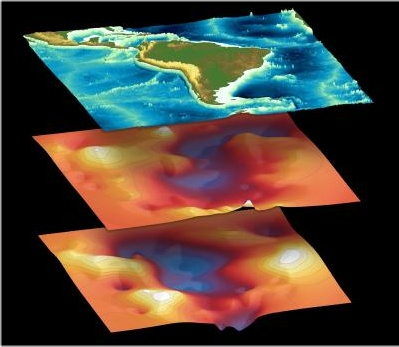
50 million years ago the Indian sub-continent collided with the enormous Eurasian continent with a velocity of about 20 cm/year. With such a high velocity India was the fastest of the former parts of Gondwanaland, according to a report by a team of scientists from the GeoForschungsZentrum Potsdam (GFZ, Germany’s National Lab for Geosciences) and the National Geophysical Research Institute, India, in the 18th October 2007 edition of the Science Magazine "Nature".

Due to this collision at such high velocities the largest mountain belt on Earth, the Himalayas, was formed, as was the massive Tibetan Plateau.

Stretching has many beneficial qualities but if you are doing it to prevent later muscle soreness, it probably isn't working, a team of Cochrane Researchers has found.

Many people stretch before starting to exercise, and some stretch again at the end of a period of exertion. The aim may be to prevent injury, to promote higher performance, or to limit the chances of feeling stiff in the days after the exercise.

Two researchers set out to assess whether stretching could reduce stiffness. They identified 10 relevant trials, each of which involved between 10 and 30 people. Nine of the studies had been carried out in laboratory situations and stretching varied from between 40 seconds and 10 minutes.


