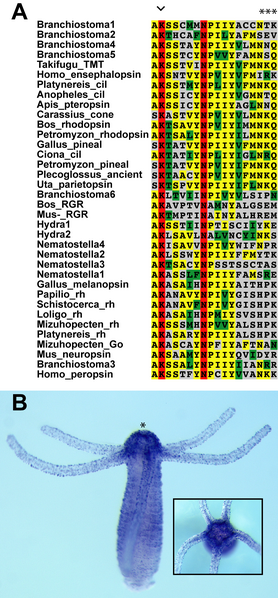





By peering deep into evolutionary history, scientists at the University of California, Santa Barbara have discovered the origins of photosensitivity in animals.

The scientists studied the aquatic animal Hydra, a member of Cnidaria, which are animals that have existed for hundreds of millions of years. The authors are the first scientists to look at light-receptive genes in cnidarians, an ancient class of animals that includes corals, jellyfish, and sea anemones.

“Not only are we the first to analyze these vision genes (opsins) in these early animals, but because we don’t find them in earlier evolving animals like sponges, we can put a date on the evolution of light sensitivity in animals,” said David C. Plachetzki, first author and a graduate student at UC Santa Barbara.


Congratulations to Al Gore for winning the Nobel Peace Prize.  Congratulations to the United Nations Intergovernmental Panel on Climate Change for sharing in that prize. There could be no better recipients for the Peace Prize than the man who, more than anyone else has raised the awareness of global warming, and for the international body of scientists that, finally, lifted the dialogue about global warming out of the world of opinion and into the world of science. 

Women with menstrual cramps are often offered either non steroidal anti-inflammatory drugs or oral contraceptives. Some women find that this treatment does not work or they can not take the drugs or they would prefer a non-drug alternative.

Chinese herbal medicine (CHM) has been used for centuries in China, being used in public hospitals to treat unexplained cramps that occur during menstruation (primary dysmenorhoea). A team of Cochrane Researchers has found evidence that CHM may provide one possible form of treatment.

This evidence came from studying 39 randomised controlled trials that together involved 3,475 women. CHM gave significant improvements in pain relief when compared to pharmaceutical drugs. It also reduced overall symptoms.

Any movie buff knows that garlic spooks vampires and thus keeps you from losing blood.

Less well known is that eating garlic may keep your blood pressure at safe levels also.

A new study from the University of Alabama at Birmingham (UAB) shows this protective effect is closely linked to how much hydrogen sulfide (H2S) is produced from garlic compounds interacting with red blood cells.

The UAB researchers found this interaction triggered red blood cells to release H2S, which then led to the relaxation of blood vessels. Fresh garlic was used at a concentration equal to eating two cloves.

Nearly one in three of the 400 largest public companies headquartered in California – including household names Apple, Callaway Golf and Skechers USA – have no women at the top, according to a study reported today by University of California, Davis, researchers. At the other end of the spectrum, five firms, led by the Los Angeles-based Nara Bancorp, have women in 35 percent to 46 percent of their top posts.

The third annual UC Davis Study of California Women Business Leaders found that 122 of the 400 surveyed companies – 30.5 percent – listed no women executives or board members in their annual reports to the Securities and Exchange Commission. Telecommunications, electronics and semiconductors were the most male-dominated industries.

Observations of I Zwicky 18 at the Palomar Observatory around 40 years ago seemed to show that it was one of the youngest galaxies in the nearby Universe. The studies suggested that the galaxy had erupted with star formation billions of years after its galactic neighbours, like our galaxy the Milky Way. Back then it was an important finding for astronomers, since this young galaxy was also nearby and could be studied in great detail; something that is not possible with observations made across great distances when the universe was much younger.

But these new Hubble data have quashed that possibility. The telescope found fainter older red stars contained within the galaxy, suggesting its star formation started at least one billion years ago and possibly as much as 10 billion years ago.

Abuse of psychostimulants such as amphetamine remains a serious public health concern. Amphetamines mediate their behavioral effects by stimulating dopaminergic signaling throughout reward circuits of the brain.

This property of amphetamine relies on its actions at the dopamine transporter (DAT), a presynaptic plasma membrane protein responsible for the reuptake of extracellular dopamine. Recently, researchers have revealed the novel ability of insulin signaling pathways in the brain to regulate DAT function as well as the cellular and behavioral actions of amphetamine.

EISLINGEN, Germany, October 16 /PRNewswire/ -- The media daily reports on new toxication occurrences in households. Home makers inhaling the toxic odors of standard household cleaners and sanitizers suffer serious health damages over the years. Also the infection rates at hospitals and the food industry are increasing constantly. It has been proved that the resistance of bacteria against standard disinfectant products are raising more and more.

Bio-AntiBact can be applied in areas where chemical material can or should not be used and are non-toxic and non-hazardous to humans, animals and the environment.

New evidence that genetics plays a key role in obesity is published today in the International Journal of Bioinformatics Research and Applications. The findings relate to the genetics of modern Pima Indians who have an unusually high rate of obesity but could be extrapolated to all people. Their obesity is thought to be linked to a thrifty metabolism that allowed them to metabolize food more efficiently in times when little was available but causes problems when food is in abundance.

Mark Rowe, David McClellan, and colleagues at Brigham Young University in Provo, Utah, USA, have studied the effect of evolutionary selection on Pima Indians, a people indigenous to the present-day Sonora desert of Arizona and New Mexico.

More than one-third of patients receiving HIV medication in Africa die or discontinue their treatment within two years, according to a study published in PLoS Medicine.

Boston University researcher Sydney Rosen and colleagues identified and analyzed scientific reports over the past 7 years that gave details on adult patients remaining on antiviral treatment in 13 sub-Saharan African countries.

They found that 77.5% of patients remained on treatment after an average period of 9.9 months. Of the patients no longer on treatment, just under half had died and half had lost contact with the clinics for undetermined reasons.


